Normal

Why Accurate Metadata Translation Boosts Global SEO

MultiLipi
MultiLipiUngültiges Datum
20 Minuten lesen
Blog-Titelbild

Visual banner titled 'Importance of Meta tags for Building Multilingual Websites' for a multilingual Seo website

Search engines treat translated metadata (such as page titles and meta descriptions) somewhat differently from regular content, and this can significantly affect how your multilingual site ranks globally. Accurately translating your website’s metadata is essential for effective website translation and mehrsprachige SEO. When done right, it improves search engines’ understanding of your pages and directly influences user engagement factors like click-through rates, ultimately boosting international visibility. In other words, metadata translation is a key SEO factor no global website owner can afford to ignore – although achieving accuracy comes with challenges. In this guide, we’ll explore why translating metadata matters and how to do it correctly to Ihre Website zu übersetzen for better global reach.

Key Points:

  1. Improved Search Visibility: Accurate metadata translation helps search engines better understand your content in each language, directly improving your multilingual site’s visibility and rankings (weglot.com).

  2. Language-Specific Optimization: Each language has unique characteristics – effective strategies must account for differences in keywords, length, and cultural context, rather than using one-size-fits-all metadata.
     
  3. Technical SEO Setup: Proper technical implementation (e.g. hreflang tags, URL structures, sitemaps) is essential to ensure search engines correctly index and serve your translated pages to the right audience.
     
  4. Translation Approach Matters: You can translate website metadata manually or automatically – a hybrid approach combining both often provides the best balance of scale and quality.
     
  5. Streamlined Workflows with the Right Tool: Using a dedicated multilingual website translator platform can simplify metadata translation by automating initial translations and allowing easy manual refinements. For example, MultiLipi’s AI-driven translation solution automates metadata translation while giving you full control to edit and optimize each snippet (multilipi.com)

Why Accurate Metadata Translation Directly Impacts Global Search Rankings

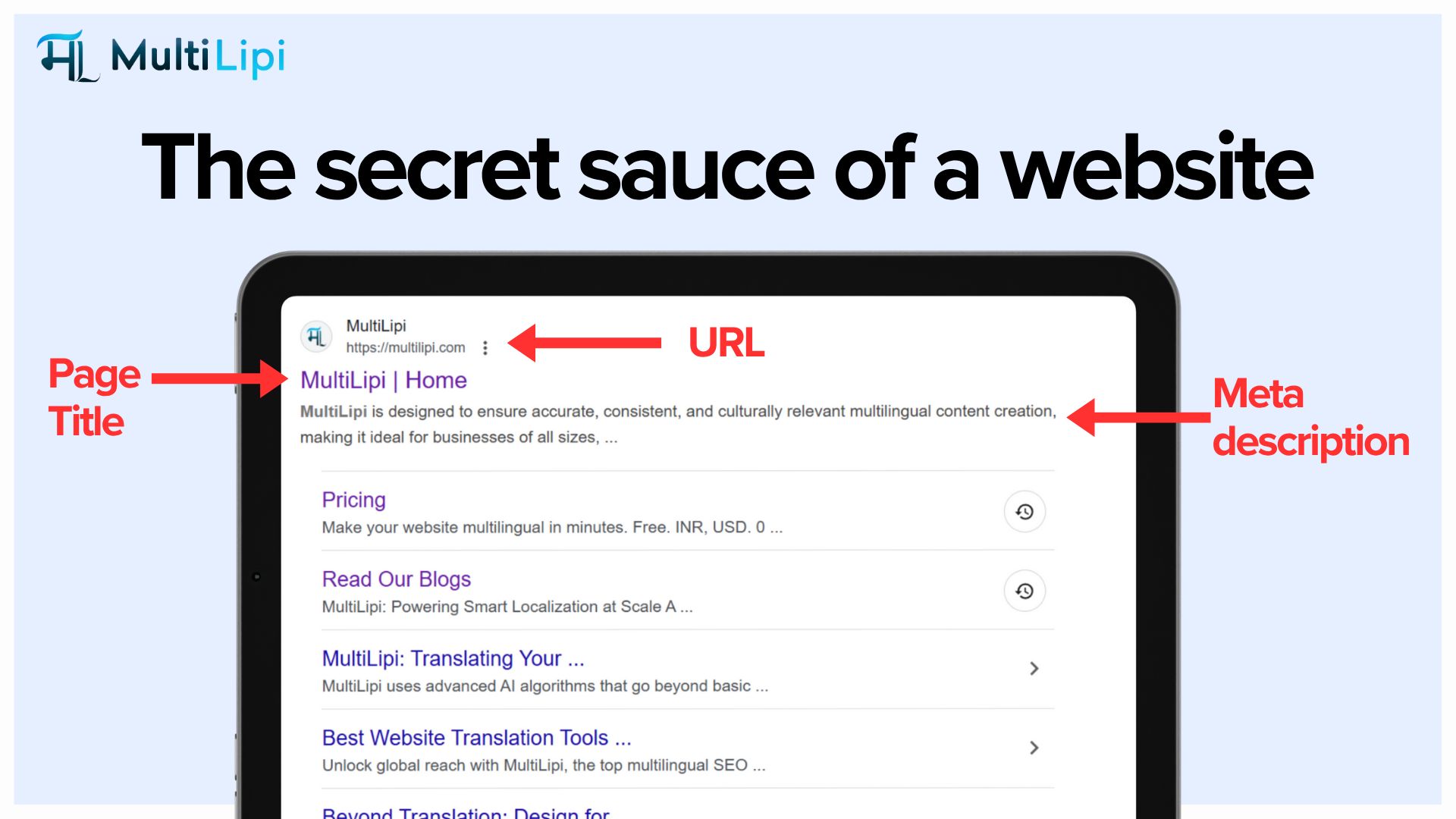
MultiLipi search result showing page title, URL, and meta description as key SEO elements for a multilingual website

Metadata – including title tags and meta descriptions – serves as a concise summary of a webpage’s content in search results. Translating these elements accurately into your target languages ensures search engines can properly interpret and categorize your content for each locale, improving your rankings in local search results (weglot.com). Equally important, these translated snippets are the first introduction to your brand that users see on a search page, so making a good first impression is critical for enticing clicks.

On the other hand, poorly translated metadata can confuse or mislead users. If your title or description reads strangely or irrelevant due to a bad translation, users are likely to skip your result or bounce off your site quickly – damaging your click-through rate and increasing bounce rate, which in turn harms SEO performance (weglot.comlinguise.com). In short, inaccurate translations lead to lost traffic.

Another critical factor is implementing hreflang-Tags for all language versions of your site. Hreflang annotations signal to search engines which language and region each page is intended for. If these tags are missing or misconfigured, even the best-translated metadata may not be shown to the right audience (weglot.comlinguise.com). Every multilingual site should use hreflang (with correct language-country codes) so Google and other engines serve users the appropriate local version of your content. Without hreflang, a French meta description might mistakenly show up for English-speaking users, or vice versa, undermining your efforts.

Fazit: Accurate metadata translation improves both search engine understanding of your content and the user appeal of your search snippets. It’s a direct contributor to higher global SEO performance when paired with proper technical SEO configuration.

Critical Components of Successful Metadata Translation

Visual showing key components of successful metadata translation: intent-focused copy, localized keywords, and translation memory.

Achieving high-quality metadata translations requires both linguistic and strategic considerations:

  • Market-Specific Keyword Research: Start by researching search behavior in your target market. Identify the keywords and phrases local users actually search for, rather than directly translating your English keywords. Focus on terms that have good search volume and align with user intent in that language. Tools like Semrush und Ahrefs (and free resources like Google Trends) are invaluable for this process, helping you discover high-volume local search terms and topics (localizejs.com). By tailoring your titles and descriptions to include language-specific keywords, you connect more effectively with local audiences and search algorithms.
     
  • Intent Over Literal Translation: Always prioritize conveying the Bedeutung and intent of the metadata, rather than doing a word-for-word translation. A phrase that works well in English might not have an equivalent in, say, Japanese or Arabic. It may require rephrasing or a creative approach (also known as transcreation) to resonate in the target language. For example, a clever marketing tagline in English could sound awkward or even change meaning if translated literally (linguise.com). Maintain the core message but adapt wording to fit local cultural nuances and search behavior. This ensures your metadata remains clear, compelling, and relevant to native speakers.
     
  • Use of Translation Memory & Glossaries: Consistency is key in multilingual content. Implementing a translation memory system or glossary can greatly improve consistency across similar pages. These tools store previously translated segments and your preferred terminology so you can reuse them for new content. For instance, MultiLipi offers a built-in glossary that lets you define translations for specific terms (e.g. product names or slogans) to enforce uniform wording across all languages (multilipi.com). By using a glossary or translation memory, you ensure that a phrase like “Free Trial” or your brand tagline is always translated the same preferred way every time it appears, strengthening brand recognition and avoiding inconsistent wording.
     
  • Leverage Data and Analytics: In addition to linguistic accuracy, use data to guide your metadata strategy. Monitor how users in different regions engage with your translated pages. Analytics and business intelligence tools can provide insight into which translated metadata versions have higher click-through rates or conversion rates. For example, integrating platforms like MicroStrategy or Sisense could help you analyze performance by region (weglot.com). If the meta description in German has a lower CTR than the English one, it might indicate the phrasing isn’t resonating and needs tweaking. Data-driven adjustments ensure your metadata is not only accurately translated but also optimized for results.
     

By combining thorough keyword research, cultural insight, consistency tools, and performance analysis, you set a strong foundation for successful metadata translation across all your target languages.

Language-Specific Optimization and Character Limits

Different languages often require tailored optimization approaches due to variations in length and script. One major consideration is text expansion or contraction. For instance, a sentence in German can be around 20–30% longer than its English equivalent (dorotapawlak.eu). This means a meta title that fits within Google’s pixel limits in English might be too long in German, causing it to truncate in search results. Always account for these differences – if you translate an English title directly, check that the translated version stays within recommended character limits (roughly 55–60 characters for titles, ~155–160 for descriptions in most cases, though these limits can vary by language and search engine). Planning for text expansion (or contraction, in languages like Chinese) will help preserve your metadata’s full message in SERPs.

CJK characters and special scripts: Languages like Chinese, Japanese, and Korean use characters that take up single spaces but convey more meaning per character. They may display differently on search pages (e.g. Google often shows fewer characters for CJK languages). Ensure your titles and descriptions in these languages are concise and still informative. Also be mindful of any required format (for example, Japanese metadata might include full-width punctuation).

Right-to-Left (RTL) languages: Arabic, Hebrew, and other RTL languages require special attention for how metadata is presented. Ensure that your website’s code properly declares the language direction so that titles and descriptions render correctly. Even in search results, you want to avoid garbled or misordered text. Simple things like the placement of punctuation in RTL text can affect readability. In short, always test how your metadata appears for RTL languages – they often need adjustments in wording or formatting for clarity (linguise.com).)

Local punctuation and characters: Each language has its own typographical conventions. Spanish uses inverted question/exclamation marks, French and German use accented characters, etc. Use the correct localized characters in your metadata – it not only looks more professional, but also can impact keyword relevancy (for example, “años” with ñ is a different word from “anos” without it). Don’t assume you can use English punctuation for all; adopting locale-specific punctuation and spacing will make your snippets look native. Neglecting these nuances can lead to misinterpretation or an unpolished impression, which can hurt user engagement.

Finally, always preview your translated metadata as it would appear in search results. Many SEO tools provide snippet preview functionality. This allows you to catch issues like truncation, weird symbols, or phrasing that might need refinement before it goes live.

Technical Requirements: Hreflang Tags and URL Structure

Accurate translation alone isn’t enough – the technical SEO setup of your multilingual site must also be sound. Proper technical implementation ensures search engines can discover and index your translated content efficiently (weglot.com). The cornerstone elements to get right are hreflang, URL structure, canonical tags, and sitemaps:

  • Hreflang Attributes: As mentioned, always use hreflang tags to specify the language (and optionally, region) of each page. For example, your French page should have a hreflang="fr" (or “fr-FR” for France vs “fr-CA” for Canadian French) linking to itself, and reciprocal tags linking back to the other language versions. This helps Google serve the French page to French users, the Spanish page to Spanish users, etc., rather than guessing. It also prevents duplicate content issues by explicitly linking equivalent pages. A correctly implemented hreflang setup is vital – without it, even if you translate meta tags perfectly, search engines “don’t know which language version to display to users”, leading to suboptimal results (linguise.com). Be meticulous with the language codes and ensure every page references all its alternates (including a self-referential tag).
     
  • URL Structure (Subdomains vs Subdirectories): Decide on a URL strategy for your multilingual content and apply it consistently. The two common approaches are subdirectories (e.g. yourwebsite.com/es/page) or subdomains (e.g. es.yourwebsite.com/page). There’s no one-size-fits-all answer – each has pros and cons, and either can work for SEO if done right. Subdirectories are often simpler to implement and concentrate all SEO authority on one domain, while subdomains can allow more separation (sometimes used if targeting different countries or when using a proxy service). The key is to be consistent and make sure each language’s pages are clearly separated in one of these structures (localizejs.com) . MultiLipi supports both options – for instance, you can choose language-specific subfolders like /fr/ or dedicated subdomains like fr.yoursite.com depending on your needs (wordpress.org). Whichever structure you choose, update internal links and navigation to point users (and crawlers) to the correct localized URLs.
     
  • Canonical Tags: If you have multiple versions of a page, use canonical tags appropriately to avoid duplicate content penalties. Generally, each language page should canonically reference itself (since it’s original content in that language, not a duplicate). Do nicht point different language pages to a single canonical URL, or search engines might ignore the alternates. The only time canonical comes into play is if you have duplicate content in the same language (e.g. a printer-friendly page). For multilingual SEO, hreflang is the primary tool, not cross-language canonicals. Ensure your CMS or translation plugin sets this up correctly.
     
  • Localized Sitemaps: For large sites, consider creating separate XML sitemaps for each language (or a combined sitemap listing all alternate URLs with hreflang). This helps search engine bots efficiently crawl your site’s structure. For example, you might have sitemap-en.xml, sitemap-fr.xml, etc., each containing URLs only for that language. Submit these in Google Search Console (and Bing Webmaster Tools, etc.) for the respective locales. This ensures no translated page is overlooked due to crawl depth issues. If maintaining multiple sitemaps is burdensome, a single sitemap is fine too – just make sure every URL is included and hreflang relationships are noted.
     
  • Other Technical Elements: Remember that metadata isn’t just titles and descriptions. Don’t forget to translate image alt attributes, Open Graph tags (for social media sharing), and any other meta tags that carry content (like Twitter Card metadata, JSON-LD schema descriptions, etc.). These can impact SEO and how your pages appear on social platforms. For example, an image’s alt text in the user’s language can help with image SEO and accessibility, and a translated Open Graph description will make your content more appealing when shared on local social networks. Many site owners overlook these technical metadata elements during localization (linguise.com), so ensure your workflow or translation tool captures them.
     

Getting these technical details right goes hand-in-hand with linguistic accuracy. Together, they create a solid infrastructure for mehrsprachige Website SEO success – where each localized page can perform to its fullest potential in search rankings.

Automation vs. Manual Translation MultiLipi Approaches

MultiLipi features for global SEO including metadata translation, multilingual SEO best practices, glossary tools, visual editor, sync, and bulk management.

When it comes to translating metadata for a multilingual website, one common question arises: should you rely on automated translation tools or invest in human translators for this task? The answer often lies somewhere in the middle. Let’s examine both approaches:

Automated Metadata Translation: Pros & Cons

  • (+) Speed and Scalability: Automated translation offers incredible speed. If you have a large e-commerce site or frequent blog updates, machine translation can turn around hundreds of meta tags almost instantly. This scalability makes it feasible to translate this webpage and thousands of others without waiting on human schedules. It’s ideal for quick turnarounds or testing multiple languages rapidly.
     
  • (+) Timely Updates: For content that changes often (news articles, dynamic product listings), automated tools ensure your metadata in all languages stays up-to-date. You won’t risk having an outdated Spanish meta description because a translator wasn’t available; the system translates new metadata on the fly.
     
  • (-) Nuance and Quality Issues: The downside is that pure machine translation may lack the cultural nuance needed for effective SEO copy. Automated tools can misinterpret idioms, tone, or context. A literal translation might come across as awkward or unclear to native speakers (linguise.com). This could hurt click-through rates if the meta description doesn’t make sense or appeal to the local audience.
     
  • (-) Inaccurate Keyword Alignment: Machines might not choose the same keywords a human SEO translator would. For example, an automatic translation might use a technically correct word that has zero search volume in the target language, whereas a human would know to use the more popular synonym. These subtleties mean fully automated metadata translations can sometimes be suboptimal for SEO performance.

Manual Metadata Translation: Pros & Cons

  • (+) Higher Accuracy & Cultural Relevance: Human translators (especially those experienced in SEO) can craft metadata that reads naturally and persuasively in the target language. They can maintain your brand voice and incorporate culturally relevant references or calls-to-action that machines would miss. The result is meta titles and descriptions that resonate with local users and search engines alike. This is particularly important for marketing content where tone and emotion matter.
     
  • (+) Intent Matching: A skilled human translator will focus on user intent and relevant keywords, not just literal meaning. They can ensure the translated metadata actually appeals to what local users are looking for. For instance, if your English meta title is “10 Tips for Great Web Design,” a human might know that in French, users are more likely to search a phrase that translates to “10 Ways to Improve Your Website” – adjusting the wording to match local search habits.
     
  • (-) Time-Consuming & Costly: Doing everything manually takes significantly more time. Crafting and reviewing metadata for dozens or hundreds of pages across multiple languages can be a slow process, delaying your global content launches. This can be impractical for large sites or time-sensitive updates. Additionally, quality human translation (and subsequent SEO copy editing) can be expensive, especially if you need professional linguists for many languages.
     
  • (-) Inconsistency Risks: Without a structured process, manual translation by different people can introduce inconsistencies. One translator might use a different phrase than another for the same concept, which could dilute your messaging. (This can be mitigated by using glossaries and providing clear guidelines to translators, but it’s something to manage carefully.)
     

Finding the Right Balance – The Hybrid Approach: The good news is that you don’t have to strictly choose one or the other. Many organizations find that a hybrider Ansatz to metadata translation yields the best results (weglot.com). In practice, this means using machine translation to handle the heavy lifting of initial translation, then having a human (such as a native-speaking editor or your marketing team) review and refine those translations. This approach offers the speed of automation with the nuance of human oversight. You can quickly get a draft translation for, say, 100 product meta descriptions, and then spend focused time polishing the most important ones or correcting any awkward phrasing.

Modern translation platforms support this workflow seamlessly. For example, you might plug your site into an AI-powered Website-Seitenübersetzer like MultiLipi to generate instant metadata translations, and then use its post-editing interface to fine-tune each one for tone and keywords. By automating the rote work and reserving human effort for quality control, you achieve high translation quality und fast turnaround (weglot.com). Many businesses report that this combo (often called AI + human in the loop) dramatically reduces time-to-market for new languages without sacrificing SEO performance.

Zusammenfassend lässt sich sagen, automation vs manual is not an either/or decision. Use automation to work at scale, but always plan for a human review stage – especially for customer-facing text like metadata where a little nuance goes a long way.

Accelerate Your Global SEO Efforts with MultiLipi

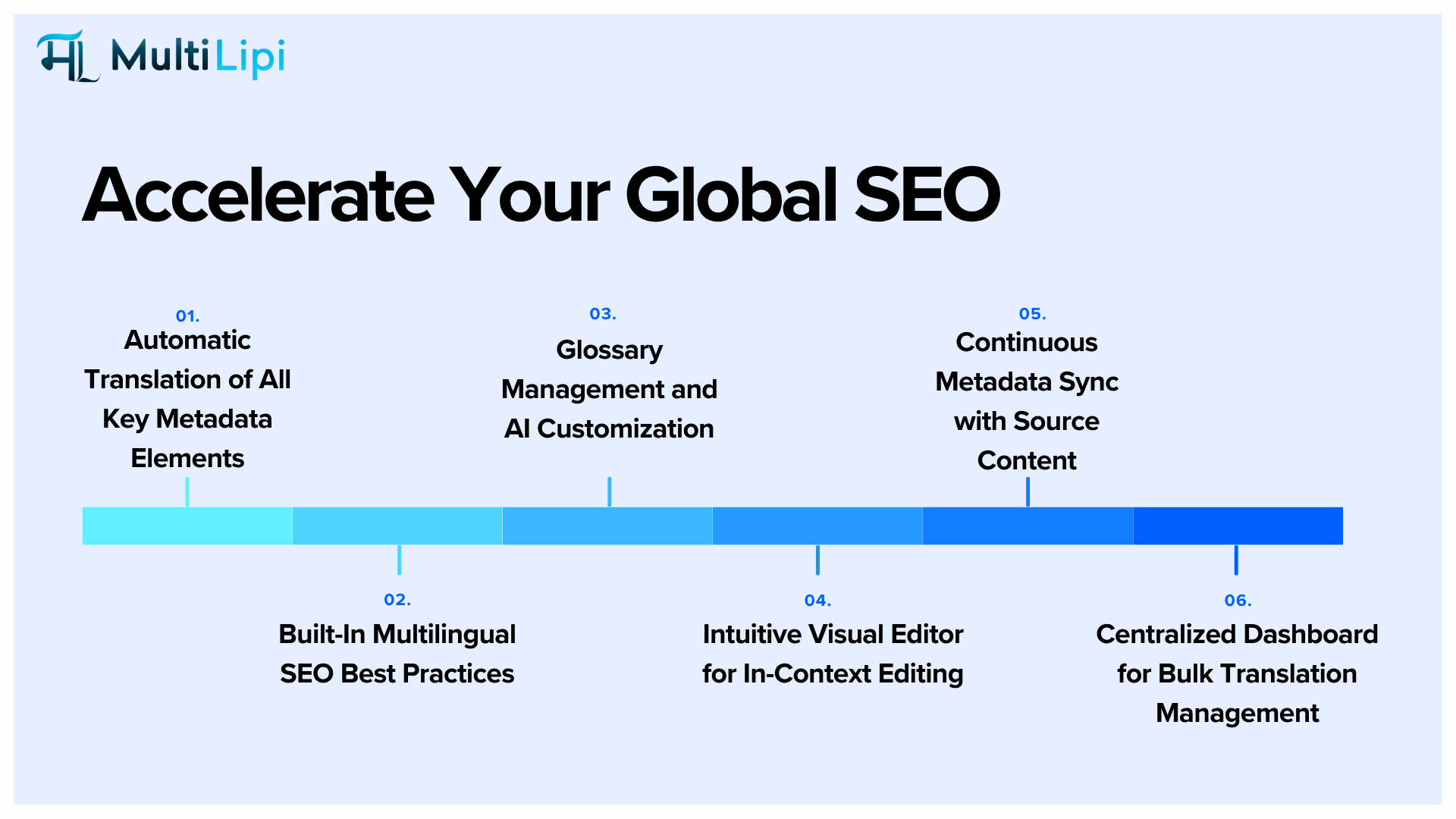
Infographic highlighting six key features of MultiLipi for multilingual SEO Accelerating Your Global SEO

MultiLipi is an AI-driven Website-Übersetzung platform designed to streamline metadata translation and take the headaches out of multilingual SEO. It combines the power of automation with the finesse of human editing in one cohesive workflow. Here’s how MultiLipi helps you optimize your metadata (and broader content) for global search success:

  • Automatic Translation of All Key Elements: MultiLipi’s solution automatically detects and translates essential on-page elements like meta titles, meta descriptions, headings, image alt text, and even custom fields or SEO tags. This ensures no piece of metadata is left untranslated. The platform is built to handle full mehrsprachige Website SEO – for example, it will translate your URL slugs or create SEO-friendly URL structures for each language, rather than keeping English URLs (wordpress.org). By covering things like translated URLs and alt tags, MultiLipi makes sure your entire page is optimized for local search, not just the visible text.
     
  • Built-In Multilingual SEO Best Practices: When you use MultiLipi, the technical SEO configuration is largely taken care of for you. The platform can automatically create language-specific subdirectories or subdomains for your translated content, depending on your preference, and implement hreflang tags site-wide (wordpress.org). This means from day one, your translated pages are properly structured and indexed by search engines in each region. MultiLipi is fully optimized for multilingual SEO, as the WordPress plugin description highlights – every translated page is indexable by Google, and your site architecture is configured for international targeting out of the box  (wordpress.orgwordpress.org.)
     
  • Glossary and AI Customization: MultiLipi includes glossary management and a translation memory, allowing you to define specific translations for brand names, industry terms, or any phrases you care about. The platform will consistently use those preferred translations across your site, preserving brand voice and terminology in all languages (multilipi Translation memory). For example, if you always translate “Contact Us” as “Kontakteer Ons” in Dutch (instead of a machine’s default), you can lock that in. This feature ensures that the nuances of your branding and messaging carry over accurately, which is a big advantage for metadata where small wording differences matter.
     
  • Intuitive Editing Dashboard (Visual Editor): A standout feature of MultiLipi is its user-friendly dashboard and live visual editor. After the initial machine translation, you can easily review and edit translations within a preview of your webpage. This means you can see your translated title or description in context – how it fits on the page, whether it exceeds any character limits, etc. – and adjust it on the spot (multilipi Virtual editor). The editor allows you to fine-tune translations for SEO, such as tweaking a meta description to include a target keyword or to better entice clicks. Because you’re editing in context, it’s easy to ensure your translated metadata stays within the required length and looks perfect for users.
     
  • Continuous Updates and Bulk Management: As your primary site content changes, MultiLipi automatically detects new or updated metadata and will prompt translation updates in your other languages. This automation significantly reduces the manual effort of keeping all language versions in sync. Moreover, the platform’s centralized dashboard lets you manage translations in bulk. For instance, you can filter specifically for SEO metadata (like all your meta titles in French) and edit them in one place. This bulk editing capability is a huge time-saver for larger websites. MultiLipi essentially provides an end-to-end workflow: from initial translation to editing to publishing – all in one hub.
     

All these features work together to ensure that your translated metadata isn’t just accurate, but optimized. MultiLipi’s approach of combining high-quality machine translation with easy human refinement means you get both speed and precision. By using the platform, businesses can achieve multilingual SEO best practices with much less effort than doing everything manually. In short, MultiLipi empowers you to present a fully optimized, multilingual website to the world – without needing to be a technical SEO expert or fluent in multiple languages.

(MultiLipi vs. others:) If you’ve been considering alternatives – such as purely manual translation or generic translation plugins – it’s worth noting how a solution like MultiLipi stands out. MultiLipi was built with SEO in mind, so it inherently handles things that others might require extra configuration (hreflang, metadata translation, etc.). Its AI-human hybrid workflow means you don’t trade off quality for speed. And features like collaborative editing (adding team members to the dashboard) make it scalable for organizations. Essentially, MultiLipi wraps translation + localization + SEO into one package so you can focus on growing your global audience.

Best Practices for Metadata Translation

To wrap up, here is a checklist of best practices and tips to ensure your metadata translation truly boosts your global SEO:

  • Account for Text Length Differences: Always consider how much longer or shorter your translated text might be. Design your titles and descriptions to fit within search engines’ recommended lengths for each language. For instance, allow ~30% extra space for German text expansion (dorotapawlak.eu). After translating, use an SEO snippet tool or Google’s preview to check for truncation in each target language. Edit down if necessary to keep important words from being cut off.
     
  • Incorporate Language-Specific Keywords: Don’t assume your source-language keywords are the best ones in another market. Do fresh keyword research or use tools like Google Trends to find what phrases locals use. Then incorporate those keywords naturally into your translated metadata. This improves relevance and can significantly boost local search rankings (localizejs.com). (Tip: Also localize any numeric formats or units in your metadata – e.g., converting currency or date formats – since searchers might use local notation in queries.)
     
  • Use Language-Appropriate Schema Markup: If you use structured data (JSON-LD, etc.) on your pages, translate any content within that markup as well, or use schema properties that support multiple languages. For example, for Organization or Product schema, provide translated name or Beschreibung fields where applicable. This helps search engines display rich results (like knowledge panels or rich snippets) in the user’s language. It’s an often overlooked aspect of multilingual SEO.
     
  • Implement Hreflang and Locale-Specific URLs: This is worth repeating – use hreflang for every page and verify it’s correct. Also, structure your site with clear language indicators in URLs (whether subdirectory or subdomain). For instance, a URL ending in /es/producto instantly signals both users and search bots that this is a Spanish page. If you have distinct regional content (e.g. en-US vs en-GB), include that in hreflang and possibly use separate URLs for clarity. Proper language targeting avoids user confusion and improves indexation for the right audience (weglot.com).
     
  • Consider Regional Variants and Dialects: Optimize for regional differences within the same language. For example, Spanish in Spain vs. Spanish in Mexico – if you target both, you might need slight metadata tweaks (different vocabulary or formal/informal tone). Similarly, European French vs Canadian French have some distinctions. Reflect those in your meta copy to maximize local relevance. If you use hreflang with region codes (like fr-FR, fr-CA), ensure the content actually matches those locales.
     
  • Mind the Search Engine-Specific Rules: If you’re targeting markets where Google isn’t the dominant engine, adjust your metadata strategy accordingly:
     
    • Baidu: Titles should be under 80 characters (and meta descriptions under ~200) for Baidu’s index (advance-metrics.com). Use Simplified Chinese keywords in your titles, as Baidu heavily relies on keyword presence. Also, Baidu still pays attention to meta keywords tag (unlike Google), so consider adding a few relevant ones in Chinese.
       
    • Yandex: The Russian search engine favors fully localized content. Ensure your titles and descriptions are not just translated but also localized with Cyrillic script and Russian context. Yandex’s algorithm also allows you to set a regional target in Yandex Webmaster – do that to boost local rankings (delante.co). Avoid any spammy or repetitive wording; Yandex is stricter than Google about keyword stuffing and will downrank pages that appear over-optimized. Focus on clear, useful meta descriptions that align with Russian users’ expectations.
       
    • Naver: South Korea’s top search engine has shorter snippet length preferences – roughly <40 characters for titles and <80 for descriptions is recommended (delante.co). Naver also places a big emphasis on user click-through and engagement. Craft your metadata to include a strong call-to-action or value proposition that encourages clicks (this could indirectly improve rankings, as higher CTR is believed to benefit Naver SEO). Also, if possible, integrate Naver-specific features like metadata for Naver Blog search if you’re using those services. Overall, treat Naver like a unique ecosystem: what works on Google (long, keyword-rich metas) might not work on Naver, which prefers brevity and engagement.
       
  • Übersetzen Alle Metadata (and then some): It’s not just the </span></span><span style="font-family:Arial,sans-serif"><span style="color:#000000" mlms_t="true"> und </span></span><span style="font-family:'Roboto Mono',monospace"><span style="color:#188038"><meta description></span></span><span style="font-family:Arial,sans-serif"><span style="color:#000000"> that need translation. Make sure to translate anchor text in meta tags (if any), image alt text, and even the URL slug if it makes sense. A localized URL (e.g., </span></span><span style="font-family:'Roboto Mono',monospace"><span style="color:#188038">.../mejores-jugadores</span></span><span style="font-family:Arial,sans-serif"><span style="color:#000000" mlms_t="true"> anstatt </span></span><span style="font-family:'Roboto Mono',monospace"><span style="color:#188038">.../best-players</span></span><span style="font-family:Arial,sans-serif"><span style="color:#000000">) can improve relevance for local queries (</span></span><a href="https://www.linguise.com/blog/guide/how-to-translate-metadata-for-better-multilingual-seo/#:~:text=Not%20translating%20slug%20URLs" style="text-decoration:none"><span style="font-family:Arial,sans-serif"><span style="color:#1155cc"><u>linguise.com</u></span></span></a><span style="font-family:Arial,sans-serif"><span style="color:#000000">) – just be sure to implement 301 redirects from the old URLs if you change them, to preserve SEO value. Similarly, translate your Open Graph and Twitter Card tags so that when your page is shared on social media in another language, the snippet is in that language. These details contribute to a cohesive localized experience and can indirectly impact SEO (through user behavior signals and link sharing).</span></span></span><br/>  </li> <li style="list-style-type:disc"><span style="font-size:20px"><span style="font-family:Arial,sans-serif"><span style="color:#000000"><strong>Maintain Consistent Branding and Terminology:</strong> Ensure your brand name and key product terms are used consistently across all languages. Use the same transliteration or translation for your brand in every title tag, unless there’s a strategic reason to adapt it. In meta descriptions, if you have a slogan or value prop, keep it consistent in spirit. Using a translation glossary, as noted, is helpful here – MultiLipi’s glossary feature, for example, will automatically apply your approved terms so that you don’t end up with different translators calling your product three different names (</span></span><a href="https://de.multilipi.com/#:~:text=experience,maintain%20consistent%20terminology%20across%20all" style="text-decoration:none"><span style="font-family:Arial,sans-serif"><span style="color:#1155cc"><u>multilipi.com</u></span></span></a><span style="font-family:Arial,sans-serif"><span style="color:#000000">). Consistency in metadata not only aids brand recognition but also looks professional to users who might compare snippets. It’s jarring if one language’s meta description uses a different company name or an informal tone when all others are formal.</span></span></span><br/>  </li> </ul> <p><span style="font-size:20px"><span style="font-family:Arial,sans-serif"><span style="color:#000000">Finally, always <strong>test and monitor</strong>. After implementing metadata translations, watch your analytics and search console data. Look at click-through rates by country/language and see if the new metadata is performing well. If the French page has a low CTR despite ranking, maybe the meta text isn’t appealing enough in French – you can A/B test a tweak. SEO is iterative, and multilingual SEO even more so. Keep refining your metadata based on real data, and you’ll continually improve your global search performance.</span></span></span></p> <h2><span style="font-size:24px"><span style="font-family:Arial,sans-serif"><span style="color:#000000"><strong>Try MultiLipi for Free and Boost Your Global SEO</strong></span></span></span><br/> <img alt="MultiLipi contact banner encouraging businesses to grow with localized content, featuring email and website support details " src="https://ik.imagekit.io/multilipi/media/media/https%3A/static.multilipi.com/media/uploads/2025/06/24/6_F3BMPQP.png" style="height:450px; width:800px" mlms_t="true" /></h2> <p><span style="font-size:20px"><span style="font-family:Arial,sans-serif"><span style="color:#000000">Properly translated and optimized metadata can have a transformative effect on your site’s global SEO. We’ve seen how implementing hreflang tags, conducting language-specific keyword research, and maintaining cultural relevance in your meta tags all contribute to better visibility in overseas markets (</span></span><a href="https://www.weglot.com/blog/metadata-translation#:~:text=%E2%80%8DWe%E2%80%99ve%20seen%20the%20benefits%20that,significantly%20improve%20their%20SEO%20overseas" style="text-decoration:none"><span style="font-family:Arial,sans-serif"><span style="color:#1155cc"><u>weglot.com</u></span></span></a><span style="font-family:Arial,sans-serif"><span style="color:#000000">). However, executing all of this manually can be complex and time-consuming. This is where </span></span><a href="https://de.multilipi.com/" style="text-decoration:none"><span style="font-family:Arial,sans-serif"><span style="color:#1155cc"><strong><u>MultiLipi</u></strong></span></span><span style="font-family:Arial,sans-serif"><span style="color:#1155cc"><u> </u></span></span></a><span style="font-family:Arial,sans-serif"><span style="color:#000000">comes in as your solution to streamline the process.</span></span></span></p> <p><span style="font-size:20px"><span style="font-family:Arial,sans-serif"><span style="color:#000000">MultiLipi enables you to overcome the typical challenges of multilingual SEO by <strong>automatically translating</strong> all crucial metadata elements while ensuring they’re indexed correctly and optimized for each locale. The platform handles the heavy lifting of technical configuration (like creating localized URLs and adding hreflang) and gives you an intuitive interface to perfect the translations. Essentially, MultiLipi is the enabler you need to fast-track your online presence into new languages and regions (</span></span><a href="https://de.multilipi.com/#:~:text=define%20your%20brand%E2%80%99s%20global%20success,Try%20MultiLipi%20for" style="text-decoration:none"><span style="font-family:Arial,sans-serif"><span style="color:#1155cc"><u>multilipi.com</u></span></span></a><span style="font-family:Arial,sans-serif"><span style="color:#000000">) – without compromising on quality or SEO best practices.</span></span></span></p> <p><span style="font-size:20px"><span style="font-family:Arial,sans-serif"><span style="color:#000000"><strong>Ready to go multilingual?</strong> You can get started with MultiLipi in minutes. The platform offers a free trial (one month free via the WordPress plugin, with an ongoing free tier available) (</span></span><a href="https://wordpress.org/plugins/multilipi-multilingual-seo/#:~:text=Enhance%20your%20visibility%2C%20boost%20conversions%2C,quality%20translations%20powered%20by%20AI" style="text-decoration:none"><span style="font-family:Arial,sans-serif"><span style="color:#1155cc"><u>wordpress.org</u></span></span></a><span style="font-family:Arial,sans-serif"><span style="color:#000000">), so you can see firsthand how it improves your translated website’s performance. With MultiLipi’s AI-powered translation and SEO toolkit, you’ll be able to <strong>translate this webpage and your entire site</strong> with ease, then fine-tune it for maximum impact in search results.</span></span></span></p> <p><span style="font-size:20px"><span style="font-family:Arial,sans-serif"><span style="color:#000000">Don’t let language barriers hold back your growth. Invest in accurate metadata translation and a robust tool like MultiLipi to <strong>boost your multilingual SEO</strong>. Start your free trial with MultiLipi today, and experience the increase in global traffic and engagement that comes from speaking your customers’ language – on every SERP and every page.</span></span></span></p> <p> </p><style> .blog-content { font-family: ui-sans-serif, system-ui, sans-serif, "Apple Color Emoji", "Segoe UI Emoji", "Segoe UI Symbol", "Noto Color Emoji"; color: var(--text-main, #0F172A); line-height: 1.75; font-size: 1.125rem; /* 18px */ max-width: 100%; } /* Headings */ .blog-content h1, .blog-content h2, .blog-content h3, .blog-content h4, .blog-content h5, .blog-content h6 { color: var(--text-main, #0F172A); font-weight: 700; margin-top: 2.5em; margin-bottom: 1em; letter-spacing: -0.02em; line-height: 1.25; } .blog-content h1:first-child, .blog-content h2:first-child, .blog-content h3:first-child { margin-top: 0; } .blog-content h1 { font-size: 2.5rem; /* 40px */ line-height: 1.2; margin-bottom: 1.5rem; } .blog-content h2 { font-size: 2rem; /* 32px */ border-bottom: 2px solid #E2E8F0; padding-bottom: 0.5em; margin-top: 3rem; } .blog-content h3 { font-size: 1.5rem; /* 24px */ margin-top: 2rem; } .blog-content h4 { font-size: 1.25rem; /* 20px */ font-weight: 600; } .blog-content h5 { font-size: 1.125rem; /* 18px */ font-weight: 600; } .blog-content h6 { font-size: 1rem; /* 16px */ font-weight: 600; color: #475569; } /* Paragraphs */ .blog-content p { margin-bottom: 1.75em; color: #334155; line-height: 1.8; } .blog-content p:last-child { margin-bottom: 0; } .blog-content strong, .blog-content b { font-weight: 600; color: #0F172A; } .blog-content em, .blog-content i { font-style: italic; } /* Lists */ .blog-content ul, .blog-content ol { margin-bottom: 2em; padding-left: 2em; color: #334155; } .blog-content ul li, .blog-content ol li { margin-bottom: 0.75em; padding-left: 0.5em; line-height: 1.75; } .blog-content ul li:last-child, .blog-content ol li:last-child { margin-bottom: 0; } .blog-content ul { list-style-type: disc; } .blog-content ol { list-style-type: decimal; } .blog-content ul ul, .blog-content ol ul { margin-top: 0.5em; margin-bottom: 0.5em; } .blog-content ul ol, .blog-content ol ol { margin-top: 0.5em; margin-bottom: 0.5em; } /* Links */ .blog-content a { color: #2563EB; text-decoration: none; border-bottom: 1px solid transparent; transition: all 0.2s ease; font-weight: 500; } .blog-content a:hover { border-bottom-color: #2563EB; color: #1E40AF; } .blog-content a:focus { outline: 2px solid #3B82F6; outline-offset: 2px; border-radius: 2px; } /* Images */ .blog-content img { border-radius: 0.75rem; /* 12px */ margin: 2.5em 0; max-width: 100%; height: auto; box-shadow: 0 10px 30px -10px rgba(0, 0, 0, 0.1), 0 4px 6px -2px rgba(0, 0, 0, 0.05); border: 1px solid #E2E8F0; } .blog-content figure { margin: 2.5em 0; } .blog-content figcaption { margin-top: 1em; text-align: center; font-size: 0.875rem; color: #64748B; font-style: italic; } /* Blockquotes */ .blog-content blockquote { border-left: 4px solid #3B82F6; padding: 1.5em 1.75em; margin: 2.5em 0; font-style: italic; color: #475569; background: linear-gradient(135deg, #F8FAFC 0%, #F1F5F9 100%); border-radius: 0 0.75rem 0.75rem 0; box-shadow: 0 2px 8px rgba(0, 0, 0, 0.05); } .blog-content blockquote p { margin-bottom: 0.75em; } .blog-content blockquote p:last-child { margin-bottom: 0; } .blog-content blockquote cite { display: block; margin-top: 1em; font-size: 0.875rem; color: #64748B; font-style: normal; } /* Code Blocks */ .blog-content pre { background: #1E293B; color: #E2E8F0; padding: 1.5em; border-radius: 0.75rem; overflow-x: auto; margin: 2em 0; border: 1px solid #334155; box-shadow: 0 4px 12px rgba(0, 0, 0, 0.15); line-height: 1.6; } .blog-content code { font-family: 'Menlo', 'Monaco', 'Courier New', monospace; font-size: 0.875em; } .blog-content pre code { background: transparent; color: inherit; padding: 0; border-radius: 0; } .blog-content p code, .blog-content li code { background: #F1F5F9; color: #0F172A; padding: 0.25em 0.5em; border-radius: 0.375rem; font-weight: 500; border: 1px solid #E2E8F0; } /* Tables */ .blog-content table { width: 100%; border-collapse: collapse; margin: 2.5em 0; border-radius: 0.75rem; overflow: hidden; box-shadow: 0 4px 12px rgba(0, 0, 0, 0.08); } .blog-content table thead { background: linear-gradient(135deg, #3B82F6 0%, #2563EB 100%); } .blog-content table th { padding: 1em 1.25em; text-align: left; font-weight: 600; color: #FFFFFF; font-size: 0.875rem; text-transform: uppercase; letter-spacing: 0.05em; } .blog-content table td { padding: 1em 1.25em; border-bottom: 1px solid #E2E8F0; color: #334155; } .blog-content table tbody tr { background: #FFFFFF; transition: background 0.2s ease; } .blog-content table tbody tr:nth-child(even) { background: #F8FAFC; } .blog-content table tbody tr:hover { background: #F1F5F9; } .blog-content table tbody tr:last-child td { border-bottom: none; } /* Horizontal Rule */ .blog-content hr { border: none; border-top: 2px solid #E2E8F0; margin: 3em 0; } /* Responsive Typography */ @media (max-width: 768px) { .blog-content { font-size: 1rem; /* 16px on mobile */ line-height: 1.7; } .blog-content h1 { font-size: 2rem; /* 32px */ } .blog-content h2 { font-size: 1.625rem; /* 26px */ } .blog-content h3 { font-size: 1.375rem; /* 22px */ } .blog-content h4 { font-size: 1.125rem; /* 18px */ } .blog-content ul, .blog-content ol { padding-left: 1.5em; } .blog-content pre { padding: 1em; font-size: 0.875rem; } .blog-content blockquote { padding: 1em 1.25em; } } </style></div></article><div class="mt-12 space-y-12"><div><h3 style="font-size:28px;font-weight:700;color:#0F172A;margin-bottom:24px" mlms_t="true">Weiterlesen</h3><div class="grid md:grid-cols-3 gap-6 read-next-grid"><a href="/blog/markdown-vs-html-seo-ai-content" class="block h-full" style="text-decoration:none"><article class="rounded-xl overflow-hidden cursor-pointer group h-full" style="background:#FFFFFF;border:1px solid #E2E8F0"><div class="relative overflow-hidden" style="height:160px"><div class="relative inline-block overflow-hidden w-full h-full object-cover transition-transform duration-700 group-hover:scale-110"><img alt="Markdown vs HTML for SEO: Implications for AI-Generated Content" loading="lazy" decoding="async" data-nimg="fill" class="w-full h-full object-cover transition-transform duration-700 group-hover:scale-110" style="position:absolute;height:100%;width:100%;left:0;top:0;right:0;bottom:0;object-fit:cover;color:transparent" src="https://ik.imagekit.io/multilipi/media/cover_images/blog_title_card_gMo3r3O.png" mlms_t="true" /></div></div><div class="p-5"><span class="inline-block rounded-full px-3 py-1 mb-3" style="background:#64748B15;font-size:11px;font-weight:700;color:#64748B;text-transform:uppercase">Normal</span><h4 style="font-size:16px;font-weight:700;color:#0F172A;margin-bottom:12px;line-height:1.4">Markdown vs HTML for SEO: Implications for AI-Generated Content</h4><div class="flex items-center gap-2" style="color:#94A3B8;font-size:12px"><span>7/20/2026</span><span>•</span><span mlms_t="true">5 Min<!-- --> lesen</span></div></div></article></a><a href="/blog/google-eeat-ai-era-quality-signals" class="block h-full" style="text-decoration:none"><article class="rounded-xl overflow-hidden cursor-pointer group h-full" style="background:#FFFFFF;border:1px solid #E2E8F0"><div class="relative overflow-hidden" style="height:160px"><div class="relative inline-block overflow-hidden w-full h-full object-cover transition-transform duration-700 group-hover:scale-110"><img alt="Google’s E-E-A-T in the AI Era: Evolving Quality Signals" loading="lazy" decoding="async" data-nimg="fill" class="w-full h-full object-cover transition-transform duration-700 group-hover:scale-110" style="position:absolute;height:100%;width:100%;left:0;top:0;right:0;bottom:0;object-fit:cover;color:transparent" src="https://ik.imagekit.io/multilipi/media/cover_images/blog_title_card_pxszrcV.png" mlms_t="true" /></div></div><div class="p-5"><span class="inline-block rounded-full px-3 py-1 mb-3" style="background:#64748B15;font-size:11px;font-weight:700;color:#64748B;text-transform:uppercase">Normal</span><h4 style="font-size:16px;font-weight:700;color:#0F172A;margin-bottom:12px;line-height:1.4">Google’s E-E-A-T in AI Era: Evolving Quality Signals</h4><div class="flex items-center gap-2" style="color:#94A3B8;font-size:12px"><span>7/13/2026</span><span>•</span><span mlms_t="true">5 Min<!-- --> lesen</span></div></div></article></a><a href="/blog/ai-search-brand-authority-demand" class="block h-full" style="text-decoration:none"><article class="rounded-xl overflow-hidden cursor-pointer group h-full" style="background:#FFFFFF;border:1px solid #E2E8F0"><div class="relative overflow-hidden" style="height:160px"><div class="relative inline-block overflow-hidden w-full h-full object-cover transition-transform duration-700 group-hover:scale-110"><img alt="KI-Suchära: Wie Markenautorität die Nachfrage in KI-gesteuerten SERPs prägt" loading="lazy" decoding="async" data-nimg="fill" class="w-full h-full object-cover transition-transform duration-700 group-hover:scale-110" style="position:absolute;height:100%;width:100%;left:0;top:0;right:0;bottom:0;object-fit:cover;color:transparent" src="https://ik.imagekit.io/multilipi/media/cover_images/blog_title_card_hkB8j1H.png" mlms_t="true" /></div></div><div class="p-5"><span class="inline-block rounded-full px-3 py-1 mb-3" style="background:#64748B15;font-size:11px;font-weight:700;color:#64748B;text-transform:uppercase">Normal</span><h4 style="font-size:16px;font-weight:700;color:#0F172A;margin-bottom:12px;line-height:1.4" mlms_t="true">KI-Suchära: Wie Markenautorität die Nachfrage in KI-gesteuerten SERPs prägt</h4><div class="flex items-center gap-2" style="color:#94A3B8;font-size:12px"><span>7/7/2026</span><span>•</span><span mlms_t="true">15 Min<!-- --> lesen</span></div></div></article></a></div></div></div></div><div class="lg:col-span-3" style="min-width:0"><div class="sticky rounded-2xl p-6 toc-pad" style="top:100px;background:#FFFFFF;border:1px solid #E2E8F0"><h3 style="font-size:16px;font-weight:700;color:#0F172A;margin-bottom:20px;text-transform:uppercase;letter-spacing:0.05em" mlms_t="true">In diesem Artikel</h3><nav class="space-y-1"></nav><button class="flex items-center justify-center gap-2 rounded-xl py-3 px-4 transition-all w-full mt-4" style="background:linear-gradient(135deg, #3B82F6 0%, #2563EB 100%);color:#FFFFFF;font-size:14px;font-weight:700;border:none;cursor:pointer;box-shadow:0 4px 12px rgba(59, 130, 246, 0.25)" tabindex="0"><span mlms_t="true">Zusammenfassung in ChatGPT</span><svg xmlns="http://www.w3.org/2000/svg" width="24" height="24" viewBox="0 0 24 24" fill="none" stroke="currentColor" stroke-width="2" stroke-linecap="round" stroke-linejoin="round" class="lucide lucide-arrow-right h-4 w-4"><path d="M5 12h14"></path><path d="m12 5 7 7-7 7"></path></svg></button><div class="mt-8 pt-6" style="border-top:1px solid #E2E8F0"><p style="font-size:13px;font-weight:600;color:#64748B;margin-bottom:12px;text-transform:uppercase;letter-spacing:0.05em" mlms_t="true">Teilen</p><div class="flex gap-2"><button class="flex-1 rounded-lg py-2 px-3 transition-all hover:bg-blue-50" style="background:#F8FAFC;border:1px solid #E2E8F0;cursor:pointer" title="LinkedIn" mlms_t="true"><svg xmlns="http://www.w3.org/2000/svg" width="24" height="24" viewBox="0 0 24 24" fill="none" stroke="currentColor" stroke-width="2" stroke-linecap="round" stroke-linejoin="round" class="lucide lucide-linkedin h-4 w-4 mx-auto" style="color:#64748B"><path d="M16 8a6 6 0 0 1 6 6v7h-4v-7a2 2 0 0 0-2-2 2 2 0 0 0-2 2v7h-4v-7a6 6 0 0 1 6-6z"></path><rect width="4" height="12" x="2" y="9"></rect><circle cx="4" cy="4" r="2"></circle></svg></button><button class="flex-1 rounded-lg py-2 px-3 transition-all hover:bg-blue-50" style="background:#F8FAFC;border:1px solid #E2E8F0;cursor:pointer" title="Twitter" mlms_t="true"><svg xmlns="http://www.w3.org/2000/svg" width="24" height="24" viewBox="0 0 24 24" fill="none" stroke="currentColor" stroke-width="2" stroke-linecap="round" stroke-linejoin="round" class="lucide lucide-twitter h-4 w-4 mx-auto" style="color:#64748B"><path d="M22 4s-.7 2.1-2 3.4c1.6 10-9.4 17.3-18 11.6 2.2.1 4.4-.6 6-2C3 15.5.5 9.6 3 5c2.2 2.6 5.6 4.1 9 4-.9-4.2 4-6.6 7-3.8 1.1 0 3-1.2 3-1.2z"></path></svg></button><button class="flex-1 rounded-lg py-2 px-3 transition-all hover:bg-blue-50" style="background:#F8FAFC;border:1px solid #E2E8F0;cursor:pointer" title="Link kopieren" mlms_t="true"><svg xmlns="http://www.w3.org/2000/svg" width="24" height="24" viewBox="0 0 24 24" fill="none" stroke="currentColor" stroke-width="2" stroke-linecap="round" stroke-linejoin="round" class="lucide lucide-link h-4 w-4 mx-auto" style="color:#64748B"><path d="M10 13a5 5 0 0 0 7.54.54l3-3a5 5 0 0 0-7.07-7.07l-1.72 1.71"></path><path d="M14 11a5 5 0 0 0-7.54-.54l-3 3a5 5 0 0 0 7.07 7.07l1.71-1.71"></path></svg></button></div><div class="mt-4 rounded-lg px-3 py-2.5" style="background:linear-gradient(135deg, rgba(37, 99, 235, 0.05) 0%, rgba(147, 51, 234, 0.05) 100%);border:1px solid rgba(37, 99, 235, 0.15)"><p style="font-size:11px;color:#64748B;line-height:1.5" mlms_t="true">💡 <strong style="color:#2563EB" mlms_t="true">Profi-Tipp:</strong> Das Teilen von mehrsprachigem Wissen hilft der globalen Gemeinschaft beim Lernen. Markieren Sie uns<!-- --> <span style="color:#2563EB;font-weight:600">@MultiLipi</span> und wir werden Sie vorstellen!</p></div></div></div></div></div></div></section><section class="relative py-24" style="background:#FAFAFC"><div class="mx-auto max-w-[1200px] px-6"><div class="grid md:grid-cols-2 gap-12 items-center"><div style="opacity:0;transform:translateX(-30px)"><h2 class="mb-4 text-3xl md:text-5xl" style="font-weight:700;letter-spacing:-0.02em;color:#0F172A;line-height:1.2" mlms_t="true">Bereit für den globalen Markt?</h2><p class="mb-6" style="font-size:20px;line-height:1.7;color:#64748B" mlms_t="true">Lassen Sie uns besprechen, wie MultiLipi Ihre Content-Strategie transformieren und Ihnen helfen kann, globale Zielgruppen mit KI-gestützter mehrsprachiger Optimierung zu erreichen.</p><p style="font-size:16px;line-height:1.7;color:#64748B" mlms_t="true">Füllen Sie das Formular aus und unser Team wird sich innerhalb von 24 Stunden bei Ihnen melden.</p></div><div class="rounded-3xl p-8" style="background:rgba(255, 255, 255, 0.9);backdrop-filter:blur(20px);border:1px solid rgba(226, 232, 240, 0.8);box-shadow:0 20px 50px rgba(0, 0, 0, 0.08);opacity:0;transform:translateX(30px)"><form class="space-y-4"><div class="grid md:grid-cols-2 gap-4"><input type="text" placeholder="Vollständiger Name" required="" class="rounded-xl px-4 py-3 focus:outline-none focus:ring-2 focus:ring-blue-500 transition-all" style="background:#F1F5F9;border:none;font-size:15px;color:#0F172A;opacity:1" name="name" value="" mlms_t="true" /><input type="email" placeholder="E-Mail" required="" class="rounded-xl px-4 py-3 focus:outline-none focus:ring-2 focus:ring-blue-500 transition-all" style="background:#F1F5F9;border:none;font-size:15px;color:#0F172A;opacity:1" name="email" value="" mlms_t="true" /></div><div class="grid md:grid-cols-2 gap-4"><input type="tel" placeholder="Telefonnummer" class="rounded-xl px-4 py-3 focus:outline-none focus:ring-2 focus:ring-blue-500 transition-all" style="background:#F1F5F9;border:none;font-size:15px;color:#0F172A;opacity:1" name="phone" value="" mlms_t="true" /><input type="text" placeholder="Firmenname" class="rounded-xl px-4 py-3 focus:outline-none focus:ring-2 focus:ring-blue-500 transition-all" style="background:#F1F5F9;border:none;font-size:15px;color:#0F172A;opacity:1" name="company" value="" mlms_t="true" /></div><input type="text" placeholder="Betreff" class="w-full rounded-xl px-4 py-3 focus:outline-none focus:ring-2 focus:ring-blue-500 transition-all" style="background:#F1F5F9;border:none;font-size:15px;color:#0F172A;opacity:1" name="subject" value="" mlms_t="true" /><textarea name="message" placeholder="Nachricht" rows="5" class="w-full rounded-xl px-4 py-3 focus:outline-none focus:ring-2 focus:ring-blue-500 transition-all" style="background:#F1F5F9;border:none;font-size:15px;color:#0F172A;resize:none;opacity:1" mlms_t="true"></textarea><div class="pt-2 flex justify-center"><div id="cf-turnstile"></div></div><button type="submit" disabled="" class="w-full flex items-center justify-center gap-2 rounded-xl px-6 py-4 transition-all" style="background:#3B82F6;color:#FFFFFF;font-size:16px;font-weight:700;border:none;cursor:not-allowed;box-shadow:0 8px 24px rgba(59, 130, 246, 0.3);opacity:0.6" tabindex="0" mlms_t="true">Nachricht senden<svg xmlns="http://www.w3.org/2000/svg" width="24" height="24" viewBox="0 0 24 24" fill="none" stroke="currentColor" stroke-width="2" stroke-linecap="round" stroke-linejoin="round" class="lucide lucide-send h-5 w-5"><path d="M14.536 21.686a.5.5 0 0 0 .937-.024l6.5-19a.496.496 0 0 0-.635-.635l-19 6.5a.5.5 0 0 0-.024.937l7.93 3.18a2 2 0 0 1 1.112 1.11z"></path><path d="m21.854 2.147-10.94 10.939"></path></svg></button></form></div></div></div></section></div><!--$--><!--/$--></main><footer class="relative mt-0" style="background:#000000"><div class="absolute inset-0" style="opacity:0.08;pointer-events:none"><svg class="h-full w-full" xmlns="http://www.w3.org/2000/svg"><defs><pattern id="footer-grid" width="60" height="60" patternUnits="userSpaceOnUse"><path d="M 60 0 L 0 0 0 60" fill="none" stroke="#FFFFFF" stroke-width="0.5"></path></pattern></defs><rect width="100%" height="100%" fill="url(#footer-grid)"></rect></svg></div><div class="absolute left-0 top-0 h-full w-1/3" style="background:radial-gradient(ellipse at left center, rgba(37, 99, 235, 0.15) 0%, rgba(37, 99, 235, 0.05) 40%, transparent 70%);filter:blur(60px);pointer-events:none"></div><div class="absolute right-0 top-0 h-full w-1/3" style="background:radial-gradient(ellipse at right center, rgba(147, 51, 234, 0.15) 0%, rgba(147, 51, 234, 0.05) 40%, transparent 70%);filter:blur(60px);pointer-events:none"></div><div class="relative mx-auto max-w-[1400px] px-4 md:px-12 pt-16 pb-12"><div class="grid grid-cols-1 md:grid-cols-2 gap-8 md:gap-16 items-start"><div><div class="flex items-center justify-between mb-6" style="height:50px"><div class="flex items-center gap-2.5 mb-6"><div class="relative flex h-30 w-30 items-center justify-center rounded-lg"><img alt="Logo" loading="lazy" decoding="async" data-nimg="fill" class="object-contain" style="position:absolute;height:100%;width:100%;left:0;top:0;right:0;bottom:0;color:transparent" sizes="100vw" srcSet="/_next/image?url=%2F_next%2Fstatic%2Fmedia%2FMultiLip.0xgex_hqqpl37.png&w=640&q=75 640w, /_next/image?url=%2F_next%2Fstatic%2Fmedia%2FMultiLip.0xgex_hqqpl37.png&w=750&q=75 750w, /_next/image?url=%2F_next%2Fstatic%2Fmedia%2FMultiLip.0xgex_hqqpl37.png&w=828&q=75 828w, /_next/image?url=%2F_next%2Fstatic%2Fmedia%2FMultiLip.0xgex_hqqpl37.png&w=1080&q=75 1080w, /_next/image?url=%2F_next%2Fstatic%2Fmedia%2FMultiLip.0xgex_hqqpl37.png&w=1200&q=75 1200w, /_next/image?url=%2F_next%2Fstatic%2Fmedia%2FMultiLip.0xgex_hqqpl37.png&w=1920&q=75 1920w, /_next/image?url=%2F_next%2Fstatic%2Fmedia%2FMultiLip.0xgex_hqqpl37.png&w=2048&q=75 2048w, /_next/image?url=%2F_next%2Fstatic%2Fmedia%2FMultiLip.0xgex_hqqpl37.png&w=3840&q=75 3840w" src="/_next/image?url=%2F_next%2Fstatic%2Fmedia%2FMultiLip.0xgex_hqqpl37.png&w=3840&q=75" mlms_t="true" /></div></div><div class="flex items-center gap-3"><a href="https://www.linkedin.com/company/multilipi-technologies-pvt-ltd/ " target="_blank" rel="noopener noreferrer" class="flex items-center justify-center rounded-full transition-all hover:scale-110" style="width:36px;height:36px;background:rgba(255, 255, 255, 0.08);border:1px solid rgba(255, 255, 255, 0.15)" aria-label="LinkedIn" mlms_t="true"><svg xmlns="http://www.w3.org/2000/svg" width="24" height="24" viewBox="0 0 24 24" fill="none" stroke="currentColor" stroke-width="2" stroke-linecap="round" stroke-linejoin="round" class="lucide lucide-linkedin h-4 w-4 transition-colors" style="color:#94A3B8;stroke-width:1.5"><path d="M16 8a6 6 0 0 1 6 6v7h-4v-7a2 2 0 0 0-2-2 2 2 0 0 0-2 2v7h-4v-7a6 6 0 0 1 6-6z"></path><rect width="4" height="12" x="2" y="9"></rect><circle cx="4" cy="4" r="2"></circle></svg></a><a href="https://www.youtube.com/@multilipi2628" target="_blank" rel="noopener noreferrer" class="flex items-center justify-center rounded-full transition-all hover:scale-110" style="width:36px;height:36px;background:rgba(255, 255, 255, 0.08);border:1px solid rgba(255, 255, 255, 0.15)" aria-label="YouTube" mlms_t="true"><svg xmlns="http://www.w3.org/2000/svg" width="24" height="24" viewBox="0 0 24 24" fill="none" stroke="currentColor" stroke-width="2" stroke-linecap="round" stroke-linejoin="round" class="lucide lucide-youtube h-4 w-4 transition-colors" style="color:#94A3B8;stroke-width:1.5"><path d="M2.5 17a24.12 24.12 0 0 1 0-10 2 2 0 0 1 1.4-1.4 49.56 49.56 0 0 1 16.2 0A2 2 0 0 1 21.5 7a24.12 24.12 0 0 1 0 10 2 2 0 0 1-1.4 1.4 49.55 49.55 0 0 1-16.2 0A2 2 0 0 1 2.5 17"></path><path d="m10 15 5-3-5-3z"></path></svg></a><a href="https://x.com/MultiLipi?s=20" target="_blank" rel="noopener noreferrer" class="flex items-center justify-center rounded-full transition-all hover:scale-110" style="width:36px;height:36px;background:rgba(255, 255, 255, 0.08);border:1px solid rgba(255, 255, 255, 0.15)" aria-label="X" mlms_t="true"><svg xmlns="http://www.w3.org/2000/svg" width="24" height="24" viewBox="0 0 24 24" fill="none" stroke="currentColor" stroke-width="2" stroke-linecap="round" stroke-linejoin="round" class="lucide lucide-twitter h-4 w-4 transition-colors" style="color:#94A3B8;stroke-width:1.5"><path d="M22 4s-.7 2.1-2 3.4c1.6 10-9.4 17.3-18 11.6 2.2.1 4.4-.6 6-2C3 15.5.5 9.6 3 5c2.2 2.6 5.6 4.1 9 4-.9-4.2 4-6.6 7-3.8 1.1 0 3-1.2 3-1.2z"></path></svg></a></div></div><h3 class="mb-5" style="font-size:16px;font-weight:600;color:#E2E8F0;line-height:1.5;font-family:'Inter', 'SF Pro Display', -apple-system, sans-serif" mlms_t="true">KI-gestützte Website-Übersetzung, mehrsprachige SEO & GEO-Plattform</h3><p style="font-size:14px;line-height:1.7;color:#94A3B8;font-family:'Inter', 'SF Pro Text', -apple-system, sans-serif;font-style:italic" mlms_t="true">"MultiLipi wurde entwickelt, um Ihnen Zeit zu sparen, damit Sie skalieren können <span style="color:#60A5FA;font-weight:600" mlms_t="true">global</span> ohne den Aufwand von manuellen <span style="color:#60A5FA;font-weight:600" mlms_t="true">Lokalisierung</span>."</p></div><div class="space-y-6"><div class="flex items-center gap-4 p-4 rounded-2xl transition-all hover:scale-[1.02]" style="background:rgba(255, 255, 255, 0.05);backdrop-filter:blur(12px);border:1px solid rgba(255, 255, 255, 0.1);cursor:pointer"><div class="relative inline-block overflow-hidden rounded-xl" style="width:56px;height:56px;object-fit:cover;border:2px solid rgba(255, 255, 255, 0.15)"><img alt="Dewang Bhardwaj" loading="lazy" decoding="async" data-nimg="fill" class="rounded-xl" style="position:absolute;height:100%;width:100%;left:0;top:0;right:0;bottom:0;object-fit:cover;color:transparent" sizes="100vw" srcSet="/_next/image?url=https%3A%2F%2Fstatic.multilipi.com%2Fstatic-staging%2Fimgs%2Fdewang-pfp.jpg&w=640&q=75 640w, /_next/image?url=https%3A%2F%2Fstatic.multilipi.com%2Fstatic-staging%2Fimgs%2Fdewang-pfp.jpg&w=750&q=75 750w, /_next/image?url=https%3A%2F%2Fstatic.multilipi.com%2Fstatic-staging%2Fimgs%2Fdewang-pfp.jpg&w=828&q=75 828w, /_next/image?url=https%3A%2F%2Fstatic.multilipi.com%2Fstatic-staging%2Fimgs%2Fdewang-pfp.jpg&w=1080&q=75 1080w, /_next/image?url=https%3A%2F%2Fstatic.multilipi.com%2Fstatic-staging%2Fimgs%2Fdewang-pfp.jpg&w=1200&q=75 1200w, /_next/image?url=https%3A%2F%2Fstatic.multilipi.com%2Fstatic-staging%2Fimgs%2Fdewang-pfp.jpg&w=1920&q=75 1920w, /_next/image?url=https%3A%2F%2Fstatic.multilipi.com%2Fstatic-staging%2Fimgs%2Fdewang-pfp.jpg&w=2048&q=75 2048w, /_next/image?url=https%3A%2F%2Fstatic.multilipi.com%2Fstatic-staging%2Fimgs%2Fdewang-pfp.jpg&w=3840&q=75 3840w" src="/_next/image?url=https%3A%2F%2Fstatic.multilipi.com%2Fstatic-staging%2Fimgs%2Fdewang-pfp.jpg&w=3840&q=75" mlms_t="true" /></div><div class="flex-1"><div style="font-size:15px;font-weight:600;color:#F8FAFC;font-family:'Inter', 'SF Pro Display', -apple-system, sans-serif">Dewang Bhardwaj</div><div style="font-size:13px;color:#94A3B8;font-family:'Inter', 'SF Pro Text', -apple-system, sans-serif">Co-Founder @MultiLipi</div></div><a href="https://www.linkedin.com/in/dewang-bhardwaj-7718091b4/" target="_blank" rel="noopener noreferrer" class="flex items-center justify-center rounded-lg transition-all hover:scale-110" style="width:32px;height:32px;background:rgba(255, 255, 255, 0.08);border:1px solid rgba(255, 255, 255, 0.15);flex-shrink:0" aria-label="Dewang Bhardwaj LinkedIn" mlms_t="true"><svg xmlns="http://www.w3.org/2000/svg" width="24" height="24" viewBox="0 0 24 24" fill="none" stroke="currentColor" stroke-width="2" stroke-linecap="round" stroke-linejoin="round" class="lucide lucide-linkedin h-4 w-4 transition-colors" style="color:#94A3B8;stroke-width:1.5"><path d="M16 8a6 6 0 0 1 6 6v7h-4v-7a2 2 0 0 0-2-2 2 2 0 0 0-2 2v7h-4v-7a6 6 0 0 1 6-6z"></path><rect width="4" height="12" x="2" y="9"></rect><circle cx="4" cy="4" r="2"></circle></svg></a></div><div class="flex items-center gap-4 p-4 rounded-2xl transition-all hover:scale-[1.02]" style="background:rgba(255, 255, 255, 0.05);backdrop-filter:blur(12px);border:1px solid rgba(255, 255, 255, 0.1);cursor:pointer"><div class="relative inline-block overflow-hidden rounded-xl" style="width:56px;height:56px;object-fit:cover;border:2px solid rgba(255, 255, 255, 0.15)"><img alt="Kunal Singh Shekhawat" loading="lazy" decoding="async" data-nimg="fill" class="rounded-xl" style="position:absolute;height:100%;width:100%;left:0;top:0;right:0;bottom:0;object-fit:cover;color:transparent" sizes="100vw" srcSet="/_next/image?url=https%3A%2F%2Fstatic.multilipi.com%2Fstatic-staging%2Fimgs%2Fkunal-pfp.jpeg&w=640&q=75 640w, /_next/image?url=https%3A%2F%2Fstatic.multilipi.com%2Fstatic-staging%2Fimgs%2Fkunal-pfp.jpeg&w=750&q=75 750w, /_next/image?url=https%3A%2F%2Fstatic.multilipi.com%2Fstatic-staging%2Fimgs%2Fkunal-pfp.jpeg&w=828&q=75 828w, /_next/image?url=https%3A%2F%2Fstatic.multilipi.com%2Fstatic-staging%2Fimgs%2Fkunal-pfp.jpeg&w=1080&q=75 1080w, /_next/image?url=https%3A%2F%2Fstatic.multilipi.com%2Fstatic-staging%2Fimgs%2Fkunal-pfp.jpeg&w=1200&q=75 1200w, /_next/image?url=https%3A%2F%2Fstatic.multilipi.com%2Fstatic-staging%2Fimgs%2Fkunal-pfp.jpeg&w=1920&q=75 1920w, /_next/image?url=https%3A%2F%2Fstatic.multilipi.com%2Fstatic-staging%2Fimgs%2Fkunal-pfp.jpeg&w=2048&q=75 2048w, /_next/image?url=https%3A%2F%2Fstatic.multilipi.com%2Fstatic-staging%2Fimgs%2Fkunal-pfp.jpeg&w=3840&q=75 3840w" src="/_next/image?url=https%3A%2F%2Fstatic.multilipi.com%2Fstatic-staging%2Fimgs%2Fkunal-pfp.jpeg&w=3840&q=75" mlms_t="true" /></div><div class="flex-1"><div style="font-size:15px;font-weight:600;color:#F8FAFC;font-family:'Inter', 'SF Pro Display', -apple-system, sans-serif">Kunal Singh Shekhawat</div><div style="font-size:13px;color:#94A3B8;font-family:'Inter', 'SF Pro Text', -apple-system, sans-serif">Co-Founder @MultiLipi</div></div><a href="https://www.linkedin.com/in/kunal-singh-shekhawat-3904ba196/" target="_blank" rel="noopener noreferrer" class="flex items-center justify-center rounded-lg transition-all hover:scale-110" style="width:32px;height:32px;background:rgba(255, 255, 255, 0.08);border:1px solid rgba(255, 255, 255, 0.15);flex-shrink:0" aria-label="Dewang Bhardwaj LinkedIn" mlms_t="true"><svg xmlns="http://www.w3.org/2000/svg" width="24" height="24" viewBox="0 0 24 24" fill="none" stroke="currentColor" stroke-width="2" stroke-linecap="round" stroke-linejoin="round" class="lucide lucide-linkedin h-4 w-4 transition-colors" style="color:#94A3B8;stroke-width:1.5"><path d="M16 8a6 6 0 0 1 6 6v7h-4v-7a2 2 0 0 0-2-2 2 2 0 0 0-2 2v7h-4v-7a6 6 0 0 1 6-6z"></path><rect width="4" height="12" x="2" y="9"></rect><circle cx="4" cy="4" r="2"></circle></svg></a></div></div></div></div><div class="mx-4 md:mx-12" style="height:1px;background:rgba(255, 255, 255, 0.1)"></div><div class="relative mx-auto max-w-[1400px] px-4 md:px-12 pt-12 pb-12"><div class="grid grid-cols-2 md:grid-cols-4 lg:grid-cols-7 gap-8"><div class="col-span-1"><h3 class="mb-5" style="font-size:12px;font-weight:700;color:#FFFFFF;text-transform:uppercase;letter-spacing:0.1em;font-family:'Inter', 'SF Pro Display', -apple-system, sans-serif" mlms_t="true">Kostenlose Tools</h3><ul class="space-y-3"><li><a class="transition-colors hover:text-blue-400" style="font-size:14px;line-height:1.6;color:#94A3B8;text-decoration:none;font-family:'Inter', 'SF Pro Text', -apple-system, sans-serif;display:block" href="/tools/word-count" mlms_t="true">Wortzähl-Tool</a></li><li><a class="transition-colors hover:text-blue-400" style="font-size:14px;line-height:1.6;color:#94A3B8;text-decoration:none;font-family:'Inter', 'SF Pro Text', -apple-system, sans-serif;display:block" href="/tools/seo-analyzer" mlms_t="true">KI-SEO-Analysator</a></li><li><a class="transition-colors hover:text-blue-400" style="font-size:14px;line-height:1.6;color:#94A3B8;text-decoration:none;font-family:'Inter', 'SF Pro Text', -apple-system, sans-serif;display:block" href="/tools/hreflang-checker" mlms_t="true">Hreflang-Detektor</a></li><li><a class="transition-colors hover:text-blue-400" style="font-size:14px;line-height:1.6;color:#94A3B8;text-decoration:none;font-family:'Inter', 'SF Pro Text', -apple-system, sans-serif;display:block" href="/tools/llms-generator">LLMS.txt Maker</a></li><li><a class="transition-colors hover:text-blue-400" style="font-size:14px;line-height:1.6;color:#94A3B8;text-decoration:none;font-family:'Inter', 'SF Pro Text', -apple-system, sans-serif;display:block" href="/tools/schema-generator" mlms_t="true">Schema.org Ersteller</a></li><li><a class="transition-colors hover:text-blue-400" style="font-size:14px;line-height:1.6;color:#60A5FA;text-decoration:none;font-family:'Inter', 'SF Pro Text', -apple-system, sans-serif;display:block" href="/tools" mlms_t="true">Alle Tools anzeigen</a></li></ul></div><div class="col-span-1"><h3 class="mb-5" style="font-size:12px;font-weight:700;color:#FFFFFF;text-transform:uppercase;letter-spacing:0.1em;font-family:'Inter', 'SF Pro Display', -apple-system, sans-serif" mlms_t="true">Lösungen</h3><ul class="space-y-3"><li><a class="transition-colors hover:text-blue-400" style="font-size:14px;line-height:1.6;color:#94A3B8;text-decoration:none;font-family:'Inter', 'SF Pro Text', -apple-system, sans-serif;display:block" href="/solutions/ecommerce" mlms_t="true">Für E-Commerce</a></li><li><a class="transition-colors hover:text-blue-400" style="font-size:14px;line-height:1.6;color:#94A3B8;text-decoration:none;font-family:'Inter', 'SF Pro Text', -apple-system, sans-serif;display:block" href="/solutions/government" mlms_t="true">Für Regierungen</a></li><li><a class="transition-colors hover:text-blue-400" style="font-size:14px;line-height:1.6;color:#94A3B8;text-decoration:none;font-family:'Inter', 'SF Pro Text', -apple-system, sans-serif;display:block" href="/solutions/marketing" mlms_t="true">Für Marketing</a></li><li><a class="transition-colors hover:text-blue-400" style="font-size:14px;line-height:1.6;color:#94A3B8;text-decoration:none;font-family:'Inter', 'SF Pro Text', -apple-system, sans-serif;display:block" href="/solutions/agencies" mlms_t="true">Für Webagenturen</a></li></ul></div><div class="col-span-1"><h3 class="mb-5" style="font-size:12px;font-weight:700;color:#FFFFFF;text-transform:uppercase;letter-spacing:0.1em;font-family:'Inter', 'SF Pro Display', -apple-system, sans-serif" mlms_t="true">Integrationen</h3><ul class="space-y-3"><li><a class="transition-colors hover:text-blue-400" style="font-size:14px;line-height:1.6;color:#94A3B8;text-decoration:none;font-family:'Inter', 'SF Pro Text', -apple-system, sans-serif;display:block" href="/integrations/wordpress">WordPress</a></li><li><a class="transition-colors hover:text-blue-400" style="font-size:14px;line-height:1.6;color:#94A3B8;text-decoration:none;font-family:'Inter', 'SF Pro Text', -apple-system, sans-serif;display:block" href="/integrations/wix">Wix</a></li><li><a class="transition-colors hover:text-blue-400" style="font-size:14px;line-height:1.6;color:#94A3B8;text-decoration:none;font-family:'Inter', 'SF Pro Text', -apple-system, sans-serif;display:block" href="/integrations/webflow">Webflow</a></li><li><a class="transition-colors hover:text-blue-400" style="font-size:14px;line-height:1.6;color:#94A3B8;text-decoration:none;font-family:'Inter', 'SF Pro Text', -apple-system, sans-serif;display:block" href="/integrations/shopify">Shopify</a></li></ul></div><div class="col-span-1"><h3 class="mb-5" style="font-size:12px;font-weight:700;color:#FFFFFF;text-transform:uppercase;letter-spacing:0.1em;font-family:'Inter', 'SF Pro Display', -apple-system, sans-serif" mlms_t="true">Plattform</h3><ul class="space-y-3"><li><a class="transition-colors hover:text-blue-400" style="font-size:14px;line-height:1.6;color:#94A3B8;text-decoration:none;font-family:'Inter', 'SF Pro Text', -apple-system, sans-serif;display:block" href="/pricing" mlms_t="true">Preise</a></li><li><a class="transition-colors hover:text-blue-400" style="font-size:14px;line-height:1.6;color:#94A3B8;text-decoration:none;font-family:'Inter', 'SF Pro Text', -apple-system, sans-serif;display:block" href="/technology" mlms_t="true">Technologie</a></li><li><a class="transition-colors hover:text-blue-400" style="font-size:14px;line-height:1.6;color:#94A3B8;text-decoration:none;font-family:'Inter', 'SF Pro Text', -apple-system, sans-serif;display:block" href="/affiliate" mlms_t="true">Partner (40%)</a></li><li><a class="transition-colors hover:text-blue-400" style="font-size:14px;line-height:1.6;color:#94A3B8;text-decoration:none;font-family:'Inter', 'SF Pro Text', -apple-system, sans-serif;display:block" href="/available-languages" mlms_t="true">Verfügbare Sprachen</a></li><li><a class="transition-colors hover:text-blue-400" style="font-size:14px;line-height:1.6;color:#94A3B8;text-decoration:none;font-family:'Inter', 'SF Pro Text', -apple-system, sans-serif;display:block" href="/help" mlms_t="true">Hilfe-Center</a></li><li><a class="transition-colors hover:text-blue-400" style="font-size:14px;line-height:1.6;color:#94A3B8;text-decoration:none;font-family:'Inter', 'SF Pro Text', -apple-system, sans-serif;display:block" href="/contact-us" mlms_t="true">Kontaktieren Sie uns</a></li></ul></div><div class="col-span-1"><h3 class="mb-5" style="font-size:12px;font-weight:700;color:#FFFFFF;text-transform:uppercase;letter-spacing:0.1em;font-family:'Inter', 'SF Pro Display', -apple-system, sans-serif" mlms_t="true">Ressourcen</h3><ul class="space-y-3"><li><a class="transition-colors hover:text-blue-400" style="font-size:14px;line-height:1.6;color:#94A3B8;text-decoration:none;font-family:'Inter', 'SF Pro Text', -apple-system, sans-serif;display:block" href="/blog">Blog</a></li><li><a class="transition-colors hover:text-blue-400" style="font-size:14px;line-height:1.6;color:#94A3B8;text-decoration:none;font-family:'Inter', 'SF Pro Text', -apple-system, sans-serif;display:block" href="/glossary" mlms_t="true">Glossar</a></li><li><a class="transition-colors hover:text-blue-400" style="font-size:14px;line-height:1.6;color:#94A3B8;text-decoration:none;font-family:'Inter', 'SF Pro Text', -apple-system, sans-serif;display:block" href="/case-studies" mlms_t="true">Fallstudien</a></li><li><a class="transition-colors hover:text-blue-400" style="font-size:14px;line-height:1.6;color:#94A3B8;text-decoration:none;font-family:'Inter', 'SF Pro Text', -apple-system, sans-serif;display:block" href="/translate" mlms_t="true">Kostenloser Übersetzer</a></li><li><a class="transition-colors hover:text-blue-400" style="font-size:14px;line-height:1.6;color:#94A3B8;text-decoration:none;font-family:'Inter', 'SF Pro Text', -apple-system, sans-serif;display:block" href="/faq">FAQs</a></li><li><a class="transition-colors hover:text-blue-400" style="font-size:14px;line-height:1.6;color:#94A3B8;text-decoration:none;font-family:'Inter', 'SF Pro Text', -apple-system, sans-serif;display:block" href="/migration" mlms_t="true">Migrationen</a></li></ul></div><div class="col-span-1"><h3 class="mb-5" style="font-size:12px;font-weight:700;color:#FFFFFF;text-transform:uppercase;letter-spacing:0.1em;font-family:'Inter', 'SF Pro Display', -apple-system, sans-serif" mlms_t="true">Lernen</h3><ul class="space-y-3"><li><a class="transition-colors hover:text-blue-400" style="font-size:14px;line-height:1.6;color:#94A3B8;text-decoration:none;font-family:'Inter', 'SF Pro Text', -apple-system, sans-serif;display:block" href="/multilingual-seo" mlms_t="true">Mehrsprachige SEO</a></li><li><a class="transition-colors hover:text-blue-400" style="font-size:14px;line-height:1.6;color:#94A3B8;text-decoration:none;font-family:'Inter', 'SF Pro Text', -apple-system, sans-serif;display:block" href="/geo-guide" mlms_t="true">GEO Leitfaden</a></li><li><a class="transition-colors hover:text-blue-400" style="font-size:14px;line-height:1.6;color:#94A3B8;text-decoration:none;font-family:'Inter', 'SF Pro Text', -apple-system, sans-serif;display:block" href="/aeo-guide" mlms_t="true">AEO-Leitfaden</a></li><li><a class="transition-colors hover:text-blue-400" style="font-size:14px;line-height:1.6;color:#94A3B8;text-decoration:none;font-family:'Inter', 'SF Pro Text', -apple-system, sans-serif;display:block" href="/llm-optimization" mlms_t="true">LLM-Optimierung</a></li></ul></div><div class="col-span-1"><h3 class="mb-5" style="font-size:12px;font-weight:700;color:#FFFFFF;text-transform:uppercase;letter-spacing:0.1em;font-family:'Inter', 'SF Pro Display', -apple-system, sans-serif" mlms_t="true">Vergleichen</h3><ul class="space-y-3"><li><a class="transition-colors hover:text-blue-400" style="font-size:14px;line-height:1.6;color:#94A3B8;text-decoration:none;font-family:'Inter', 'SF Pro Text', -apple-system, sans-serif;display:block;font-weight:400" href="/alternatives/weglot-vs-multilipi">Weglot Alternative</a></li><li><a class="transition-colors hover:text-blue-400" style="font-size:14px;line-height:1.6;color:#94A3B8;text-decoration:none;font-family:'Inter', 'SF Pro Text', -apple-system, sans-serif;display:block;font-weight:400" href="/alternatives/gtranslate-vs-multilipi">GTranslate Alternative</a></li><li><a class="transition-colors hover:text-blue-400" style="font-size:14px;line-height:1.6;color:#94A3B8;text-decoration:none;font-family:'Inter', 'SF Pro Text', -apple-system, sans-serif;display:block;font-weight:400" href="/alternatives/wpml-vs-multilipi">WPML Alternative</a></li><li><a class="transition-colors hover:text-blue-400" style="font-size:14px;line-height:1.6;color:#94A3B8;text-decoration:none;font-family:'Inter', 'SF Pro Text', -apple-system, sans-serif;display:block;font-weight:400" href="/alternatives/translatepress-vs-multilipi">TranslatePress Alternative</a></li><li><a class="transition-colors hover:text-blue-400" style="font-size:14px;line-height:1.6;color:#60A5FA;text-decoration:none;font-family:'Inter', 'SF Pro Text', -apple-system, sans-serif;display:block;font-weight:600" href="/alternatives" mlms_t="true">mehr anzeigen</a></li></ul></div><div class="col-span-2 md:col-span-4 lg:col-span-7 flex flex-wrap justify-center gap-x-82 gap-y-4 pt-2 pb-1"><a class="transition-colors hover:text-blue-400" style="font-size:14px;color:#94A3B8;text-decoration:none;font-family:'Inter', 'SF Pro Text', -apple-system, sans-serif" href="/terms_and_conditions" mlms_t="true">Nutzungsbedingungen</a><a class="transition-colors hover:text-blue-400" style="font-size:14px;color:#94A3B8;text-decoration:none;font-family:'Inter', 'SF Pro Text', -apple-system, sans-serif" href="/privacy_policy" mlms_t="true">Datenschutzrichtlinie</a><a class="transition-colors hover:text-blue-400" style="font-size:14px;color:#94A3B8;text-decoration:none;font-family:'Inter', 'SF Pro Text', -apple-system, sans-serif" href="/refund_policy" mlms_t="true">Rückerstattungsrichtlinie</a></div></div></div><div class="relative border-t" style="border-color:rgba(255, 255, 255, 0.1)"><div class="mx-auto max-w-[1400px] px-4 md:px-12 py-8"><div class="flex items-center justify-center"><span style="font-size:13px;color:#94A3B8;font-family:'Inter', 'SF Pro Text', -apple-system, sans-serif;text-align:center" mlms_t="true">© 2026 MultiLipi – Die Komplettlösung für KI-gestützte Website-Übersetzung, mehrsprachige SEO und Generative Engine Optimization (GEO).</span></div></div></div></footer><script src="/_next/static/chunks/0_k5kz-r4593u.js" id="_R_" async=""></script><script>(self.__next_f=self.__next_f||[]).push([0])</script><script>self.__next_f.push([1,"1:\"$Sreact.fragment\"\n2:I[39756,[\"/_next/static/chunks/0b82nu517l61p.js\",\"/_next/static/chunks/00-csyj9a6t-x.js\"],\"default\"]\n3:I[58298,[\"/_next/static/chunks/0b82nu517l61p.js\",\"/_next/static/chunks/00-csyj9a6t-x.js\",\"/_next/static/chunks/0t7ga2wirmt1q.js\",\"/_next/static/chunks/0adcua~-1pm01.js\"],\"default\"]\n4:I[37457,[\"/_next/static/chunks/0b82nu517l61p.js\",\"/_next/static/chunks/00-csyj9a6t-x.js\"],\"default\"]\n5:I[29306,[\"/_next/static/chunks/0b82nu517l61p.js\",\"/_next/static/chunks/00-csyj9a6t-x.js\",\"/_next/static/chunks/0v8~s1hkg7zf7.js\",\"/_next/static/chunks/0adcua~-1pm01.js\"],\"default\"]\n6:I[54576,[\"/_next/static/chunks/0b82nu517l61p.js\",\"/_next/static/chunks/00-csyj9a6t-x.js\"],\"GoogleAnalytics\"]\n7:I[79520,[\"/_next/static/chunks/0b82nu517l61p.js\",\"/_next/static/chunks/00-csyj9a6t-x.js\"],\"\"]\n8:I[83481,[\"/_next/static/chunks/0b82nu517l61p.js\",\"/_next/static/chunks/00-csyj9a6t-x.js\",\"/_next/static/chunks/0cwjn7-uyk_a-.js\",\"/_next/static/chunks/0adcua~-1pm01.js\"],\"PremiumNav\"]\n9:I[59598,[\"/_next/static/chunks/0b82nu517l61p.js\",\"/_next/static/chunks/00-csyj9a6t-x.js\",\"/_next/static/chunks/0cwjn7-uyk_a-.js\",\"/_next/static/chunks/0adcua~-1pm01.js\"],\"LegacyNavigationProvider\"]\na:I[20068,[\"/_next/static/chunks/0b82nu517l61p.js\",\"/_next/static/chunks/00-csyj9a6t-x.js\",\"/_next/static/chunks/0cwjn7-uyk_a-.js\",\"/_next/static/chunks/0adcua~-1pm01.js\"],\"PremiumFooter\"]\nb:I[23130,[\"/_next/static/chunks/0b82nu517l61p.js\",\"/_next/static/chunks/00-csyj9a6t-x.js\",\"/_next/static/chunks/0cwjn7-uyk_a-.js\",\"/_next/static/chunks/0adcua~-1pm01.js\"],\"default\"]\nc:I[48659,[\"/_next/static/chunks/0b82nu517l61p.js\",\"/_next/static/chunks/00-csyj9a6t-x.js\",\"/_next/static/chunks/0cwjn7-uyk_a-.js\",\"/_next/static/chunks/0adcua~-1pm01.js\"],\"MultilipiSlugTracker\"]\ne:I[97367,[\"/_next/static/chunks/0b82nu517l61p.js\",\"/_next/static/chunks/00-csyj9a6t-x.js\"],\"OutletBoundary\"]\nf:\"$Sreact.suspense\"\n12:I[97367,[\"/_next/static/chunks/0b82nu517l61p.js\",\"/_next/static/chunks/00-csyj9a6t-x.js\"],\"ViewportBoundary\"]\n14:I[97367,[\"/_next/static/chunks/0b82nu517l61p.js\",\"/_next/static/chunks/00-csyj9a6t-x.js\"],\"MetadataBoundary\"]\n16:I[63491,[\"/_next/static/chunks/0b82nu517l61p.js\",\"/_next/static/chunks/00-csyj9a6t-x.js\",\"/_next/static/chunks/0i42mm_yh40_-.js\",\"/_next/static/chunks/0adcua~-1pm01.js\"],\"default\"]\n:HL[\"/_next/static/chunks/10e8vgd.bn__w.css\",\"style\"]\n"])</script><script>self.__next_f.push([1,"0:{\"P\":null,\"c\":[\"\",\"blog\",\"metadata-translation-for-global-seo\"],\"q\":\"\",\"i\":false,\"f\":[[[\"\",{\"children\":[\"(main)\",{\"children\":[\"blog\",{\"children\":[[\"slug\",\"metadata-translation-for-global-seo\",\"d\",null],{\"children\":[\"__PAGE__\",{}]}]}]}]},\"$undefined\",\"$undefined\",16],[[\"$\",\"$1\",\"c\",{\"children\":[[[\"$\",\"link\",\"0\",{\"rel\":\"stylesheet\",\"href\":\"/_next/static/chunks/10e8vgd.bn__w.css\",\"precedence\":\"next\",\"crossOrigin\":\"$undefined\",\"nonce\":\"$undefined\"}],[\"$\",\"script\",\"script-0\",{\"src\":\"/_next/static/chunks/0b82nu517l61p.js\",\"async\":true,\"nonce\":\"$undefined\"}],[\"$\",\"script\",\"script-1\",{\"src\":\"/_next/static/chunks/00-csyj9a6t-x.js\",\"async\":true,\"nonce\":\"$undefined\"}]],[\"$\",\"html\",null,{\"lang\":\"en\",\"suppressHydrationWarning\":true,\"children\":[\"$\",\"body\",null,{\"className\":\"font-sans antialiased\",\"suppressHydrationWarning\":true,\"children\":[[\"$\",\"$L2\",null,{\"parallelRouterKey\":\"children\",\"error\":\"$3\",\"errorStyles\":[],\"errorScripts\":[[\"$\",\"script\",\"script-0\",{\"src\":\"/_next/static/chunks/0t7ga2wirmt1q.js\",\"async\":true}],[\"$\",\"script\",\"script-1\",{\"src\":\"/_next/static/chunks/0adcua~-1pm01.js\",\"async\":true}]],\"template\":[\"$\",\"$L4\",null,{}],\"templateStyles\":\"$undefined\",\"templateScripts\":\"$undefined\",\"notFound\":[[\"$\",\"$L5\",null,{}],[]],\"forbidden\":\"$undefined\",\"unauthorized\":\"$undefined\"}],[\"$\",\"$L6\",null,{\"gaId\":\"G-3LLSTZJTF8\"}],[\"$\",\"$L7\",null,{\"src\":\"https://referly.so/affiliate-tracker.js\",\"data-affiliate\":true,\"data-program-id\":\"45a2a404-fa09-4700-ae94-9873c0eedb4e\",\"strategy\":\"afterInteractive\"}]]}]}]]}],{\"children\":[[\"$\",\"$1\",\"c\",{\"children\":[[[\"$\",\"script\",\"script-0\",{\"src\":\"/_next/static/chunks/0cwjn7-uyk_a-.js\",\"async\":true,\"nonce\":\"$undefined\"}],[\"$\",\"script\",\"script-1\",{\"src\":\"/_next/static/chunks/0adcua~-1pm01.js\",\"async\":true,\"nonce\":\"$undefined\"}]],[[\"$\",\"$L8\",null,{}],[\"$\",\"$L9\",null,{\"children\":[\"$\",\"main\",null,{\"className\":\"pt-16 min-h-screen bg-[#FAFAFC]\",\"children\":[\"$\",\"$L2\",null,{\"parallelRouterKey\":\"children\",\"error\":\"$undefined\",\"errorStyles\":\"$undefined\",\"errorScripts\":\"$undefined\",\"template\":[\"$\",\"$L4\",null,{}],\"templateStyles\":\"$undefined\",\"templateScripts\":\"$undefined\",\"notFound\":[[\"$\",\"$L5\",null,{}],[]],\"forbidden\":\"$undefined\",\"unauthorized\":\"$undefined\"}]}]}],[\"$\",\"$La\",null,{}],[\"$\",\"$Lb\",null,{}],[\"$\",\"$Lc\",null,{}]]]}],{\"children\":[[\"$\",\"$1\",\"c\",{\"children\":[null,[\"$\",\"$L2\",null,{\"parallelRouterKey\":\"children\",\"error\":\"$undefined\",\"errorStyles\":\"$undefined\",\"errorScripts\":\"$undefined\",\"template\":[\"$\",\"$L4\",null,{}],\"templateStyles\":\"$undefined\",\"templateScripts\":\"$undefined\",\"notFound\":\"$undefined\",\"forbidden\":\"$undefined\",\"unauthorized\":\"$undefined\"}]]}],{\"children\":[[\"$\",\"$1\",\"c\",{\"children\":[null,[\"$\",\"$L2\",null,{\"parallelRouterKey\":\"children\",\"error\":\"$undefined\",\"errorStyles\":\"$undefined\",\"errorScripts\":\"$undefined\",\"template\":[\"$\",\"$L4\",null,{}],\"templateStyles\":\"$undefined\",\"templateScripts\":\"$undefined\",\"notFound\":\"$undefined\",\"forbidden\":\"$undefined\",\"unauthorized\":\"$undefined\"}]]}],{\"children\":[[\"$\",\"$1\",\"c\",{\"children\":[\"$Ld\",[[\"$\",\"script\",\"script-0\",{\"src\":\"/_next/static/chunks/0xmirdrmqtj_2.js\",\"async\":true,\"nonce\":\"$undefined\"}],[\"$\",\"script\",\"script-1\",{\"src\":\"/_next/static/chunks/0ur35.19~28r..js\",\"async\":true,\"nonce\":\"$undefined\"}],[\"$\",\"script\",\"script-2\",{\"src\":\"/_next/static/chunks/0i7tr9jd~aj4e.js\",\"async\":true,\"nonce\":\"$undefined\"}]],[\"$\",\"$Le\",null,{\"children\":[\"$\",\"$f\",null,{\"name\":\"Next.MetadataOutlet\",\"children\":\"$@10\"}]}]]}],{},null,false,null]},null,false,\"$@11\"]},null,false,\"$@11\"]},null,false,null]},null,false,null],[\"$\",\"$1\",\"h\",{\"children\":[null,[\"$\",\"$L12\",null,{\"children\":\"$L13\"}],[\"$\",\"div\",null,{\"hidden\":true,\"children\":[\"$\",\"$L14\",null,{\"children\":[\"$\",\"$f\",null,{\"name\":\"Next.Metadata\",\"children\":\"$L15\"}]}]}],null]}],false]],\"m\":\"$undefined\",\"G\":[\"$16\",[[\"$\",\"link\",\"0\",{\"rel\":\"stylesheet\",\"href\":\"/_next/static/chunks/10e8vgd.bn__w.css\",\"precedence\":\"next\",\"crossOrigin\":\"$undefined\",\"nonce\":\"$undefined\"}]]],\"S\":false,\"h\":null,\"s\":\"$undefined\",\"l\":\"$undefined\",\"p\":\"$undefined\",\"d\":\"$undefined\",\"b\":\"KEB-VGMNikF0v0vbsTFkE\"}\n"])</script><script>self.__next_f.push([1,"17:[]\n11:\"$W17\"\n13:[[\"$\",\"meta\",\"0\",{\"charSet\":\"utf-8\"}],[\"$\",\"meta\",\"1\",{\"name\":\"viewport\",\"content\":\"width=device-width, initial-scale=1\"}]]\n"])</script><script>self.__next_f.push([1,"19:I[69993,[\"/_next/static/chunks/0b82nu517l61p.js\",\"/_next/static/chunks/00-csyj9a6t-x.js\",\"/_next/static/chunks/0cwjn7-uyk_a-.js\",\"/_next/static/chunks/0adcua~-1pm01.js\",\"/_next/static/chunks/0xmirdrmqtj_2.js\",\"/_next/static/chunks/0ur35.19~28r..js\",\"/_next/static/chunks/0i7tr9jd~aj4e.js\"],\"default\"]\n1e:I[27201,[\"/_next/static/chunks/0b82nu517l61p.js\",\"/_next/static/chunks/00-csyj9a6t-x.js\"],\"IconMark\"]\n18:T795,"])</script><script>self.__next_f.push([1,"{\"@context\":\"https://schema.org\",\"@graph\":[{\"@type\":\"Organization\",\"@id\":\"https://multilipi.com/#organization\",\"name\":\"MultiLipi\",\"legalName\":\"MultiLipi Technologies Pvt Ltd\",\"url\":\"https://multilipi.com\",\"logo\":{\"@type\":\"ImageObject\",\"url\":\"https://static.multilipi.com/static-staging/files/image.webp\",\"width\":112,\"height\":112},\"sameAs\":[\"https://www.linkedin.com/company/multilipi-technologies-pvt-ltd/\",\"https://x.com/MultiLipi\",\"https://www.youtube.com/@multilipi2628\",\"https://www.g2.com/products/multilipi/reviews\"],\"contactPoint\":{\"@type\":\"ContactPoint\",\"email\":\"support@multilipi.com\",\"contactType\":\"customer support\",\"areaServed\":\"World\",\"availableLanguage\":[\"English\",\"Hindi\",\"French\",\"Japanese\"]}},{\"@type\":\"WebSite\",\"@id\":\"https://multilipi.com/#website\",\"url\":\"https://multilipi.com\",\"name\":\"MultiLipi\",\"description\":\"The #1 Multilingual SEO \u0026 Generative Engine Optimization (GEO) Platform.\",\"publisher\":{\"@id\":\"https://multilipi.com/#organization\"},\"inLanguage\":\"en\"},{\"@type\":\"SoftwareApplication\",\"@id\":\"https://multilipi.com/#software\",\"name\":\"MultiLipi Website Translator\",\"applicationCategory\":\"BusinessApplication\",\"operatingSystem\":\"Cloud, SaaS\",\"offers\":{\"@type\":\"Offer\",\"price\":\"0\",\"priceCurrency\":\"USD\",\"availability\":\"https://schema.org/InStock\"},\"aggregateRating\":{\"@type\":\"AggregateRating\",\"ratingValue\":\"4.8\",\"ratingCount\":\"120\"}},{\"@type\":\"BlogPosting\",\"@id\":\"https://multilipi.com/blog/metadata-translation-for-global-seo#main-content\",\"url\":\"https://multilipi.com/blog/metadata-translation-for-global-seo\",\"name\":\"Why Accurate Metadata Translation Matters for SEO\",\"description\":\"Read this article on MultiLipi.\",\"image\":{\"@type\":\"ImageObject\",\"url\":\"https://multilipi.com/default-og.png\"},\"isPartOf\":{\"@id\":\"https://multilipi.com/#website\"},\"about\":{\"@id\":\"https://multilipi.com/#software\"},\"author\":{\"@type\":\"Person\",\"name\":\"MultiLipi Team\"},\"headline\":\"Why Accurate Metadata Translation Matters for SEO\"}]}"])</script><script>self.__next_f.push([1,"1a:Ta768,"])</script><script>self.__next_f.push([1,"\u003cstyle\u003e\r\n:root{\r\n --ml-blue:#2563eb;\r\n --ml-deep:#0f172a;\r\n --ml-indigo:#3730a3;\r\n --ml-purple:#7c3aed;\r\n --ml-cyan:#06b6d4;\r\n --ml-emerald:#059669;\r\n --ml-slate:#334155;\r\n --ml-muted:#64748b;\r\n --ml-soft:#f8fafc;\r\n --ml-border:rgba(37,99,235,.16);\r\n}\r\n.ml-article{font-family:Inter, ui-sans-serif, system-ui, -apple-system, BlinkMacSystemFont, \"Segoe UI\", sans-serif;color:#334155;line-height:1.8;background:#fff;border:1px solid rgba(37,99,235,.10);border-radius:28px;padding:42px;box-shadow:0 18px 55px rgba(15,23,42,.07);overflow:hidden;}\r\n.ml-article *{box-sizing:border-box;}\r\n.ml-article a{color:#2563eb;text-decoration:underline;text-decoration-thickness:2px;text-underline-offset:3px;font-weight:750;}\r\n.ml-article h2{font-size:34px;line-height:1.2;margin:56px 0 18px;color:#0f172a;font-weight:900;letter-spacing:-.03em;border:0;padding:0;}\r\n.ml-article h3{font-size:24px;line-height:1.35;margin:36px 0 14px;color:#111827;font-weight:850;letter-spacing:-.015em;}\r\n.ml-article h4{font-size:19px;line-height:1.4;margin:26px 0 8px;color:#1e3a8a;font-weight:850;}\r\n.ml-article p{font-size:18px;line-height:1.82;color:#475569;margin:0 0 20px;}\r\n.ml-article ul,.ml-article ol{margin:18px 0 28px;padding-left:0;list-style:none;display:grid;gap:12px;}\r\n.ml-article li{position:relative;font-size:17px;line-height:1.7;color:#475569;background:#f8fafc;border:1px solid rgba(37,99,235,.11);border-radius:16px;padding:14px 18px 14px 48px;}\r\n.ml-article li:before{content:\"\";position:absolute;left:18px;top:22px;width:10px;height:10px;border-radius:999px;background:linear-gradient(135deg,#2563eb,#7c3aed);box-shadow:0 0 0 5px rgba(37,99,235,.10);}\r\n.ml-format-brief{background:linear-gradient(135deg,#0f172a 0%,#1e3a8a 55%,#4c1d95 100%);border-radius:28px;padding:34px;margin:8px 0 32px;box-shadow:0 28px 60px rgba(30,58,138,.25);position:relative;overflow:hidden;}\r\n.ml-format-brief:after{content:\"\";position:absolute;width:340px;height:340px;right:-100px;top:-110px;border-radius:50%;background:radial-gradient(circle,rgba(6,182,212,.30),transparent 65%);}\r\n.ml-brief-label{display:inline-flex;color:#bae6fd;background:rgba(255,255,255,.12);border:1px solid rgba(255,255,255,.18);border-radius:999px;padding:8px 14px;font-weight:800;font-size:13px;text-transform:uppercase;letter-spacing:.08em;}\r\n.ml-format-brief h2{color:#fff!important;margin:18px 0 24px;font-size:34px;max-width:880px;position:relative;z-index:1;}\r\n.ml-brief-grid{display:grid;grid-template-columns:repeat(3,1fr);gap:16px;position:relative;z-index:1;}\r\n.ml-brief-card{background:rgba(255,255,255,.10);border:1px solid rgba(255,255,255,.18);border-radius:22px;padding:22px;min-height:210px;backdrop-filter:blur(12px);}\r\n.ml-brief-num{display:inline-flex;width:38px;height:38px;border-radius:14px;align-items:center;justify-content:center;background:#fff;color:#1e3a8a;font-weight:900;margin-bottom:18px;}\r\n.ml-brief-card p{color:#f8fafc!important;font-size:16px;line-height:1.7;margin:0;font-weight:550;}\r\n.ml-syntax-lab{border-radius:30px;background:linear-gradient(180deg,#f8fbff 0%,#eef2ff 100%);border:1px solid rgba(37,99,235,.18);padding:28px;margin:34px 0 48px;}\r\n.ml-syntax-header{display:flex;justify-content:space-between;gap:28px;align-items:flex-start;margin-bottom:20px;}\r\n.ml-syntax-header span{font-weight:900;color:#2563eb;text-transform:uppercase;letter-spacing:.10em;font-size:13px;}\r\n.ml-syntax-header p{max-width:710px;font-size:16px;margin:0;color:#475569;}\r\n.ml-syntax-grid{display:grid;grid-template-columns:1fr 160px 1fr;gap:18px;align-items:stretch;}\r\n.ml-code-panel{border-radius:24px;padding:22px;background:#fff;border:1px solid rgba(37,99,235,.15);box-shadow:0 14px 35px rgba(15,23,42,.06);}\r\n.ml-code-tab{font-weight:900;font-size:12px;letter-spacing:.10em;color:#64748b;margin-bottom:14px;}\r\n.ml-code-panel pre{white-space:pre-wrap;background:#0f172a;color:#dbeafe;border-radius:18px;padding:20px;font-size:14px;line-height:1.55;margin:0 0 14px;font-family:\"SFMono-Regular\",Consolas,monospace;}\r\n.ml-code-panel p{font-size:15px;margin:0;color:#475569;}\r\n.ml-router-core{border-radius:28px;background:linear-gradient(135deg,#2563eb,#7c3aed);color:#fff;display:flex;flex-direction:column;align-items:center;justify-content:center;text-align:center;padding:18px;box-shadow:0 20px 45px rgba(37,99,235,.25);}\r\n.ml-router-core span{font-size:42px;line-height:1;margin-bottom:10px;}\r\n.ml-router-core strong{font-size:17px;}\r\n.ml-router-core p{font-size:13px;color:#e0e7ff;margin:8px 0 0;line-height:1.5;}\r\n.ml-parser-stack,.ml-html-console,.ml-md-workbench,.ml-router-map,.ml-myth-scanner,.ml-delivery-panel,.ml-faq-intro{border-radius:26px;margin:24px 0 34px;padding:28px;border:1px solid rgba(37,99,235,.16);box-shadow:0 16px 42px rgba(15,23,42,.06);}\r\n.ml-parser-stack{display:grid;grid-template-columns:1.2fr 1fr;gap:24px;background:linear-gradient(135deg,#eff6ff,#f5f3ff);}\r\n.ml-stack-kicker{font-size:12px;text-transform:uppercase;letter-spacing:.10em;color:#2563eb;font-weight:900;}\r\n.ml-parser-stack h3,.ml-html-console h3,.ml-md-workbench h3,.ml-router-map h3,.ml-myth-scanner h3,.ml-delivery-panel h3,.ml-faq-intro h3{margin:8px 0 10px;color:#0f172a;}\r\n.ml-parser-stack p,.ml-html-console p,.ml-md-workbench p,.ml-router-map p,.ml-myth-scanner p,.ml-faq-intro p{font-size:16px;line-height:1.65;margin:0;color:#475569;}\r\n.ml-stack-steps{display:grid;grid-template-columns:1fr;gap:10px;}\r\n.ml-stack-steps span{display:block;padding:13px 16px;border-radius:16px;background:#fff;color:#1e3a8a;font-weight:800;border:1px solid rgba(37,99,235,.13);}\r\n.ml-html-console{display:grid;grid-template-columns:1.1fr 1fr;gap:22px;background:#0f172a;color:#fff;}\r\n.ml-html-console span{font-size:13px;text-transform:uppercase;letter-spacing:.10em;font-weight:900;color:#93c5fd;}\r\n.ml-html-console h3{color:#fff;}\r\n.ml-html-console p{color:#dbeafe;}\r\n.ml-console-grid{display:grid;grid-template-columns:repeat(2,1fr);gap:12px;}\r\n.ml-console-grid b{background:rgba(255,255,255,.09);border:1px solid rgba(255,255,255,.14);border-radius:16px;padding:18px;color:#fff;}\r\n.ml-md-workbench{background:linear-gradient(135deg,#ecfdf5,#f8fafc);}\r\n.ml-md-workbench div{display:flex;flex-wrap:wrap;gap:10px;margin-top:18px;}\r\n.ml-md-workbench span{border-radius:999px;background:#fff;border:1px solid rgba(5,150,105,.18);color:#047857;padding:10px 15px;font-weight:800;}\r\n.ml-router-map{background:linear-gradient(135deg,#fff7ed,#eef2ff);}\r\n.ml-route-lanes{display:grid;grid-template-columns:repeat(5,1fr);gap:10px;margin-top:18px;}\r\n.ml-route-lanes span{background:#fff;border:1px solid rgba(124,58,237,.14);border-radius:16px;padding:14px;font-weight:850;color:#4c1d95;text-align:center;}\r\n.ml-myth-scanner{background:linear-gradient(135deg,#fff1f2,#f8fafc);border-color:rgba(225,29,72,.16);}\r\n.ml-delivery-panel{background:linear-gradient(135deg,#eff6ff,#ecfeff);}\r\n.ml-delivery-panel div{display:grid;grid-template-columns:repeat(5,1fr);gap:10px;margin-top:16px;}\r\n.ml-delivery-panel span{background:#fff;border:1px solid rgba(6,182,212,.16);color:#0e7490;border-radius:16px;padding:14px;text-align:center;font-weight:850;font-size:14px;}\r\n.ml-visual-matrix{margin:30px 0 38px;border-radius:26px;background:#fff;border:1px solid rgba(37,99,235,.14);overflow:hidden;box-shadow:0 16px 44px rgba(15,23,42,.06);}\r\n.ml-matrix-title{background:linear-gradient(135deg,#1e3a8a,#2563eb,#7c3aed);padding:16px 22px;color:#fff;font-weight:900;text-transform:uppercase;letter-spacing:.08em;font-size:13px;}\r\n.ml-matrix-row{display:grid;grid-template-columns:repeat(auto-fit,minmax(190px,1fr));gap:1px;background:rgba(37,99,235,.12);border-top:1px solid rgba(37,99,235,.12);}\r\n.ml-matrix-cell{background:#fff;padding:20px;min-height:116px;}\r\n.ml-matrix-primary{background:#f8fbff;}\r\n.ml-matrix-label{font-size:12px;color:#64748b;text-transform:uppercase;letter-spacing:.08em;font-weight:900;margin-bottom:8px;}\r\n.ml-matrix-value{font-size:17px;line-height:1.55;color:#1f2937;font-weight:700;}\r\n.ml-insight-label{display:inline-flex;margin-top:24px;border-radius:999px;background:#eef2ff;color:#3730a3;border:1px solid rgba(124,58,237,.18);padding:8px 14px;font-size:13px;letter-spacing:.08em;text-transform:uppercase;font-weight:900;}\r\n.ml-expert-quote{margin:18px 0 34px;padding:26px;border-radius:22px;background:linear-gradient(135deg,#f8fafc,#eef2ff);border:1px solid rgba(37,99,235,.14);border-left:6px solid #2563eb;}\r\n.ml-expert-quote p{font-size:18px;line-height:1.75;color:#1e293b;font-weight:650;margin:0;}\r\n.ml-faq-intro{background:#f8fafc;}\r\n.ml-article h2:nth-of-type(8) ~ h3{ }\r\n@media(max-width:900px){.ml-article{padding:24px}.ml-brief-grid,.ml-syntax-grid,.ml-parser-stack,.ml-html-console{grid-template-columns:1fr}.ml-router-core{min-height:120px}.ml-route-lanes,.ml-delivery-panel div{grid-template-columns:1fr 1fr}.ml-format-brief h2,.ml-article h2{font-size:28px}}\r\n\u003c/style\u003e\r\n\u003carticle aria-label=\"Markdown vs HTML for SEO article\" class=\"ml-article markdown-html-ai-seo\" role=\"article\"\u003e\r\n\u003csection aria-label=\"Format decision brief\" class=\"ml-format-brief\"\u003e\r\n\u003cdiv class=\"ml-brief-label\"\u003eDecision brief\u003c/div\u003e\r\n\u003ch2\u003eMarkdown is the authoring layer. HTML is the delivery signal layer.\u003c/h2\u003e\r\n\u003cdiv class=\"ml-brief-grid\"\u003e\u003cdiv class=\"ml-brief-card\"\u003e\r\n\u003cspan class=\"ml-brief-num\"\u003e01\u003c/span\u003e\r\n\u003cp\u003eMarkdown can improve editor efficiency and reduce token load in AI workflows, but HTML remains the reliable standard for SEO signals and consistent crawling.\u003c/p\u003e\r\n\u003c/div\u003e\u003cdiv class=\"ml-brief-card\"\u003e\r\n\u003cspan class=\"ml-brief-num\"\u003e02\u003c/span\u003e\r\n\u003cp\u003eFor multilingual and global sites, focus on end-to-end signaling (\u003ca href=\"https://multilipi.com/blog/ai-friendly-content-formatting-guide\" rel=\"noopener\" target=\"_blank\"\u003esemantic markup\u003c/a\u003e, \u003ca href=\"https://multilipi.com/tools/schema-generator\" rel=\"noopener\" target=\"_blank\"\u003estructured data\u003c/a\u003e, and stable translations) rather than relying on file format alone.\u003c/p\u003e\r\n\u003c/div\u003e\u003cdiv class=\"ml-brief-card\"\u003e\r\n\u003cspan class=\"ml-brief-num\"\u003e03\u003c/span\u003e\r\n\u003cp\u003eDeploy a pragmatic mix: use Markdown for authoring and workflows where appropriate, but ensure clean HTML delivery with accessibility and multilingual signals for \u003ca href=\"https://multilipi.com/geo-guide\" rel=\"noopener\" target=\"_blank\"\u003eAI agents\u003c/a\u003e and humans.\u003c/p\u003e\r\n\u003c/div\u003e\u003c/div\u003e\r\n\u003c/section\u003e\r\n\u003csection aria-label=\"Markdown and HTML signal lab\" class=\"ml-syntax-lab\"\u003e\r\n\u003cdiv class=\"ml-syntax-header\"\u003e\r\n\u003cspan\u003eAI Content Delivery Lab\u003c/span\u003e\r\n\u003cp\u003eUse Markdown for cleaner authoring, then ship semantic HTML with metadata, schema, accessibility, multilingual routing, and an \u003ca href=\"https://multilipi.com/tools/llms-generator\" rel=\"noopener\" target=\"_blank\"\u003ellms.txt\u003c/a\u003e roadmap for AI-readable discovery.\u003c/p\u003e\r\n\u003c/div\u003e\r\n\u003cdiv class=\"ml-syntax-grid\"\u003e\r\n\u003cdiv class=\"ml-code-panel ml-markdown-panel\"\u003e\r\n\u003cdiv class=\"ml-code-tab\"\u003eMARKDOWN SOURCE\u003c/div\u003e\r\n\u003cpre\u003e# Product Guide\r\n\r\n- Clean structure\r\n- Lower token load\r\n- Easy review diffs\r\n\r\n[CTA](localized-url)\u003c/pre\u003e\r\n\u003cp\u003eBest for authoring, review, archives, and knowledge-base workflows.\u003c/p\u003e\r\n\u003c/div\u003e\r\n\u003cdiv class=\"ml-router-core\"\u003e\r\n\u003cspan\u003e↔\u003c/span\u003e\r\n\u003cstrong\u003eSignal Router\u003c/strong\u003e\r\n\u003cp\u003eRender once, validate everywhere.\u003c/p\u003e\r\n\u003c/div\u003e\r\n\u003cdiv class=\"ml-code-panel ml-html-panel\"\u003e\r\n\u003cdiv class=\"ml-code-tab\"\u003eHTML DELIVERY\u003c/div\u003e\r\n\u003cpre\u003e\u0026lt;article\u0026gt;\r\n \u0026lt;h2\u0026gt;...\u0026lt;/h2\u0026gt;\r\n \u0026lt;script type=\"application/ld+json\"\u0026gt;\r\n \u0026lt;link rel=\"canonical\"\u0026gt;\u003c/pre\u003e\r\n\u003cp\u003eBest for crawling, accessibility, schema, rich presentation, and SEO reliability.\u003c/p\u003e\r\n\u003c/div\u003e\r\n\u003c/div\u003e\r\n\u003c/section\u003e\r\n\u003cdiv class=\"ml-insight-label\"\u003eExpert Insight\u003c/div\u003e\r\n\u003cblockquote class=\"ml-expert-quote\"\u003e\u003cp\u003e\"Markdown is emerging as the lean, AI-friendly lingua franca for the web, lighter, more readable, and easier for AI agents to crawl, chunk, and reuse content, making markdown-ready pages more likely to appear in AI snapshots than bulky HTML alone.\" , Industry Analyst\u003c/p\u003e\u003c/blockquote\u003e\r\n\u003ch2\u003eIntroduction\u003c/h2\u003e\r\n\u003cp\u003eAt MultiLipi, we recognize that \u003ca href=\"https://multilipi.com/blog/what-is-ai-search-complete-guide-2026\" rel=\"noopener\" target=\"_blank\"\u003eAI tools are reshaping how content is created\u003c/a\u003e, delivered, and discovered. The discussion around the Markdown-like formatting option for SEO goes beyond formatting; it affects how crawlers interpret structure, how AI agents process content, and where your pages appear for global audiences.\u003c/p\u003e\r\n\u003cp\u003eClaude Code is increasingly referenced as an exemplar of how AI agents can leverage structured outputs; in practice, integrating its approach with Markdown-to-HTML pipelines helps balance editor efficiency with crawler reliability for \u003ca href=\"https://multilipi.com/multilingual-seo\" rel=\"noopener\" target=\"_blank\"\u003emultilingual sites\u003c/a\u003e. Google continues to prioritize robust HTML semantics and reliable crawling signals, while Markdown can streamline editorial workflows when paired with accurate rendering for bots and users alike.\u003c/p\u003e\r\n\u003cp\u003eSearch engines continue to rely on HTML as the standard, while markdown can offer efficiency in certain AI workflows. Our approach is practical: optimize for both human readers and \u003ca href=\"https://multilipi.com/blog/how-ai-crawlers-read-websites\" rel=\"noopener\" target=\"_blank\"\u003eAI-powered bots\u003c/a\u003e without sacrificing accessibility, multilingual relevance, or site speed.\u003c/p\u003e\r\n\u003cp\u003eThis section outlines best practices that respect modern AI workflows while preserving human readability. You’ll see how clean semantics, accessible markup, and thoughtful data structuring translate into stronger visibility across languages and regions.\u003c/p\u003e\r\n\u003cp\u003eKey ideas to watch for:\u003c/p\u003e\r\n\u003cp\u003eGitHub’s ecosystem is a practical reminder that tooling and hosting matter: Markdown workflows shine in authoring and previews, while GitHub Pages and repos underpin reliable HTML delivery and versioned, multilingual deployment pipelines for AI-enabled sites.\u003c/p\u003e\r\n\u003cul\u003e\u003cli\u003eToken efficiency versus human readability\u003c/li\u003e\r\n\u003cli\u003eHow AI agents interpret structure and markup\u003c/li\u003e\r\n\u003cli\u003ePractical deployment patterns for multilingual sites\u003c/li\u003e\u003c/ul\u003e\r\n\u003ch2\u003e1. SEO Implications of Markdown vs HTML for AI Generated Content\u003c/h2\u003e\r\n\u003cdiv class=\"ml-parser-stack\"\u003e\u003cdiv\u003e\u003cspan class=\"ml-stack-kicker\"\u003eCrawler parse stack\u003c/span\u003e\u003ch3\u003eFormat only matters after the full pipeline is measured.\u003c/h3\u003e\u003cp\u003eAI crawler behavior is shaped by rendered structure, entity clarity, metadata, and retrieval cost. Markdown can reduce noise inside \u003ca href=\"https://multilipi.com/blog/what-is-llm-optimization-guide-2026\" rel=\"noopener\" target=\"_blank\"\u003eAI pipelines\u003c/a\u003e, but HTML still carries stronger public-web semantics.\u003c/p\u003e\u003c/div\u003e\u003cdiv class=\"ml-stack-steps\"\u003e\u003cspan\u003eSource\u003c/span\u003e\u003cspan\u003eRender\u003c/span\u003e\u003cspan\u003eSemantic extraction\u003c/span\u003e\u003cspan\u003eEntity mapping\u003c/span\u003e\u003cspan\u003eAI answer reuse\u003c/span\u003e\u003c/div\u003e\u003c/div\u003e\r\n\u003ch3\u003eToken Efficiency and Parsing\u003c/h3\u003e\r\n\u003cp\u003eMarkdown can reduce token counts in AI pipelines by presenting content in clean, plain text, making it an appealing choice for many creators. This reduction can lower processing costs for AI tools that convert content into internal representations, highlighting the advantages of Markdown vs HTML token efficiency. However, when considering the handling of HTML vs Markdown by LLM crawlers for optimization purposes, it's important to acknowledge that token efficiency does not automatically translate to higher search visibility or better indexing. HTML still provides explicit structural signals that aid parsing and comprehension by both humans and AI systems, which is crucial for LLM crawlers to interpret content effectively. Furthermore, the impact of token length on RAG and large-context ingestion adds another layer to this discussion, as excessive token lengths can hinder the efficacy of retrieval-augmented generation processes. Thus, while Markdown may excel in reducing costs associated with token usage in AI agent outputs, HTML remains a strong contender in the quest for improved crawler performance and optimized content delivery.\u003c/p\u003e\r\n\u003cul\u003e\u003cli\u003eMarkdown reduces boilerplate noise, which may lower token usage during content ingestion by some AI agents.\u003c/li\u003e\r\n\u003cli\u003eHTML preserves semantic cues through tags that help identify headings, lists, and sections for downstream processing.\u003c/li\u003e\r\n\u003cli\u003eFor AI bots that rely on explicit structure, HTML-based documents often yield more consistent extraction of key entities and relationships.\u003c/li\u003e\u003c/ul\u003e\r\n\u003ch3\u003eImpact on AI Understanding and Answer Quality\u003c/h3\u003e\r\n\u003cp\u003eAI models trained on web content rely on visible structure to infer topic hierarchies and relationships. When markup clearly conveys structure, AI agents can generate more accurate summaries and answers. Markdown can be highly readable to models, but without standardized semantics, signals may be missed or misinterpreted by certain crawlers.\u003c/p\u003e\r\n\u003cp\u003eIndustry discussions and experiments emphasize that HTML provides dense information, visual navigation, interactive components, and embedded media. These elements support use cases like code snippets, research reports, prototypes, and interactive UI, which AI systems and humans alike leverage for better comprehension. For more insights, consider exploring LLM optimization.\u003c/p\u003e\r\n\u003cdiv aria-label=\"Format signal matrix\" class=\"ml-visual-matrix\" role=\"group\"\u003e\r\n\u003cdiv class=\"ml-matrix-title\"\u003e\u003cspan\u003eFormat signal matrix\u003c/span\u003e\u003c/div\u003e\r\n\u003cdiv class=\"ml-matrix-row\"\u003e\r\n\u003cdiv class=\"ml-matrix-cell ml-matrix-primary\"\u003e\u003cdiv class=\"ml-matrix-label\"\u003eAspect\u003c/div\u003e\u003cdiv class=\"ml-matrix-value\"\u003eSemantic signals\u003c/div\u003e\u003c/div\u003e\r\n\u003cdiv class=\"ml-matrix-cell\"\u003e\u003cdiv class=\"ml-matrix-label\"\u003eMarkdown\u003c/div\u003e\u003cdiv class=\"ml-matrix-value\"\u003eLess explicit\u003c/div\u003e\u003c/div\u003e\r\n\u003cdiv class=\"ml-matrix-cell\"\u003e\u003cdiv class=\"ml-matrix-label\"\u003eHTML\u003c/div\u003e\u003cdiv class=\"ml-matrix-value\"\u003eExplicit via tags\u003c/div\u003e\u003c/div\u003e\r\n\u003c/div\u003e\r\n\u003cdiv class=\"ml-matrix-row\"\u003e\r\n\u003cdiv class=\"ml-matrix-cell ml-matrix-primary\"\u003e\u003cdiv class=\"ml-matrix-label\"\u003eAspect\u003c/div\u003e\u003cdiv class=\"ml-matrix-value\"\u003eToken footprint\u003c/div\u003e\u003c/div\u003e\r\n\u003cdiv class=\"ml-matrix-cell\"\u003e\u003cdiv class=\"ml-matrix-label\"\u003eMarkdown\u003c/div\u003e\u003cdiv class=\"ml-matrix-value\"\u003eLower in many pipelines\u003c/div\u003e\u003c/div\u003e\r\n\u003cdiv class=\"ml-matrix-cell\"\u003e\u003cdiv class=\"ml-matrix-label\"\u003eHTML\u003c/div\u003e\u003cdiv class=\"ml-matrix-value\"\u003eVaries; includes tags\u003c/div\u003e\u003c/div\u003e\r\n\u003c/div\u003e\r\n\u003cdiv class=\"ml-matrix-row\"\u003e\r\n\u003cdiv class=\"ml-matrix-cell ml-matrix-primary\"\u003e\u003cdiv class=\"ml-matrix-label\"\u003eAspect\u003c/div\u003e\u003cdiv class=\"ml-matrix-value\"\u003eAI comprehension\u003c/div\u003e\u003c/div\u003e\r\n\u003cdiv class=\"ml-matrix-cell\"\u003e\u003cdiv class=\"ml-matrix-label\"\u003eMarkdown\u003c/div\u003e\u003cdiv class=\"ml-matrix-value\"\u003eDepends on parser\u003c/div\u003e\u003c/div\u003e\r\n\u003cdiv class=\"ml-matrix-cell\"\u003e\u003cdiv class=\"ml-matrix-label\"\u003eHTML\u003c/div\u003e\u003cdiv class=\"ml-matrix-value\"\u003eEnhanced by clear structure\u003c/div\u003e\u003c/div\u003e\r\n\u003c/div\u003e\r\n\u003cdiv class=\"ml-matrix-row\"\u003e\r\n\u003cdiv class=\"ml-matrix-cell ml-matrix-primary\"\u003e\u003cdiv class=\"ml-matrix-label\"\u003eAspect\u003c/div\u003e\u003cdiv class=\"ml-matrix-value\"\u003eCrawling reliability\u003c/div\u003e\u003c/div\u003e\r\n\u003cdiv class=\"ml-matrix-cell\"\u003e\u003cdiv class=\"ml-matrix-label\"\u003eMarkdown\u003c/div\u003e\u003cdiv class=\"ml-matrix-value\"\u003eDepends on implementation\u003c/div\u003e\u003c/div\u003e\r\n\u003cdiv class=\"ml-matrix-cell\"\u003e\u003cdiv class=\"ml-matrix-label\"\u003eHTML\u003c/div\u003e\u003cdiv class=\"ml-matrix-value\"\u003eStronger due to standardization\u003c/div\u003e\u003c/div\u003e\r\n\u003c/div\u003e\r\n\u003c/div\u003e\r\n\u003ch2\u003e2. HTML as the SEO Standard for Humans and Agents\u003c/h2\u003e\r\n\u003cdiv class=\"ml-html-console\"\u003e\u003cdiv class=\"ml-console-left\"\u003e\u003cspan\u003eHTML Signal Console\u003c/span\u003e\u003ch3\u003eThe crawler sees more than visible copy.\u003c/h3\u003e\u003cp\u003eHTML gives machines a dependable map: headings, metadata, \u003ca href=\"https://multilipi.com/tools/canonical-validator\" rel=\"noopener\" target=\"_blank\"\u003ecanonical links\u003c/a\u003e, structured data, accessibility attributes, and page relationships.\u003c/p\u003e\u003c/div\u003e\u003cdiv class=\"ml-console-grid\"\u003e\u003cb\u003eMeta\u003c/b\u003e\u003cb\u003eSchema\u003c/b\u003e\u003cb\u003eCanonical\u003c/b\u003e\u003cb\u003eHeadings\u003c/b\u003e\u003cb\u003eARIA\u003c/b\u003e\u003cb\u003eInternal links\u003c/b\u003e\u003c/div\u003e\u003c/div\u003e\r\n\u003ch3\u003eTraditional SEO Signals in HTML\u003c/h3\u003e\r\n\u003cp\u003eHTML has long anchored SEO through explicit, machine readable signals. Title tags, meta descriptions, header hierarchies, and structured data guide both users and crawlers, contributing to crawlability and site performance as SEO fundamentals. These elements provide consistent context for topic relevance and intent, which AI agents also leverage when assembling answers.\u003c/p\u003e\r\n\u003cul\u003e\u003cli\u003eHeadings create navigable topic trees that AI models can follow across pages.\u003c/li\u003e\r\n\u003cli\u003eMeta information helps summarize content for search previews and snippets.\u003c/li\u003e\r\n\u003cli\u003eStructured data enables explicit relationships, aiding entity recognition.\u003c/li\u003e\u003c/ul\u003e\r\n\u003ch3\u003eWhy HTML Labs Still Favor HTML for Crawlers\u003c/h3\u003e\r\n\u003cp\u003eCrawlers have been built around HTML processing for decades. The standardization reduces ambiguity and ensures dependable content extraction. While AI agents adapt, HTML's predictable structure remains a reliable baseline for both indexing and answer generation.\u003c/p\u003e\r\n\u003cdiv aria-label=\"Format signal matrix\" class=\"ml-visual-matrix\" role=\"group\"\u003e\r\n\u003cdiv class=\"ml-matrix-title\"\u003e\u003cspan\u003eFormat signal matrix\u003c/span\u003e\u003c/div\u003e\r\n\u003cdiv class=\"ml-matrix-row\"\u003e\r\n\u003cdiv class=\"ml-matrix-cell ml-matrix-primary\"\u003e\u003cdiv class=\"ml-matrix-label\"\u003eSignal\u003c/div\u003e\u003cdiv class=\"ml-matrix-value\"\u003eHeadings and structure\u003c/div\u003e\u003c/div\u003e\r\n\u003cdiv class=\"ml-matrix-cell\"\u003e\u003cdiv class=\"ml-matrix-label\"\u003eHTML\u003c/div\u003e\u003cdiv class=\"ml-matrix-value\"\u003eExplicit and consistent\u003c/div\u003e\u003c/div\u003e\r\n\u003cdiv class=\"ml-matrix-cell\"\u003e\u003cdiv class=\"ml-matrix-label\"\u003eMarkdown\u003c/div\u003e\u003cdiv class=\"ml-matrix-value\"\u003eInferable but variable\u003c/div\u003e\u003c/div\u003e\r\n\u003c/div\u003e\r\n\u003cdiv class=\"ml-matrix-row\"\u003e\r\n\u003cdiv class=\"ml-matrix-cell ml-matrix-primary\"\u003e\u003cdiv class=\"ml-matrix-label\"\u003eSignal\u003c/div\u003e\u003cdiv class=\"ml-matrix-value\"\u003eMetadata visibility\u003c/div\u003e\u003c/div\u003e\r\n\u003cdiv class=\"ml-matrix-cell\"\u003e\u003cdiv class=\"ml-matrix-label\"\u003eHTML\u003c/div\u003e\u003cdiv class=\"ml-matrix-value\"\u003eDirect access via meta tags\u003c/div\u003e\u003c/div\u003e\r\n\u003cdiv class=\"ml-matrix-cell\"\u003e\u003cdiv class=\"ml-matrix-label\"\u003eMarkdown\u003c/div\u003e\u003cdiv class=\"ml-matrix-value\"\u003eLimited prior standardization\u003c/div\u003e\u003c/div\u003e\r\n\u003c/div\u003e\r\n\u003cdiv class=\"ml-matrix-row\"\u003e\r\n\u003cdiv class=\"ml-matrix-cell ml-matrix-primary\"\u003e\u003cdiv class=\"ml-matrix-label\"\u003eSignal\u003c/div\u003e\u003cdiv class=\"ml-matrix-value\"\u003eStructured data support\u003c/div\u003e\u003c/div\u003e\r\n\u003cdiv class=\"ml-matrix-cell\"\u003e\u003cdiv class=\"ml-matrix-label\"\u003eHTML\u003c/div\u003e\u003cdiv class=\"ml-matrix-value\"\u003eWide adoption with \u003ca href=\"https://multilipi.com/tools/schema-checker\" rel=\"noopener\" target=\"_blank\"\u003eschema.org\u003c/a\u003e\u003c/div\u003e\u003c/div\u003e\r\n\u003cdiv class=\"ml-matrix-cell\"\u003e\u003cdiv class=\"ml-matrix-label\"\u003eMarkdown\u003c/div\u003e\u003cdiv class=\"ml-matrix-value\"\u003eLess standardized\u003c/div\u003e\u003c/div\u003e\r\n\u003c/div\u003e\r\n\u003c/div\u003e\r\n\u003ch2\u003e3. Markdown Advantages for AI Workflows\u003c/h2\u003e\r\n\u003cdiv class=\"ml-md-workbench\"\u003e\u003ch3\u003eMarkdown Workbench\u003c/h3\u003e\u003cp\u003eMarkdown wins when teams need speed, readable diffs, low-friction edits, and cleaner text blocks for LLM optimization workflows.\u003c/p\u003e\u003cdiv\u003e\u003cspan\u003eDiffable\u003c/span\u003e\u003cspan\u003ePortable\u003c/span\u003e\u003cspan\u003eLean\u003c/span\u003e\u003cspan\u003eReviewable\u003c/span\u003e\u003c/div\u003e\u003c/div\u003e\r\n\u003ch3\u003eCleaner Semantics and Structure\u003c/h3\u003e\r\n\u003cp\u003eMarkdown presents content in a plain, human readable form that emphasizes meaning over presentation. This clarity helps AI pipelines preprocess text more predictably, aiding models in recognizing headings, lists, and related blocks. The result is a clearer input for parsers and extraction tools, especially when serving raw Markdown files to AI agents instead of full HTML/React payloads.\u003c/p\u003e\r\n\u003cul\u003e\u003cli\u003eSimple nesting and indentation reduce parsing errors in many workflows.\u003c/li\u003e\r\n\u003cli\u003eConsistent line breaks support logical segmentation by models.\u003c/li\u003e\r\n\u003cli\u003eFewer stylistic distractions allow signals about structure and meaning to stand out.\u003c/li\u003e\u003c/ul\u003e\r\n\u003ch3\u003eReduced Token Costs in AI Pipelines\u003c/h3\u003e\r\n\u003cp\u003eIn AI workflows, clean markdown input often lowers token usage during translation and internal representation. This can speed up processing and reduce compute costs when large volumes move through agents and tools.\u003c/p\u003e\r\n\u003cdiv aria-label=\"Format signal matrix\" class=\"ml-visual-matrix\" role=\"group\"\u003e\r\n\u003cdiv class=\"ml-matrix-title\"\u003e\u003cspan\u003eFormat signal matrix\u003c/span\u003e\u003c/div\u003e\r\n\u003cdiv class=\"ml-matrix-row\"\u003e\r\n\u003cdiv class=\"ml-matrix-cell ml-matrix-primary\"\u003e\u003cdiv class=\"ml-matrix-label\"\u003eFactor\u003c/div\u003e\u003cdiv class=\"ml-matrix-value\"\u003eInput verbosity\u003c/div\u003e\u003c/div\u003e\r\n\u003cdiv class=\"ml-matrix-cell\"\u003e\u003cdiv class=\"ml-matrix-label\"\u003eMarkdown\u003c/div\u003e\u003cdiv class=\"ml-matrix-value\"\u003eTypically leaner\u003c/div\u003e\u003c/div\u003e\r\n\u003cdiv class=\"ml-matrix-cell\"\u003e\u003cdiv class=\"ml-matrix-label\"\u003eHTML\u003c/div\u003e\u003cdiv class=\"ml-matrix-value\"\u003eOften heavier due to tags\u003c/div\u003e\u003c/div\u003e\r\n\u003c/div\u003e\r\n\u003cdiv class=\"ml-matrix-row\"\u003e\r\n\u003cdiv class=\"ml-matrix-cell ml-matrix-primary\"\u003e\u003cdiv class=\"ml-matrix-label\"\u003eFactor\u003c/div\u003e\u003cdiv class=\"ml-matrix-value\"\u003eParsing overhead\u003c/div\u003e\u003c/div\u003e\r\n\u003cdiv class=\"ml-matrix-cell\"\u003e\u003cdiv class=\"ml-matrix-label\"\u003eMarkdown\u003c/div\u003e\u003cdiv class=\"ml-matrix-value\"\u003eLower in many pipelines\u003c/div\u003e\u003c/div\u003e\r\n\u003cdiv class=\"ml-matrix-cell\"\u003e\u003cdiv class=\"ml-matrix-label\"\u003eHTML\u003c/div\u003e\u003cdiv class=\"ml-matrix-value\"\u003eHigher when parsing structural tags\u003c/div\u003e\u003c/div\u003e\r\n\u003c/div\u003e\r\n\u003cdiv class=\"ml-matrix-row\"\u003e\r\n\u003cdiv class=\"ml-matrix-cell ml-matrix-primary\"\u003e\u003cdiv class=\"ml-matrix-label\"\u003eFactor\u003c/div\u003e\u003cdiv class=\"ml-matrix-value\"\u003eToken efficiency\u003c/div\u003e\u003c/div\u003e\r\n\u003cdiv class=\"ml-matrix-cell\"\u003e\u003cdiv class=\"ml-matrix-label\"\u003eMarkdown\u003c/div\u003e\u003cdiv class=\"ml-matrix-value\"\u003ePotential gains in AI ingestion\u003c/div\u003e\u003c/div\u003e\r\n\u003cdiv class=\"ml-matrix-cell\"\u003e\u003cdiv class=\"ml-matrix-label\"\u003eHTML\u003c/div\u003e\u003cdiv class=\"ml-matrix-value\"\u003eVariable by implementation\u003c/div\u003e\u003c/div\u003e\r\n\u003c/div\u003e\r\n\u003c/div\u003e\r\n\u003ch2\u003e4. Practical Deployment Considerations for Multilingual Sites\u003c/h2\u003e\r\n\u003cdiv class=\"ml-router-map\"\u003e\u003ch3\u003eMultilingual Format Router\u003c/h3\u003e\u003cp\u003eGlobal sites need format parity across markets: same structure, translated metadata, local schema details, stable hreflang clusters, and synchronized Markdown/HTML versions.\u003c/p\u003e\u003cdiv class=\"ml-route-lanes\"\u003e\u003cspan\u003eEN source\u003c/span\u003e\u003cspan\u003eFR render\u003c/span\u003e\u003cspan\u003eJA render\u003c/span\u003e\u003cspan\u003eAR render\u003c/span\u003e\u003cspan\u003eES render\u003c/span\u003e\u003c/div\u003e\u003c/div\u003e\r\n\u003ch3\u003eLocalization Implications for AI Generated Content\u003c/h3\u003e\r\n\u003cp\u003eLocalization shapes how AI tools interpret content. Make \u003ca href=\"https://multilipi.com/tools/hreflang-checker\" rel=\"noopener\" target=\"_blank\"\u003elanguage attributes\u003c/a\u003e accurate and ensure markup clearly signals language and region. Multilingual pages should preserve semantic separation between translations to aid reliable entity recognition by AI. Use clear URL structures, localized language selectors, accurate hreflang tags, and region-specific metadata to enhance accessibility and SEO.\u003c/p\u003e\r\n\u003cul\u003e\u003cli\u003eUse language codes in HTML or explicit metadata to aid AI parsing.\u003c/li\u003e\r\n\u003cli\u003eKeep translated content aligned with the source structure to preserve signals used by crawlers and AI models.\u003c/li\u003e\r\n\u003cli\u003eTest markup across languages to confirm consistent extraction by crawlers and AI agents such as ChatGPT and other AI tools.\u003c/li\u003e\u003c/ul\u003e\r\n\u003ch2\u003e5. Misconceptions About Markdown and AI Discovery\u003c/h2\u003e\r\n\u003cdiv class=\"ml-myth-scanner\"\u003e\u003ch3\u003eAI Discovery Myth Scanner\u003c/h3\u003e\u003cp\u003eThe file extension is not the ranking strategy. Signal quality, rendered clarity, source reliability, and structured evidence decide whether a page becomes useful to AI systems.\u003c/p\u003e\u003c/div\u003e\r\n\u003ch3\u003eBot Traffic and Citation Effects\u003c/h3\u003e\r\n\u003cp\u003eYou might assume that using Markdown automatically boosts AI driven citations or bot traffic. In reality, the impact of content format on bot-driven traffic is more nuanced; search systems weigh content signals the same way when the HTML is correctly generated from Markdown. The source format should not, by itself, shift visibility during indexing, as the overall quality and relevance of the content play a crucial role in attracting bots. Anthropic researchers emphasize that model behavior depends on reliable signals and stable structures, not file extensions alone.\u003c/p\u003e\r\n\u003cul\u003e\u003cli\u003eDirect citations from Markdown pages are not guaranteed simply because of the file type.\u003c/li\u003e\r\n\u003cli\u003eContent quality and structured data remain the primary drivers for AI answers.\u003c/li\u003e\r\n\u003cli\u003eConsistent metadata and canonical signals help crawlers map pages across formats.\u003c/li\u003e\u003c/ul\u003e\r\n\u003ch3\u003eReal World vs Perceived Benefits\u003c/h3\u003e\r\n\u003cp\u003eMany touted advantages of Markdown in AI workflows reflect tooling preferences rather than durable SEO gains. Real world outcomes depend on the full end to end setup, including server rendering, accessibility signals, and how content feeds into \u003ca href=\"https://multilipi.com/blog/build-brand-entity-knowledge-graph\" rel=\"noopener\" target=\"_blank\"\u003eknowledge graphs\u003c/a\u003e.\u003c/p\u003e\r\n\u003cul\u003e\u003cli\u003eToken efficiency can improve processing in isolation but only within a complete pipeline.\u003c/li\u003e\r\n\u003cli\u003eAI agents respond to semantic cues, not file extensions, when data is parsed consistently.\u003c/li\u003e\r\n\u003cli\u003eMarkdown is practical for editors, but HTML remains the robust baseline for indexing and rich presentation.\u003c/li\u003e\u003c/ul\u003e\r\n\u003cdiv aria-label=\"Myth vs reality scanner\" class=\"ml-visual-matrix\" role=\"group\"\u003e\r\n\u003cdiv class=\"ml-matrix-title\"\u003e\u003cspan\u003eMyth vs reality scanner\u003c/span\u003e\u003c/div\u003e\r\n\u003cdiv class=\"ml-matrix-row\"\u003e\r\n\u003cdiv class=\"ml-matrix-cell ml-matrix-primary\"\u003e\u003cdiv class=\"ml-matrix-label\"\u003eClaim\u003c/div\u003e\u003cdiv class=\"ml-matrix-value\"\u003eMarkdown boosts citations\u003c/div\u003e\u003c/div\u003e\r\n\u003cdiv class=\"ml-matrix-cell\"\u003e\u003cdiv class=\"ml-matrix-label\"\u003eReality\u003c/div\u003e\u003cdiv class=\"ml-matrix-value\"\u003eNot inherently guaranteed\u003c/div\u003e\u003c/div\u003e\r\n\u003cdiv class=\"ml-matrix-cell\"\u003e\u003cdiv class=\"ml-matrix-label\"\u003eImplication\u003c/div\u003e\u003cdiv class=\"ml-matrix-value\"\u003eFocus on signals that matter to crawlers\u003c/div\u003e\u003c/div\u003e\r\n\u003c/div\u003e\r\n\u003cdiv class=\"ml-matrix-row\"\u003e\r\n\u003cdiv class=\"ml-matrix-cell ml-matrix-primary\"\u003e\u003cdiv class=\"ml-matrix-label\"\u003eClaim\u003c/div\u003e\u003cdiv class=\"ml-matrix-value\"\u003eMarkdown improves AI discovery\u003c/div\u003e\u003c/div\u003e\r\n\u003cdiv class=\"ml-matrix-cell\"\u003e\u003cdiv class=\"ml-matrix-label\"\u003eReality\u003c/div\u003e\u003cdiv class=\"ml-matrix-value\"\u003eDepends on conversion and tooling\u003c/div\u003e\u003c/div\u003e\r\n\u003cdiv class=\"ml-matrix-cell\"\u003e\u003cdiv class=\"ml-matrix-label\"\u003eImplication\u003c/div\u003e\u003cdiv class=\"ml-matrix-value\"\u003eMeasure end to end performance\u003c/div\u003e\u003c/div\u003e\r\n\u003c/div\u003e\r\n\u003c/div\u003e\r\n\u003ch3\u003eHigh Priority Topics and Evidence\u003c/h3\u003e\r\n\u003cp\u003eBelow we address key findings with factual context from controlled experiments and expert commentary. Each topic reflects patterns observed across industry analysis of Markdown versus HTML in AI workflows.\u003c/p\u003e\r\n\u003ch4\u003eImpact of Markdown vs HTML on AI Bot Traffic\u003c/h4\u003e\r\n\u003cp\u003eControlled experiments across multiple sites tracked 381 pages and compared Markdown and HTML formats. The Markdown set showed a median of one additional bot visit over three weeks and a 16 percent higher average, but the difference was not statistically significant. In a separate analysis, a ChatGPT user bot showed a +20 percent advantage for Markdown on high traffic pages, yet overall results remained inconclusive.\u003c/p\u003e\r\n\u003cp\u003eImplication: Do not expect Markdown to dramatically reduce or boost bot traffic. Prioritize end to end signal quality, not file type alone.\u003c/p\u003e\r\n\u003ch4\u003eExperiment Methodology and Significance\u003c/h4\u003e\r\n\u003cp\u003eExperiments used randomized page assignment with 189 HTML pages and 192 Markdown pages over three weeks. The study aimed to detect effects above 40 percent with power calculations, but results showed no significant effects due to traffic volatility and pre existing noise. Pre experiment traffic averaged a +12 percent lift, illustrating natural variability.\u003c/p\u003e\r\n\u003cp\u003eImplication: A/B style testing provides insight, but small observed lifts should not be over interpreted. Use robust, long term measurements when evaluating markup choices.\u003c/p\u003e\r\n\u003ch4\u003eLLM Parsing and Behavior\u003c/h4\u003e\r\n\u003cp\u003eLeading AI providers such as OpenAI, Anthropic, and Perplexity are trained on billions of HTML pages. Experts like John Mueller have noted that LLMs handle HTML well, and the hypothesis is that HTML complexity is not a barrier. As a result, switching to Markdown offers minimal crawl advantage if models are already optimized for HTML.\u003c/p\u003e\r\n\u003cp\u003eImplication: Focus on delivering stable, semantically rich HTML where appropriate, while Markdown can be a convenient authoring layer for editors when paired with reliable, standards compliant conversion.\u003c/p\u003e\r\n\u003ch4\u003ePerceived Advantages for Humans and AI\u003c/h4\u003e\r\n\u003cp\u003eHTML provides dense information, navigation, and embedded media, which support complex uses such as code snippets, research reports, prototypes, and UI elements. Platforms like Claude, ChatGPT Canvas, and Salesforce's Agentforce rely on HTML for agent to human delivery, signaling industry adoption of HTML for richer interactions.\u003c/p\u003e\r\n\u003cp\u003eImplication: If your artefact benefits from interactive or media rich presentation, HTML remains advantageous for both humans and AI agents.\u003c/p\u003e\r\n\u003ch4\u003eCost, Speed, and Security Implications\u003c/h4\u003e\r\n\u003cp\u003eHTML generally incurs higher token counts and longer generation times than Markdown, affecting cost and speed. JavaScript within HTML can introduce XSS security risks, and HTML diffs can be noisy during editing and review. Cost models show HTML scaling potentially costing about $11k per year at modest scale versus roughly $6.6k for Markdown.\u003c/p\u003e\r\n\u003cp\u003eImplication: Weigh token economy and security considerations when choosing markup. For archives or editor friendly workflows, Markdown can reduce friction and cost, while HTML remains essential for dynamic presentation.\u003c/p\u003e\r\n\u003ch4\u003eSource Legibility, Reviewability, and Long-term Storage\u003c/h4\u003e\r\n\u003cp\u003eMarkdown offers human readable, diffable source and is typically friendlier to version control. HTML can be more challenging to audit and review, impacting long term storage and governance of AI produced content.\u003c/p\u003e\r\n\u003cp\u003eImplication: For content that requires rigorous review and audit trails, Markdown provides tangible advantages, especially when combined with reliable conversion to HTML for delivery.\u003c/p\u003e\r\n\u003ch4\u003eUse Case Distinctions: Session vs Archive\u003c/h4\u003e\r\n\u003cp\u003eHTML suits transient, interactive, or presentation oriented outputs, whereas Markdown is well suited for archived, searchable, and editable documents. The decision should reflect the artifact's intended lifespan and purpose rather than a one size fits all rule.\u003c/p\u003e\r\n\u003cp\u003eImplication: Choose HTML for live experiences and dashboards; choose Markdown for stable, evergreen documentation and knowledge baselines.\u003c/p\u003e\r\n\u003cdiv class=\"ml-insight-label\"\u003eExpert Insight\u003c/div\u003e\r\n\u003cblockquote class=\"ml-expert-quote\"\u003e\u003cp\u003e\"HTML-based, interactive presentations unlock live engagement and traceable audience participation, making transient talks feel dynamic while preserving the ability to audit and review the evolving content.\" , Industry Analyst\u003c/p\u003e\u003c/blockquote\u003e\r\n\u003ch2\u003e6. Best Practices for AI-Optimized Content Delivery\u003c/h2\u003e\r\n\u003cdiv class=\"ml-delivery-panel\"\u003e\u003ch3\u003eAI-Optimized Delivery Control Panel\u003c/h3\u003e\u003cdiv\u003e\u003cspan\u003eSemantic HTML\u003c/span\u003e\u003cspan\u003e\u003ca href=\"https://multilipi.com/blog/guide-multilingual-schema-markup\" rel=\"noopener\" target=\"_blank\"\u003eJSON-LD\u003c/a\u003e\u003c/span\u003e\u003cspan\u003eAccessible labels\u003c/span\u003e\u003cspan\u003eLocalized metadata\u003c/span\u003e\u003cspan\u003eStable entity names\u003c/span\u003e\u003c/div\u003e\u003c/div\u003e\r\n\u003ch3\u003eStructured Data and Accessibility\u003c/h3\u003e\r\n\u003cp\u003eEmbed clear, machine readable signals that CMIs and crawlers can interpret. Use semantic HTML elements to mark headings, lists, and tables, and provide descriptive alt text for images.\u003c/p\u003e\r\n\u003cp\u003eLeverage structured data formats such as JSON-LD to annotate entities, products, and events. This helps AI agents map content to knowledge graphs while keeping human readability intact.\u003c/p\u003e\r\n\u003cul\u003e\u003cli\u003eDescribe page purpose with concise meta descriptions and canonical links.\u003c/li\u003e\r\n\u003cli\u003eAnnotate organization, article, and schema types to improve entity recognition.\u003c/li\u003e\r\n\u003cli\u003eEnsure accessibility attributes align with markup signals for assistive technologies.\u003c/li\u003e\u003c/ul\u003e\r\n\u003ch3\u003eBalancing Human Readability with AI Efficiency\u003c/h3\u003e\r\n\u003cp\u003eDesign content so humans can skim quickly while AI bots extract signals efficiently. Favor clean headings, concise paragraphs, and consistent terminology across sections.\u003c/p\u003e\r\n\u003cp\u003eMaintain a stable content structure that mirrors your data model. When structure changes are needed, implement them gradually to avoid breaking AI signal chains.\u003c/p\u003e\r\n\u003cul\u003e\u003cli\u003eKeep language simple and avoid ambiguous phrasing that could confuse parsers.\u003c/li\u003e\r\n\u003cli\u003eSynchronize translations with the original structure to preserve metadata signals.\u003c/li\u003e\r\n\u003cli\u003eTest content across tools to confirm that AI agents and humans interpret it consistently.\u003c/li\u003e\u003c/ul\u003e\r\n\u003cdiv aria-label=\"Delivery decision board\" class=\"ml-visual-matrix\" role=\"group\"\u003e\r\n\u003cdiv class=\"ml-matrix-title\"\u003e\u003cspan\u003eDelivery decision board\u003c/span\u003e\u003c/div\u003e\r\n\u003cdiv class=\"ml-matrix-row\"\u003e\r\n\u003cdiv class=\"ml-matrix-cell ml-matrix-primary\"\u003e\u003cdiv class=\"ml-matrix-label\"\u003eFocus Area\u003c/div\u003e\u003cdiv class=\"ml-matrix-value\"\u003eSemantic markup\u003c/div\u003e\u003c/div\u003e\r\n\u003cdiv class=\"ml-matrix-cell\"\u003e\u003cdiv class=\"ml-matrix-label\"\u003eBest Practice\u003c/div\u003e\u003cdiv class=\"ml-matrix-value\"\u003eUse clear HTML semantics and ARIA where appropriate\u003c/div\u003e\u003c/div\u003e\r\n\u003cdiv class=\"ml-matrix-cell\"\u003e\u003cdiv class=\"ml-matrix-label\"\u003eImpact\u003c/div\u003e\u003cdiv class=\"ml-matrix-value\"\u003eImproves AI comprehension and accessibility\u003c/div\u003e\u003c/div\u003e\r\n\u003c/div\u003e\r\n\u003cdiv class=\"ml-matrix-row\"\u003e\r\n\u003cdiv class=\"ml-matrix-cell ml-matrix-primary\"\u003e\u003cdiv class=\"ml-matrix-label\"\u003eFocus Area\u003c/div\u003e\u003cdiv class=\"ml-matrix-value\"\u003eStructured data\u003c/div\u003e\u003c/div\u003e\r\n\u003cdiv class=\"ml-matrix-cell\"\u003e\u003cdiv class=\"ml-matrix-label\"\u003eBest Practice\u003c/div\u003e\u003cdiv class=\"ml-matrix-value\"\u003eImplement JSON-LD for entities and events\u003c/div\u003e\u003c/div\u003e\r\n\u003cdiv class=\"ml-matrix-cell\"\u003e\u003cdiv class=\"ml-matrix-label\"\u003eImpact\u003c/div\u003e\u003cdiv class=\"ml-matrix-value\"\u003eEnhances knowledge graph integration\u003c/div\u003e\u003c/div\u003e\r\n\u003c/div\u003e\r\n\u003cdiv class=\"ml-matrix-row\"\u003e\r\n\u003cdiv class=\"ml-matrix-cell ml-matrix-primary\"\u003e\u003cdiv class=\"ml-matrix-label\"\u003eFocus Area\u003c/div\u003e\u003cdiv class=\"ml-matrix-value\"\u003eConsistency\u003c/div\u003e\u003c/div\u003e\r\n\u003cdiv class=\"ml-matrix-cell\"\u003e\u003cdiv class=\"ml-matrix-label\"\u003eBest Practice\u003c/div\u003e\u003cdiv class=\"ml-matrix-value\"\u003eAlign terminology and signals across languages\u003c/div\u003e\u003c/div\u003e\r\n\u003cdiv class=\"ml-matrix-cell\"\u003e\u003cdiv class=\"ml-matrix-label\"\u003eImpact\u003c/div\u003e\u003cdiv class=\"ml-matrix-value\"\u003eReduces parsing errors by AI tools\u003c/div\u003e\u003c/div\u003e\r\n\u003c/div\u003e\r\n\u003c/div\u003e\r\n\u003ch2\u003eFAQ\u003c/h2\u003e\r\n\u003cdiv class=\"ml-faq-intro\"\u003e\u003ch3\u003eQuick answers for implementation teams\u003c/h3\u003e\u003cp\u003eUse this section to settle format decisions with engineering, SEO, localization, and content teams.\u003c/p\u003e\u003c/div\u003e\r\n\u003cp\u003eBelow are concise answers to common questions about markdown and HTML in the context of AI generated content and SEO.\u003c/p\u003e\r\n\u003ch3\u003eIs Markdown good for AI?\u003c/h3\u003e\r\n\u003cp\u003eMarkdown can improve clarity and token efficiency in some AI pipelines, but it does not automatically boost discovery. The decisive factors are how content is structured, rendered for crawlers, and how end-to-end signaling is implemented, not the file format alone.\u003c/p\u003e\r\n\u003ch3\u003eDoes HTML affect SEO?\u003c/h3\u003e\r\n\u003cp\u003eHTML remains the standard for SEO signals. Proper semantic markup, accessible structure, and structured data signals reliably drive indexing and AI interpretation more than the file type itself.\u003c/p\u003e\r\n\u003ch3\u003eIs Markdown better than HTML?\u003c/h3\u003e\r\n\u003cp\u003eNot inherently. Markdown offers editorial simplicity, while HTML provides consistent crawling signals and broader compatibility. Choose based on your workflow, then ensure correct rendering for bots and humans alike.\u003c/p\u003e\r\n\u003ch3\u003eIs AI content ok for SEO?\u003c/h3\u003e\r\n\u003cp\u003eYes, when it is well structured, accessible, and enriched with metadata. AI can generate high-quality content, but signals such as headings, alt text, and JSON-LD influence how AI agents map information.\u003c/p\u003e\r\n\u003cul\u003e\u003cli\u003eFocus on end-to-end signal quality, not file format alone.\u003c/li\u003e\r\n\u003cli\u003eMaintain consistent structure across languages and translations.\u003c/li\u003e\r\n\u003cli\u003eValidate that markup renders identically for humans and AI crawlers.\u003c/li\u003e\u003c/ul\u003e\r\n\u003ch2\u003eConclusion\u003c/h2\u003e\r\n\u003cp\u003eAs we wrap up, the choice between markdown and HTML should hinge on end-to-end outcomes for AI driven content. The aim is reliable, scalable signals that both humans and AI agents can interpret consistently.\u003c/p\u003e\r\n\u003cp\u003eAt MultiLipi we stay practical and neutral. Deploy the markup that fits your CMS, localization workflows, and \u003ca href=\"https://multilipi.com/blog/multilingual-seo-best-practices-global-website\" rel=\"noopener\" target=\"_blank\"\u003emultilingual SEO strategy\u003c/a\u003e. Focus on structure, accessibility, and compatibility rather than chasing a format fad.\u003c/p\u003e\r\n\u003cul\u003e\u003cli\u003eEvaluate how content travels through your AI pipelines and how crawlers render it.\u003c/li\u003e\r\n\u003cli\u003ePrioritize semantic markup and structured data to support multilingual knowledge graphs.\u003c/li\u003e\r\n\u003cli\u003eBalance editor simplicity with robust signals that matter to bots and humans alike.\u003c/li\u003e\u003c/ul\u003e\r\n\u003cdiv aria-label=\"Delivery decision board\" class=\"ml-visual-matrix\" role=\"group\"\u003e\r\n\u003cdiv class=\"ml-matrix-title\"\u003e\u003cspan\u003eDelivery decision board\u003c/span\u003e\u003c/div\u003e\r\n\u003cdiv class=\"ml-matrix-row\"\u003e\r\n\u003cdiv class=\"ml-matrix-cell ml-matrix-primary\"\u003e\u003cdiv class=\"ml-matrix-label\"\u003eRule\u003c/div\u003e\u003cdiv class=\"ml-matrix-value\"\u003eSemantic correctness\u003c/div\u003e\u003c/div\u003e\r\n\u003cdiv class=\"ml-matrix-cell\"\u003e\u003cdiv class=\"ml-matrix-label\"\u003ePractical takeaway\u003c/div\u003e\u003cdiv class=\"ml-matrix-value\"\u003eUse meaningful headings and lists\u003c/div\u003e\u003c/div\u003e\r\n\u003cdiv class=\"ml-matrix-cell\"\u003e\u003cdiv class=\"ml-matrix-label\"\u003eImpact\u003c/div\u003e\u003cdiv class=\"ml-matrix-value\"\u003eImproves parsing by AI and accessibility tooling\u003c/div\u003e\u003c/div\u003e\r\n\u003c/div\u003e\r\n\u003cdiv class=\"ml-matrix-row\"\u003e\r\n\u003cdiv class=\"ml-matrix-cell ml-matrix-primary\"\u003e\u003cdiv class=\"ml-matrix-label\"\u003eRule\u003c/div\u003e\u003cdiv class=\"ml-matrix-value\"\u003eStructured data\u003c/div\u003e\u003c/div\u003e\r\n\u003cdiv class=\"ml-matrix-cell\"\u003e\u003cdiv class=\"ml-matrix-label\"\u003ePractical takeaway\u003c/div\u003e\u003cdiv class=\"ml-matrix-value\"\u003eAnnotate entities, products, and events\u003c/div\u003e\u003c/div\u003e\r\n\u003cdiv class=\"ml-matrix-cell\"\u003e\u003cdiv class=\"ml-matrix-label\"\u003eImpact\u003c/div\u003e\u003cdiv class=\"ml-matrix-value\"\u003eEnhances mapping to knowledge graphs\u003c/div\u003e\u003c/div\u003e\r\n\u003c/div\u003e\r\n\u003cdiv class=\"ml-matrix-row\"\u003e\r\n\u003cdiv class=\"ml-matrix-cell ml-matrix-primary\"\u003e\u003cdiv class=\"ml-matrix-label\"\u003eRule\u003c/div\u003e\u003cdiv class=\"ml-matrix-value\"\u003eLocalization readiness\u003c/div\u003e\u003c/div\u003e\r\n\u003cdiv class=\"ml-matrix-cell\"\u003e\u003cdiv class=\"ml-matrix-label\"\u003ePractical takeaway\u003c/div\u003e\u003cdiv class=\"ml-matrix-value\"\u003eKeep translation structure stable across languages\u003c/div\u003e\u003c/div\u003e\r\n\u003cdiv class=\"ml-matrix-cell\"\u003e\u003cdiv class=\"ml-matrix-label\"\u003eImpact\u003c/div\u003e\u003cdiv class=\"ml-matrix-value\"\u003ePreserves metadata signals in multilingual contexts\u003c/div\u003e\u003c/div\u003e\r\n\u003c/div\u003e\r\n\u003c/div\u003e\r\n\u003cp\u003eIn practice, test your workflow with real user and AI bot signals. Measure end-to-end impact rather than relying on format alone. That balance is where robust SEO for \u003ca href=\"https://multilipi.com/blog/how-to-optimize-content-rank-ai-generated-search-results\" rel=\"noopener\" target=\"_blank\"\u003eAI-generated content\u003c/a\u003e lives.\u003c/p\u003e\r\n\u003csection class=\"ml-related-cta\" style=\"margin-top:54px;border-radius:28px;background:linear-gradient(135deg,#0f172a,#1d4ed8);padding:34px;text-align:center;box-shadow:0 24px 60px rgba(37,99,235,.22);\"\u003e\r\n\u003ch2 style=\"color:#fff!important;margin:0 0 14px;font-size:30px;\"\u003eMake every format discoverable in every language\u003c/h2\u003e\r\n\u003cp style=\"color:#dbeafe!important;max-width:760px;margin:0 auto 22px;font-size:17px;\"\u003eMultiLipi helps teams translate, structure, and optimize global websites so AI crawlers, search engines, and multilingual users all receive the right signals.\u003c/p\u003e\r\n\u003cspan style=\"display:inline-flex;background:#fff;color:#1d4ed8;border-radius:14px;padding:14px 22px;font-weight:900;\"\u003eExplore MultiLipi plans →\u003c/span\u003e\r\n\u003c/section\u003e\r\n\u003c/article\u003e"])</script><script>self.__next_f.push([1,"1b:Tc65d,"])</script><script>self.__next_f.push([1,"\u003cstyle\u003e\r\n:root {\r\n --ml-blue: #2563eb;\r\n --ml-indigo: #4f46e5;\r\n --ml-purple: #7c3aed;\r\n --ml-slate: #0f172a;\r\n --ml-text: #475569;\r\n --ml-muted: #64748b;\r\n --ml-border: rgba(37, 99, 235, 0.14);\r\n --ml-soft: #f8fafc;\r\n --grad-ink: linear-gradient(135deg, #0f172a 0%, #1e3a8a 48%, #312e81 100%);\r\n --grad-paper: linear-gradient(135deg, #f8fafc 0%, #ffffff 45%, #eef2ff 100%);\r\n --grad-proof: linear-gradient(135deg, #ecfeff 0%, #eff6ff 50%, #f5f3ff 100%);\r\n --grad-trust: linear-gradient(135deg, #dcfce7 0%, #f0fdf4 45%, #ffffff 100%);\r\n --grad-risk: linear-gradient(135deg, #fff7ed 0%, #fef2f2 100%);\r\n --grad-link: linear-gradient(135deg, #2563eb 0%, #7c3aed 100%);\r\n}\r\n.ml-article {\r\n position: relative;\r\n overflow: hidden;\r\n background: #ffffff;\r\n border: 1px solid rgba(37, 99, 235, 0.10);\r\n border-radius: 28px;\r\n padding: 42px;\r\n box-shadow: rgba(15, 23, 42, 0.07) 0px 24px 70px;\r\n color: var(--ml-text);\r\n}\r\n.ml-article::before {\r\n content: '';\r\n position: absolute;\r\n inset: 0 auto 0 0;\r\n width: 8px;\r\n background: linear-gradient(180deg, #2563eb, #7c3aed, #10b981, #f59e0b);\r\n}\r\n.ml-article a {\r\n color: #2563eb;\r\n text-decoration: underline;\r\n text-decoration-thickness: 1.5px;\r\n text-underline-offset: 3px;\r\n font-weight: 700;\r\n}\r\n.ml-article a:hover { color: #1d4ed8; }\r\n.ml-dossier {\r\n position: relative;\r\n overflow: hidden;\r\n border-radius: 28px;\r\n background: var(--grad-ink);\r\n color: white;\r\n padding: 34px;\r\n margin-bottom: 44px;\r\n box-shadow: rgba(30, 58, 138, 0.22) 0px 24px 70px;\r\n}\r\n.ml-dossier::after {\r\n content: 'E-E-A-T';\r\n position: absolute;\r\n right: -12px;\r\n bottom: -24px;\r\n font-size: 112px;\r\n line-height: 1;\r\n opacity: 0.06;\r\n font-weight: 950;\r\n letter-spacing: -0.07em;\r\n}\r\n.ml-dossier-label {\r\n display: inline-flex;\r\n gap: 8px;\r\n align-items: center;\r\n padding: 8px 13px;\r\n border-radius: 999px;\r\n background: rgba(255,255,255,0.12);\r\n border: 1px solid rgba(255,255,255,0.18);\r\n font-size: 12px;\r\n font-weight: 900;\r\n letter-spacing: 0.08em;\r\n text-transform: uppercase;\r\n}\r\n.ml-dossier-title {\r\n margin: 20px 0 14px 0;\r\n font-size: 32px;\r\n line-height: 1.15;\r\n font-weight: 950;\r\n color: white;\r\n letter-spacing: -0.035em;\r\n}\r\n.ml-dossier-grid {\r\n display: grid;\r\n grid-template-columns: 1.1fr 0.9fr;\r\n gap: 24px;\r\n align-items: stretch;\r\n margin-top: 24px;\r\n position: relative;\r\n z-index: 2;\r\n}\r\n.ml-dossier-bullets {\r\n display: grid;\r\n gap: 14px;\r\n}\r\n.ml-dossier-bullet {\r\n display: grid;\r\n grid-template-columns: 36px 1fr;\r\n gap: 12px;\r\n align-items: start;\r\n background: rgba(255,255,255,0.08);\r\n border: 1px solid rgba(255,255,255,0.15);\r\n border-radius: 18px;\r\n padding: 16px;\r\n}\r\n.ml-bullet-dot {\r\n width: 36px; height: 36px; border-radius: 12px;\r\n display: grid; place-items: center;\r\n background: rgba(255,255,255,0.16);\r\n color: #bfdbfe;\r\n font-weight: 950;\r\n}\r\n.ml-dossier-bullet p {\r\n margin: 0;\r\n color: #ffffff !important;\r\n font-size: 15px;\r\n line-height: 1.65;\r\n}\r\n.ml-dossier-bullet p a {\r\n color: #ffffff !important;\r\n text-decoration-color: rgba(255,255,255,0.85);\r\n}\r\n.ml-compass {\r\n min-height: 100%;\r\n border-radius: 24px;\r\n padding: 22px;\r\n background: rgba(255,255,255,0.10);\r\n border: 1px solid rgba(255,255,255,0.18);\r\n display: grid;\r\n grid-template-columns: 1fr 1fr;\r\n gap: 12px;\r\n}\r\n.ml-compass-node {\r\n border-radius: 18px;\r\n padding: 16px;\r\n background: rgba(255,255,255,0.08);\r\n border: 1px solid rgba(255,255,255,0.14);\r\n}\r\n.ml-compass-node strong { display: block; color: white; font-size: 16px; margin-bottom: 8px; }\r\n.ml-compass-node span { display: block; color: rgba(255,255,255,0.75); font-size: 12px; line-height: 1.55; }\r\n.ml-section {\r\n position: relative;\r\n margin: 44px 0;\r\n padding-left: 34px;\r\n}\r\n.ml-section::before {\r\n content: '';\r\n position: absolute;\r\n top: 8px;\r\n left: 0;\r\n bottom: -18px;\r\n width: 2px;\r\n background: linear-gradient(180deg, rgba(37,99,235,0.55), rgba(124,58,237,0.12));\r\n}\r\n.ml-section-marker {\r\n position: absolute;\r\n top: 0;\r\n left: -10px;\r\n width: 22px;\r\n height: 22px;\r\n border-radius: 999px;\r\n background: #fff;\r\n border: 5px solid #2563eb;\r\n box-shadow: rgba(37,99,235,0.22) 0 0 0 8px;\r\n}\r\n.ml-section-label {\r\n font-size: 12px;\r\n font-weight: 950;\r\n text-transform: uppercase;\r\n letter-spacing: 0.10em;\r\n color: #2563eb;\r\n margin-bottom: 10px;\r\n}\r\n.ml-section h2 {\r\n font-size: 32px;\r\n line-height: 1.22;\r\n letter-spacing: -0.035em;\r\n color: #0f172a;\r\n font-weight: 950;\r\n margin: 0 0 20px 0;\r\n}\r\n.ml-article h3 {\r\n font-size: 22px;\r\n line-height: 1.35;\r\n letter-spacing: -0.018em;\r\n color: #1e293b;\r\n font-weight: 900;\r\n margin: 28px 0 12px 0;\r\n}\r\n.ml-article p {\r\n font-size: 17px;\r\n line-height: 1.82;\r\n color: #475569;\r\n margin: 0 0 18px 0;\r\n}\r\n.ml-mini-label {\r\n display: inline-flex;\r\n padding: 8px 12px;\r\n border-radius: 12px;\r\n background: #eef2ff;\r\n color: #3730a3 !important;\r\n border: 1px solid #c7d2fe;\r\n font-size: 15px !important;\r\n font-weight: 900;\r\n margin: 12px 0 14px 0 !important;\r\n}\r\n.ml-list {\r\n list-style: none;\r\n padding: 0;\r\n margin: 18px 0 24px 0;\r\n display: grid;\r\n gap: 12px;\r\n}\r\n.ml-list li {\r\n position: relative;\r\n padding: 15px 16px 15px 48px;\r\n border-radius: 16px;\r\n background: #f8fafc;\r\n border: 1px solid #e2e8f0;\r\n color: #475569;\r\n font-size: 16px;\r\n line-height: 1.65;\r\n}\r\n.ml-list li::before {\r\n content: '✓';\r\n position: absolute;\r\n top: 15px;\r\n left: 16px;\r\n width: 22px;\r\n height: 22px;\r\n display: grid;\r\n place-items: center;\r\n border-radius: 8px;\r\n background: #dbeafe;\r\n color: #2563eb;\r\n font-weight: 950;\r\n font-size: 13px;\r\n}\r\n.ml-ordered li::before { content: counter(item); counter-increment: item; background: #ede9fe; color: #7c3aed; }\r\n.ml-ordered { counter-reset: item; }\r\n.ml-quote {\r\n margin: 28px 0;\r\n border-radius: 22px;\r\n padding: 24px;\r\n background: linear-gradient(135deg, #f8fafc 0%, #eef2ff 100%);\r\n border: 1px solid #c7d2fe;\r\n box-shadow: rgba(79,70,229,0.08) 0px 14px 34px;\r\n}\r\n.ml-quote-label { font-size: 12px; letter-spacing: 0.09em; text-transform: uppercase; font-weight: 950; color: #4f46e5; margin-bottom: 10px; }\r\n.ml-quote p { margin: 0; font-size: 17px; line-height: 1.75; color: #334155; font-style: italic; }\r\n.ml-matrix {\r\n margin: 28px 0;\r\n border-radius: 26px;\r\n padding: 26px;\r\n background: var(--grad-paper);\r\n border: 1px solid #dbeafe;\r\n box-shadow: rgba(37,99,235,0.08) 0px 18px 46px;\r\n}\r\n.ml-matrix-title {\r\n display: flex;\r\n align-items: center;\r\n gap: 12px;\r\n margin-bottom: 18px;\r\n}\r\n.ml-matrix-title span {\r\n width: 40px; height: 40px; border-radius: 14px;\r\n display: grid; place-items: center;\r\n color: white;\r\n background: var(--grad-link);\r\n font-weight: 950;\r\n}\r\n.ml-matrix-title h4 {\r\n margin: 0;\r\n font-size: 21px;\r\n line-height: 1.3;\r\n font-weight: 950;\r\n color: #0f172a;\r\n}\r\n.ml-matrix-grid {\r\n display: grid;\r\n gap: 14px;\r\n}\r\n.ml-ledger-row {\r\n background: #ffffff;\r\n border: 1px solid #e2e8f0;\r\n border-radius: 18px;\r\n padding: 18px;\r\n}\r\n.ml-ledger-row-title {\r\n font-size: 18px;\r\n font-weight: 950;\r\n color: #0f172a;\r\n margin-bottom: 12px;\r\n}\r\n.ml-ledger-cols {\r\n display: grid;\r\n grid-template-columns: repeat(auto-fit, minmax(170px, 1fr));\r\n gap: 12px;\r\n}\r\n.ml-ledger-cell {\r\n padding: 12px;\r\n border-radius: 14px;\r\n background: #f8fafc;\r\n border: 1px solid #e2e8f0;\r\n}\r\n.ml-ledger-cell b {\r\n display: block;\r\n color: #2563eb;\r\n font-size: 12px;\r\n letter-spacing: 0.06em;\r\n text-transform: uppercase;\r\n margin-bottom: 6px;\r\n}\r\n.ml-ledger-cell span {\r\n color: #475569;\r\n font-size: 14px;\r\n line-height: 1.6;\r\n}\r\n.ml-artifact-strip {\r\n margin: 32px 0;\r\n padding: 24px;\r\n border-radius: 24px;\r\n background: var(--grad-proof);\r\n border: 1px solid rgba(37,99,235,0.16);\r\n}\r\n.ml-artifact-strip h4 { margin: 0 0 16px 0; font-size: 20px; font-weight: 950; color: #0f172a; }\r\n.ml-artifact-grid { display: grid; grid-template-columns: repeat(auto-fit, minmax(160px, 1fr)); gap: 12px; }\r\n.ml-artifact { background: white; border: 1px solid #dbeafe; border-radius: 16px; padding: 15px; }\r\n.ml-artifact strong { display: block; color: #0f172a; font-size: 14px; margin-bottom: 6px; }\r\n.ml-artifact span { color: #64748b; font-size: 13px; line-height: 1.55; }\r\n.ml-cta {\r\n margin: 46px 0 0 0;\r\n border-radius: 28px;\r\n padding: 32px;\r\n background: var(--grad-ink);\r\n color: white;\r\n text-align: center;\r\n box-shadow: rgba(15,23,42,0.20) 0px 24px 70px;\r\n}\r\n.ml-cta h3 { color: white; margin: 0 0 12px 0; font-size: 28px; }\r\n.ml-cta p { color: rgba(255,255,255,0.84); max-width: 780px; margin: 0 auto 22px auto; }\r\n.ml-cta a { display: inline-flex; margin: 6px; padding: 13px 20px; border-radius: 14px; background: white; color: #2563eb; text-decoration: none; font-weight: 900; }\r\n@media (max-width: 768px) {\r\n .ml-article { padding: 28px 22px; border-radius: 20px; }\r\n .ml-dossier-grid, .ml-compass { grid-template-columns: 1fr; }\r\n .ml-section { padding-left: 22px; }\r\n .ml-section h2 { font-size: 26px; }\r\n .ml-ledger-cols { grid-template-columns: 1fr; }\r\n}\r\n\r\n\r\n/* Hard readability override for the first blue-gradient dossier bullets.\r\n Kept at the end of the stylesheet so site/editor paragraph styles cannot override it. */\r\n.ml-article .ml-dossier .ml-dossier-bullets,\r\n.ml-article .ml-dossier .ml-dossier-bullet,\r\n.ml-article .ml-dossier .ml-dossier-bullet p,\r\n.ml-article .ml-dossier .ml-dossier-bullet p *,\r\n.ml-article .ml-dossier .ml-dossier-bullet a {\r\n color: #ffffff !important;\r\n opacity: 1 !important;\r\n}\r\n.ml-article .ml-dossier .ml-dossier-bullet a {\r\n text-decoration-color: rgba(255, 255, 255, 0.9) !important;\r\n}\r\n\r\n\u003c/style\u003e\r\n\u003carticle class=\"ml-article\" role=\"article\" aria-label=\"Google’s E-E-A-T in the AI Era: Evolving Quality Signals\"\u003e\r\n\u003csection class=\"ml-dossier\" id=\"quality-signal-dossier\"\u003e\r\n \u003cdiv class=\"ml-dossier-label\"\u003e🔎 AI Quality Signal Dossier\u003c/div\u003e\r\n \u003cdiv class=\"ml-dossier-title\"\u003eProof is the new ranking layer: experience, expertise, authority, and trust must travel across every language.\u003c/div\u003e\r\n \u003cdiv class=\"ml-dossier-grid\"\u003e\r\n \u003cdiv class=\"ml-dossier-bullets\"\u003e\u003cdiv class=\"ml-dossier-bullet\"\u003e\u003cdiv class=\"ml-bullet-dot\"\u003e1\u003c/div\u003e\u003cp style=\"color: #ffffff !important; opacity: 1 !important; \"\u003eE-E-A-T (Experience, Expertise, Authority, Trustworthiness) remains a cornerstone for \u003ca href=\"https://multilipi.com/tools/seo-analyzer\" style=\"color: #ffffff !important; opacity: 1 !important; text-decoration-color: rgba(255,255,255,0.9) !important;\"\u003econtent quality\u003c/a\u003e in the AI era, with Experience carrying special weight through real-world knowledge and localization context.\u003c/p\u003e\u003c/div\u003e\u003cdiv class=\"ml-dossier-bullet\"\u003e\u003cdiv class=\"ml-bullet-dot\"\u003e2\u003c/div\u003e\u003cp style=\"color: #ffffff !important; opacity: 1 !important; \"\u003eFor multilingual AI-generated content, emphasize transparent provenance, bylines, bios, verifiable sources, and region-specific examples to build credibility across languages like Hindi, French, Japanese, Arabic, and Spanish.\u003c/p\u003e\u003c/div\u003e\u003cdiv class=\"ml-dossier-bullet\"\u003e\u003cdiv class=\"ml-bullet-dot\"\u003e3\u003c/div\u003e\u003cp style=\"color: #ffffff !important; opacity: 1 !important; \"\u003ePractical playbooks focus on pairing AI drafts with human oversight, multilingual editorial governance, and robust sourcing to prevent mistranslations, bias, or outdated references.\u003c/p\u003e\u003c/div\u003e\u003c/div\u003e\r\n \u003cdiv class=\"ml-compass\" aria-label=\"E-E-A-T compass\"\u003e\r\n \u003cdiv class=\"ml-compass-node\"\u003e\u003cstrong\u003eExperience\u003c/strong\u003e\u003cspan\u003eReal-world proof, regional examples, and hands-on evidence.\u003c/span\u003e\u003c/div\u003e\r\n \u003cdiv class=\"ml-compass-node\"\u003e\u003cstrong\u003eExpertise\u003c/strong\u003e\u003cspan\u003ePrecise terminology, qualified contributors, and editorial depth.\u003c/span\u003e\u003c/div\u003e\r\n \u003cdiv class=\"ml-compass-node\"\u003e\u003cstrong\u003eAuthority\u003c/strong\u003e\u003cspan\u003eRecognized sources, bylines, bios, and consistent brand signals.\u003c/span\u003e\u003c/div\u003e\r\n \u003cdiv class=\"ml-compass-node\"\u003e\u003cstrong\u003eTrust\u003c/strong\u003e\u003cspan\u003eTransparent provenance, citations, version history, and governance.\u003c/span\u003e\u003c/div\u003e\r\n \u003c/div\u003e\r\n \u003c/div\u003e\r\n\u003c/section\u003e\r\n\u003csection class=\"ml-section\" id=\"introduction\"\u003e\u003cspan class=\"ml-section-marker\"\u003e\u003c/span\u003e\u003cdiv class=\"ml-section-label\"\u003eQuality Signal 01\u003c/div\u003e\u003ch2\u003eIntroduction\u003c/h2\u003e\r\n\u003cdiv class=\"ml-artifact-strip\"\u003e\r\n \u003ch4\u003eCredibility Passport for AI Search\u003c/h4\u003e\r\n \u003cdiv class=\"ml-artifact-grid\"\u003e\r\n \u003cdiv class=\"ml-artifact\"\u003e\u003cstrong\u003eSource\u003c/strong\u003e\u003cspan\u003eWho created the information and when it changed.\u003c/span\u003e\u003c/div\u003e\r\n \u003cdiv class=\"ml-artifact\"\u003e\u003cstrong\u003eProof\u003c/strong\u003e\u003cspan\u003eWhat evidence, examples, and references support the claim.\u003c/span\u003e\u003c/div\u003e\r\n \u003cdiv class=\"ml-artifact\"\u003e\u003cstrong\u003eLocale\u003c/strong\u003e\u003cspan\u003eWhether the message fits the target language and region.\u003c/span\u003e\u003c/div\u003e\r\n \u003cdiv class=\"ml-artifact\"\u003e\u003cstrong\u003eGovernance\u003c/strong\u003e\u003cspan\u003eHow humans verified AI-assisted production before publishing.\u003c/span\u003e\u003c/div\u003e\r\n \u003c/div\u003e\r\n\u003c/div\u003e\r\n\u003ch3\u003eE-E-A-T in a world of AI-generated content\u003c/h3\u003e\r\n\u003cp\u003e\u003ca href=\"https://multilipi.com/blog/global-eeat-authority-guide\"\u003eGoogle’s E-E-A-T framework\u003c/a\u003e remains a core yardstick for content quality, even as AI assists with generation and research. The addition of Experience changes how we assess value: real world insight and hands-on knowledge carry weight alongside demonstrated expertise. In practice, AI can speed output, but it must carry genuine credibility to rank well. For example, ChatGPT can aid drafting, but human oversight ensures alignment with local nuances and source verifiability.\u003c/p\u003e\r\n\u003cp\u003eIn the AI era, quality signals aren’t just about correctness. They’re about usefulness, relevance, and transparency. Content that clearly shows its sources, methods, and real-world experiences tends to earn higher trust. This is especially true for high stakes topics and multilingual audiences where context matters.\u003c/p\u003e\r\n\u003ch3\u003eWhy quality signals matter for \u003ca href=\"https://multilipi.com/translate\"\u003emultilingual localization\u003c/a\u003e and \u003ca href=\"https://multilipi.com/llm-optimization\"\u003eAI-assisted SEO\u003c/a\u003e\u003c/h3\u003e\r\n\u003cp\u003eLocalization adds layers of complexity. Signals must travel across languages while preserving intent and accuracy. E-E-A-T signals are not one size fits all; they must adapt to linguistic nuance and cultural context. Our approach at MultiLipi centers on delivering credible, language-specific value at scale.\u003c/p\u003e\r\n\u003cp\u003eQuality signals guide AI-assisted SEO by aligning automation with human judgment. When AI-generated content includes authentic experience, clear authoritativeness, and verifiable references, it performs better for diverse search intents and languages.\u003c/p\u003e\r\n\u003cul class=\"ml-list\"\u003e\u003cli\u003eExperience translates to real world knowledge demonstrated in multiple languages, such as case studies from regional markets and user-tested workflows\u003c/li\u003e\u003cli\u003eExpertise shows as topic mastery expressed through precise terminology, structured data, and credible sources\u003c/li\u003e\u003cli\u003eAuthoritativeness is amplified by bylines, bios, transparent provenance, and accessibility of editorial guidelines\u003c/li\u003e\u003cli\u003eTrustworthiness hinges on reliable sourcing, version history, and visible editorial governance\u003c/li\u003e\u003c/ul\u003e\r\n\u003ch3\u003ePractical steps to strengthen E-E-A-T in \u003ca href=\"https://multilipi.com/multilingual-seo\"\u003emultilingual AI content\u003c/a\u003e\u003c/h3\u003e\r\n\u003cp\u003eApply a concrete workflow that pairs AI draft generation with human checks across languages. Start with a localization brief that defines audience expectations, regulatory considerations, and preferred terminology.\u003c/p\u003e\r\n\u003cul class=\"ml-list ml-ordered\"\u003e\u003cli\u003eMap sources by language: attach native-language references and translate critical citations with fidelity. Track source reliability and update cadence.\u003c/li\u003e\u003cli\u003eEmbed real world examples in each language variation. Include at least one regional case study or user scenario per topic.\u003c/li\u003e\u003cli\u003eChoose credible contributors. Include authors with verifiable credentials and multilingual editorial oversight.\u003c/li\u003e\u003cli\u003ePublish transparent provenance. Show bylines, bios, publication dates, and revision histories where users can verify changes.\u003c/li\u003e\u003cli\u003eAudit with multilingual expert review. Schedule quarterly reviews focusing on nuance, bias, and cultural sensitivity.\u003c/li\u003e\u003c/ul\u003e\r\n\u003cp\u003eFor teams using AI to scale content, implement guardrails that preserve human judgment. Use checklists during review to verify bylines, sources, and regional relevance. The result should be content that is useful, trustworthy, and easy to verify across languages.\u003c/p\u003e\r\n\u003ch3\u003eCommon pitfalls and edge cases to watch for\u003c/h3\u003e\r\n\u003cp\u003eOverreliance on AI without human verification can dilute credibility. In multilingual work, a single mistranslated nuance can mislead readers or trigger incorrect assumptions about safety, legality, or practices.\u003c/p\u003e\r\n\u003cul class=\"ml-list\"\u003e\u003cli\u003eAssuming one-size-fits-all references across languages can weaken trust. Always localize citations and update them for regional context.\u003c/li\u003e\u003cli\u003eUnderestimating regulatory differences may create compliance risk. Maintain locale-specific governance for medical, financial, or legal topics.\u003c/li\u003e\u003cli\u003eNeglecting author transparency erodes authority. Include complete bios and editorial policies visible to readers.\u003c/li\u003e\u003c/ul\u003e\r\n\u003cp\u003eMultiLipi offers practical tooling to support these practices. The platform helps you curate multilingual sources, track provenance, and surface region-specific expertise, making E-E-A-T actionable at scale.\u003c/p\u003e\r\n\u003c/section\u003e\r\n\u003csection class=\"ml-section\" id=\"1-understanding-e-e-a-t-experience-expertise-authority-trust\"\u003e\u003cspan class=\"ml-section-marker\"\u003e\u003c/span\u003e\u003cdiv class=\"ml-section-label\"\u003eQuality Signal 02\u003c/div\u003e\u003ch2\u003e1. Understanding E-E-A-T: Experience, Expertise, Authority, Trustworthiness\u003c/h2\u003e\r\n\u003ch3\u003eDefining each component in the AI era\u003c/h3\u003e\r\n\u003cp\u003eExperience anchors real world knowledge. It signals direct involvement with the topic, not just learned theory. In AI aided workflows, documenting first hand involvement helps distinguish content from generic takes.\u003c/p\u003e\r\n\u003cp\u003eExpertise shows depth of subject mastery. With AI gathering information quickly, clear demonstrations of advanced understanding through precise terminology and nuanced analysis matter more than ever. For example, a product manager explaining feature trade offs with real sprint data carries more weight than a generic overview.\u003c/p\u003e\r\n\u003cp\u003eAuthority is about credibility. Bylines, author bios, and verifiable provenance provide readers with context about who stands behind the content and why their perspective matters in the topic area. Citing industry certifications or peer recognitions reinforces relevance to practitioners who rely on proven insight.\u003c/p\u003e\r\n\u003cp\u003eTrustworthiness centers on reliability and transparency. Open references, clear sourcing, and governance signals reduce uncertainty about the content’s origins and methods. Including version histories and publication dates helps readers judge whether guidance matches current practice.\u003c/p\u003e\r\n\u003ch3\u003eHow AI tools interact with E-E-A-T signals\u003c/h3\u003e\r\n\u003cul class=\"ml-list\"\u003e\u003cli\u003eAI can accelerate research but requires human oversight to preserve credibility. Use a fact verification checklist and set review milestones with a subject expert.\u003c/li\u003e\u003cli\u003eAI generated outputs should include verifiable references and, when possible, real world examples from authors or subject matter experts. Link to primary sources and show how data was gathered.\u003c/li\u003e\u003cli\u003eAI can surface authoritative sources, yet content creators must validate and annotate sources to maintain trust. Add brief notes explaining why a source is credible.\u003c/li\u003e\u003cli\u003eAuthor bios and transparent provenance gain importance when AI assisted content blends machine outputs with human insights. Note what parts were AI assisted and what parts were authored by humans.\u003c/li\u003e\u003cli\u003eSignal diversity matters in multilingual contexts, where firsthand experience may look different across languages and cultures. Provide examples in at least two languages when relevant and explain regional nuances.\u003c/li\u003e\u003c/ul\u003e\r\n\u003ch3\u003eExpert Insight\u003c/h3\u003e\r\n\u003cblockquote class=\"ml-quote\"\u003e\u003cdiv class=\"ml-quote-label\"\u003eExpert Insight\u003c/div\u003e\u003cp\u003e\u0026quot;AI can generate content, but it can’t replicate real experience, authority signals, or trust built over time; the bar has risen and E-E-A-T remains the benchmark for credible, helpful content.\u0026quot;, Industry Analyst\u003c/p\u003e\u003c/blockquote\u003e\r\n\u003c/section\u003e\r\n\u003csection class=\"ml-section\" id=\"2-experience-in-practice-demonstrating-real-world-knowledge\"\u003e\u003cspan class=\"ml-section-marker\"\u003e\u003c/span\u003e\u003cdiv class=\"ml-section-label\"\u003eQuality Signal 03\u003c/div\u003e\u003ch2\u003e2. Experience in Practice: Demonstrating Real-World Knowledge\u003c/h2\u003e\r\n\u003ch3\u003eCase studies of firsthand experience in content creation\u003c/h3\u003e\r\n\u003cp\u003eReal-world involvement should shine through in the content itself. Case studies rooted in direct observation or hands-on work demonstrate value that automated tools alone cannot provide. Each case should outline the problem, the steps taken, and the outcomes observed.\u003c/p\u003e\r\n\u003cp\u003eDocumented experiences help readers assess practical applicability. When you describe the environment, constraints, and decisions made, you offer a framework that readers can adapt. This approach strengthens trust and signals genuine expertise.\u003c/p\u003e\r\n\u003cul class=\"ml-list\"\u003e\u003cli\u003eDescribe specific tasks completed and the context in which they occurred\u003c/li\u003e\u003cli\u003eHighlight \u003ca href=\"https://multilipi.com/blog/translation-vs-localization-ai-search-visibility\"\u003edecisions informed by firsthand observation\u003c/a\u003e rather than secondary summaries\u003c/li\u003e\u003cli\u003eInclude measurable results or lessons learned to emphasize impact\u003c/li\u003e\u003c/ul\u003e\r\n\u003cp\u003eFor example, you might document a project where a marketing team used MultiLipi to translate a product launch guide for three regions. Show the exact steps: stakeholder interviews, glossary creation, tone adjustments, and QA checks. Include a before and after snippet to illustrate clarity gains and reduced misinterpretations.\u003c/p\u003e\r\n\u003ch3\u003eTranslating experience into multilingual credibility for global audiences\u003c/h3\u003e\r\n\u003cp\u003eTransferring real-world knowledge across languages requires careful localization of context. Concepts should be anchored to tangible examples that translate well across cultures and professional norms. Credibly bridge language gaps by foregrounding procedures, checklists, and outcomes that readers can replicate. Use localization notes to explain terminology shifts and regional nuances without sacrificing accuracy.\u003c/p\u003e\r\n\u003cdiv class=\"ml-matrix\"\u003e\r\n \u003cdiv class=\"ml-matrix-title\"\u003e\u003cspan\u003e↳\u003c/span\u003e\u003ch4\u003eEvidence Matrix: Aspect · Multilingual practice\u003c/h4\u003e\u003c/div\u003e\r\n \u003cdiv class=\"ml-matrix-grid\"\u003e\u003cdiv class=\"ml-ledger-row\"\u003e\u003cdiv class=\"ml-ledger-row-title\"\u003eFirst-hand examples\u003c/div\u003e\u003cdiv class=\"ml-ledger-cols\"\u003e\u003cdiv class=\"ml-ledger-cell\"\u003e\u003cb\u003eMultilingual practice\u003c/b\u003e\u003cspan\u003eTranslate concrete experiences into language-specific narratives\u003c/span\u003e\u003c/div\u003e\u003cdiv class=\"ml-ledger-cell\"\u003e\u003cb\u003eWhy it matters\u003c/b\u003e\u003cspan\u003eMaintains authenticity while respecting linguistic norms\u003c/span\u003e\u003c/div\u003e\u003cdiv class=\"ml-ledger-cell\"\u003e\u003cb\u003eHow to implement\u003c/b\u003e\u003cspan\u003eProvide equivalent scenarios familiar to each audience\u003c/span\u003e\u003c/div\u003e\u003c/div\u003e\u003c/div\u003e\u003cdiv class=\"ml-ledger-row\"\u003e\u003cdiv class=\"ml-ledger-row-title\"\u003eProcedural detail\u003c/div\u003e\u003cdiv class=\"ml-ledger-cols\"\u003e\u003cdiv class=\"ml-ledger-cell\"\u003e\u003cb\u003eMultilingual practice\u003c/b\u003e\u003cspan\u003eLocalize steps with culturally appropriate terminology\u003c/span\u003e\u003c/div\u003e\u003cdiv class=\"ml-ledger-cell\"\u003e\u003cb\u003eWhy it matters\u003c/b\u003e\u003cspan\u003eImproves practical applicability\u003c/span\u003e\u003c/div\u003e\u003cdiv class=\"ml-ledger-cell\"\u003e\u003cb\u003eHow to implement\u003c/b\u003e\u003cspan\u003eUse regionally recognized verbs and measurements\u003c/span\u003e\u003c/div\u003e\u003c/div\u003e\u003c/div\u003e\u003cdiv class=\"ml-ledger-row\"\u003e\u003cdiv class=\"ml-ledger-row-title\"\u003eOutcomes and metrics\u003c/div\u003e\u003cdiv class=\"ml-ledger-cols\"\u003e\u003cdiv class=\"ml-ledger-cell\"\u003e\u003cb\u003eMultilingual practice\u003c/b\u003e\u003cspan\u003ePresent results with locale-aware benchmarks\u003c/span\u003e\u003c/div\u003e\u003cdiv class=\"ml-ledger-cell\"\u003e\u003cb\u003eWhy it matters\u003c/b\u003e\u003cspan\u003eEnhances credibility through tangible evidence\u003c/span\u003e\u003c/div\u003e\u003cdiv class=\"ml-ledger-cell\"\u003e\u003cb\u003eHow to implement\u003c/b\u003e\u003cspan\u003eOffer comparable equivalents across markets\u003c/span\u003e\u003c/div\u003e\u003c/div\u003e\u003c/div\u003e\u003c/div\u003e\r\n\u003c/div\u003e\r\n\u003cul class=\"ml-list\"\u003e\u003cli\u003eEmbed author notes that explain regional considerations\u003c/li\u003e\u003cli\u003eLink to original, verifiable sources where possible\u003c/li\u003e\u003cli\u003eStructure content to support skim readers and deep dives across \u003ca href=\"https://multilipi.com/tools/hreflang-checker\"\u003elanguage variants\u003c/a\u003e\u003c/li\u003e\u003c/ul\u003e\r\n\u003cp\u003eReal-world testing can include A/B comparisons of translated headlines, or a pilot in three markets such as Hindi, French, and Japanese. Track click-through rates, time on page, and task completion signals to quantify impact. For instance, a product update article translated for India, France, and Japan showed a 12 percent higher engagement when local examples mirrored local consumer behavior.\u003c/p\u003e\r\n\u003cp\u003eBe mindful of edge cases. Some terms lack direct equivalents, requiring explanatory notes or careful paraphrase. In Latin American markets, avoid overly formal language in tech tutorials if users expect a conversational tone. In regulatory-heavy sectors, add checklists that mirror local compliance processes to prevent omissions.\u003c/p\u003e\r\n\u003c/section\u003e\r\n\u003csection class=\"ml-section\" id=\"3-expertise-and-authority-building-subject-matter-credibilit\"\u003e\u003cspan class=\"ml-section-marker\"\u003e\u003c/span\u003e\u003cdiv class=\"ml-section-label\"\u003eQuality Signal 04\u003c/div\u003e\u003ch2\u003e3. Expertise and Authority: Building Subject Matter Credibility\u003c/h2\u003e\r\n\u003ch3\u003eShowcasing subject mastery through bylines, bios, and references\u003c/h3\u003e\r\n\u003cp\u003eYour expertise shows in who is behind the content. Byline clarity signals accountability and expertise to both readers and search systems. A concise author bio should highlight specific credentials, relevant experience, and real world outcomes. Include verifiable references that underpin claims, and where possible, provide brief context about the author’s professional background.\u003c/p\u003e\r\n\u003cp\u003eReferences matter for trust. Link to primary sources, industry standards, and peer reviewed materials when feasible. For multilingual content, ensure that citations are accessible in the reader’s language and locale. \u003ca href=\"https://multilipi.com/blog/welcome-to-generative-engine-optimization\"\u003eThis transparency supports the perception of reliability across markets\u003c/a\u003e.\u003c/p\u003e\r\n\u003cul class=\"ml-list\"\u003e\u003cli\u003eClear bylines with area of expertise and years of experience\u003c/li\u003e\u003c/ul\u003e\r\n\u003cul class=\"ml-list\"\u003e\u003cli\u003eAuthor bios that reference practical qualifications and real world work\u003c/li\u003e\u003c/ul\u003e\r\n\u003cul class=\"ml-list\"\u003e\u003cli\u003eVerifiable references to primary sources and standards\u003c/li\u003e\u003c/ul\u003e\r\n\u003ch3\u003eBrand authority in the AI driven search landscape\u003c/h3\u003e\r\n\u003cp\u003e\u003ca href=\"https://multilipi.com/blog/build-brand-entity-knowledge-graph\"\u003eBrand signals\u003c/a\u003e extend beyond a single article. Consistent messaging, editorial standards, and public confirmations of expertise build long term credibility. In AI powered search, established brands often serve as anchors for trust, especially in high stakes topics.\u003c/p\u003e\r\n\u003cp\u003eMaintain a transparent governance approach. Document editorial processes, review workflows, and content provenance. When AI assists content creation, clearly delineate what was generated or assisted by machines and what was authored by humans.\u003c/p\u003e\r\n\u003cdiv class=\"ml-matrix\"\u003e\r\n \u003cdiv class=\"ml-matrix-title\"\u003e\u003cspan\u003e↳\u003c/span\u003e\u003ch4\u003eEvidence Matrix: Credibility Signal · AI Era Implications\u003c/h4\u003e\u003c/div\u003e\r\n \u003cdiv class=\"ml-matrix-grid\"\u003e\u003cdiv class=\"ml-ledger-row\"\u003e\u003cdiv class=\"ml-ledger-row-title\"\u003eAuthor bylines and bios\u003c/div\u003e\u003cdiv class=\"ml-ledger-cols\"\u003e\u003cdiv class=\"ml-ledger-cell\"\u003e\u003cb\u003eAI Era Implications\u003c/b\u003e\u003cspan\u003eDirectly tie expertise to content origin\u003c/span\u003e\u003c/div\u003e\u003cdiv class=\"ml-ledger-cell\"\u003e\u003cb\u003ePractical Implementation\u003c/b\u003e\u003cspan\u003ePublish bios with credentials and links to verifiable work\u003c/span\u003e\u003c/div\u003e\u003c/div\u003e\u003c/div\u003e\u003cdiv class=\"ml-ledger-row\"\u003e\u003cdiv class=\"ml-ledger-row-title\"\u003eCited references\u003c/div\u003e\u003cdiv class=\"ml-ledger-cols\"\u003e\u003cdiv class=\"ml-ledger-cell\"\u003e\u003cb\u003eAI Era Implications\u003c/b\u003e\u003cspan\u003eReinforces trust through evidence\u003c/span\u003e\u003c/div\u003e\u003cdiv class=\"ml-ledger-cell\"\u003e\u003cb\u003ePractical Implementation\u003c/b\u003e\u003cspan\u003eAnnotate sources; prefer primary documents and standards\u003c/span\u003e\u003c/div\u003e\u003c/div\u003e\u003c/div\u003e\u003cdiv class=\"ml-ledger-row\"\u003e\u003cdiv class=\"ml-ledger-row-title\"\u003eEditorial governance\u003c/div\u003e\u003cdiv class=\"ml-ledger-cols\"\u003e\u003cdiv class=\"ml-ledger-cell\"\u003e\u003cb\u003eAI Era Implications\u003c/b\u003e\u003cspan\u003eSignals reliability amid AI assisted workflows\u003c/span\u003e\u003c/div\u003e\u003cdiv class=\"ml-ledger-cell\"\u003e\u003cb\u003ePractical Implementation\u003c/b\u003e\u003cspan\u003eDocument review cycles; disclose AI involvement where relevant\u003c/span\u003e\u003c/div\u003e\u003c/div\u003e\u003c/div\u003e\u003c/div\u003e\r\n\u003c/div\u003e\r\n\u003cul class=\"ml-list\"\u003e\u003cli\u003eRegularly refresh author profiles to reflect current expertise\u003c/li\u003e\u003c/ul\u003e\r\n\u003cul class=\"ml-list\"\u003e\u003cli\u003eLeverage case studies that demonstrate mastery in context\u003c/li\u003e\u003c/ul\u003e\r\n\u003cul class=\"ml-list\"\u003e\u003cli\u003eUse multilingual author notes to bridge regional nuances\u003c/li\u003e\u003c/ul\u003e\r\n\u003ch3\u003eExpert Insight\u003c/h3\u003e\r\n\u003cblockquote class=\"ml-quote\"\u003e\u003cdiv class=\"ml-quote-label\"\u003eExpert Insight\u003c/div\u003e\u003cp\u003e\u0026quot;In an AI-powered landscape, credibility hinges on transparent editorial processes, verifiable credentials, and explicit disclosure of AI involvement; authentic human expertise remains the baseline that anchors trust and shapes how AI-derived answers are perceived.\u0026quot;, Industry Analyst\u003c/p\u003e\u003c/blockquote\u003e\r\n\u003c/section\u003e\r\n\u003csection class=\"ml-section\" id=\"4-trustworthiness-sourcing-transparency-and-reliability\"\u003e\u003cspan class=\"ml-section-marker\"\u003e\u003c/span\u003e\u003cdiv class=\"ml-section-label\"\u003eQuality Signal 05\u003c/div\u003e\u003ch2\u003e4. Trustworthiness: Sourcing, Transparency, and Reliability\u003c/h2\u003e\r\n\u003ch3\u003eMaintaining trust in AI-generated and human-created content\u003c/h3\u003e\r\n\u003cp\u003eAI can assist but should not replace human discernment. Disclose any AI involvement, including the role of Google E-E-A-T AI, and specify what steps were performed by or with automated tools. The integration of AI-generated answers and search results can significantly influence how content is perceived, making it essential to maintain transparency about such processes. Incorporating \u003ca href=\"https://multilipi.com/blog/multilingual-schema-markup-guide\"\u003estructured data and schema for E-E-A-T\u003c/a\u003e can further enhance credibility in your content, while clear delineation supports reader trust and aligns with Google guidelines.\u003c/p\u003e\r\n\u003cp\u003eImplement \u003ca href=\"https://multilipi.com/blog/keywords-to-entities-ai-search-optimization\"\u003egovernance around content\u003c/a\u003e creation. Use version control, review checklists, and periodic quality audits. Document how content was produced, what inputs were used, and where human oversight occurred.\u003c/p\u003e\r\n\u003c/section\u003e\r\n\u003csection class=\"ml-section\" id=\"5-e-e-a-t-in-ai-generated-content-opportunities-and-pitfalls\"\u003e\u003cspan class=\"ml-section-marker\"\u003e\u003c/span\u003e\u003cdiv class=\"ml-section-label\"\u003eQuality Signal 06\u003c/div\u003e\u003ch2\u003e5. E-E-A-T in AI Generated Content: Opportunities and Pitfalls\u003c/h2\u003e\r\n\u003cdiv class=\"ml-artifact-strip\" style=\"background: var(--grad-risk); border-color: rgba(245, 158, 11, 0.24);\"\u003e\r\n \u003ch4\u003eHuman + AI Editorial Checkpoint\u003c/h4\u003e\r\n \u003cdiv class=\"ml-artifact-grid\"\u003e\r\n \u003cdiv class=\"ml-artifact\"\u003e\u003cstrong\u003eAI drafts\u003c/strong\u003e\u003cspan\u003eSummarizes, translates, and structures quickly.\u003c/span\u003e\u003c/div\u003e\r\n \u003cdiv class=\"ml-artifact\"\u003e\u003cstrong\u003eExpert verifies\u003c/strong\u003e\u003cspan\u003eChecks factual accuracy, nuance, and originality.\u003c/span\u003e\u003c/div\u003e\r\n \u003cdiv class=\"ml-artifact\"\u003e\u003cstrong\u003eLocal editor adapts\u003c/strong\u003e\u003cspan\u003eConfirms cultural fit and domain terminology.\u003c/span\u003e\u003c/div\u003e\r\n \u003cdiv class=\"ml-artifact\"\u003e\u003cstrong\u003eGovernance records\u003c/strong\u003e\u003cspan\u003eStores sources, updates, and review history.\u003c/span\u003e\u003c/div\u003e\r\n \u003c/div\u003e\r\n\u003c/div\u003e\r\n\u003ch3\u003eBalancing automation with originality and value\u003c/h3\u003e\r\n\u003cp\u003eAI can speed up content creation, yet real value comes from human judgment. While AI tools enhance efficiency, their impact on content quality and authenticity is nuanced; emphasizing \u003ca href=\"https://multilipi.com/blog/ai-friendly-content-formatting-guide\"\u003eE-E-A-T signals in AI-generated content\u003c/a\u003e, like distinctive perspectives, practical applicability, and actionable takeaways, ensures a level of nuance and trustworthiness that AI alone cannot produce. This combination of human insight and AI efficiency is crucial for fostering authentic and high-quality content.\u003c/p\u003e\r\n\u003cp\u003eFocus on the synergy between automation and editorial oversight. Let AI draft, summarize, and translate, then bring in expert review to add nuance, context, and locale relevance.\u003c/p\u003e\r\n\u003cul class=\"ml-list\"\u003e\u003cli\u003ePreserve user intent with precise guidance for AI prompts\u003c/li\u003e\u003cli\u003eAdd original analysis or case fragments the AI cannot generate\u003c/li\u003e\u003cli\u003eCustomize for multilingual audiences with culturally aware framing\u003c/li\u003e\u003c/ul\u003e\r\n\u003ch3\u003eDetection, governance, and quality controls for AI content\u003c/h3\u003e\r\n\u003cp\u003eRobust governance reduces risk when AI contributes to content. Define roles, maintain version history, and use review checklists that separate machine outputs from human edits.\u003c/p\u003e\r\n\u003cp\u003eApply quality controls across input, process, and output stages. Verify facts, ensure current references, and validate translations across languages.\u003c/p\u003e\r\n\u003cul class=\"ml-list\"\u003e\u003cli\u003eMaintain an AI usage log noting prompts, outputs, and human interventions\u003c/li\u003e\u003cli\u003eSet thresholds for originality, data freshness, and source credibility\u003c/li\u003e\u003cli\u003eRegularly audit AI generated content against editorial standards\u003c/li\u003e\u003c/ul\u003e\r\n\u003cdiv class=\"ml-matrix\"\u003e\r\n \u003cdiv class=\"ml-matrix-title\"\u003e\u003cspan\u003e↳\u003c/span\u003e\u003ch4\u003eEvidence Matrix: AI Content Dimension · Quality Considerations\u003c/h4\u003e\u003c/div\u003e\r\n \u003cdiv class=\"ml-matrix-grid\"\u003e\u003cdiv class=\"ml-ledger-row\"\u003e\u003cdiv class=\"ml-ledger-row-title\"\u003eAccuracy\u003c/div\u003e\u003cdiv class=\"ml-ledger-cols\"\u003e\u003cdiv class=\"ml-ledger-cell\"\u003e\u003cb\u003eQuality Considerations\u003c/b\u003e\u003cspan\u003eFacts must be verifiable with primary sources\u003c/span\u003e\u003c/div\u003e\u003cdiv class=\"ml-ledger-cell\"\u003e\u003cb\u003ePractical Approach\u003c/b\u003e\u003cspan\u003eCross-check data with up to date references; flag uncertainties\u003c/span\u003e\u003c/div\u003e\u003c/div\u003e\u003c/div\u003e\u003cdiv class=\"ml-ledger-row\"\u003e\u003cdiv class=\"ml-ledger-row-title\"\u003eOriginality\u003c/div\u003e\u003cdiv class=\"ml-ledger-cols\"\u003e\u003cdiv class=\"ml-ledger-cell\"\u003e\u003cb\u003eQuality Considerations\u003c/b\u003e\u003cspan\u003eUnique insights outperform generic repetition\u003c/span\u003e\u003c/div\u003e\u003cdiv class=\"ml-ledger-cell\"\u003e\u003cb\u003ePractical Approach\u003c/b\u003e\u003cspan\u003eRequire expert commentary or original examples\u003c/span\u003e\u003c/div\u003e\u003c/div\u003e\u003c/div\u003e\u003cdiv class=\"ml-ledger-row\"\u003e\u003cdiv class=\"ml-ledger-row-title\"\u003eClarity\u003c/div\u003e\u003cdiv class=\"ml-ledger-cols\"\u003e\u003cdiv class=\"ml-ledger-cell\"\u003e\u003cb\u003eQuality Considerations\u003c/b\u003e\u003cspan\u003eClear value propositions for readers\u003c/span\u003e\u003c/div\u003e\u003cdiv class=\"ml-ledger-cell\"\u003e\u003cb\u003ePractical Approach\u003c/b\u003e\u003cspan\u003eTrim jargon; emphasize practical takeaways\u003c/span\u003e\u003c/div\u003e\u003c/div\u003e\u003c/div\u003e\u003cdiv class=\"ml-ledger-row\"\u003e\u003cdiv class=\"ml-ledger-row-title\"\u003eLocalization\u003c/div\u003e\u003cdiv class=\"ml-ledger-cols\"\u003e\u003cdiv class=\"ml-ledger-cell\"\u003e\u003cb\u003eQuality Considerations\u003c/b\u003e\u003cspan\u003eContent must respect linguistic and cultural nuance\u003c/span\u003e\u003c/div\u003e\u003cdiv class=\"ml-ledger-cell\"\u003e\u003cb\u003ePractical Approach\u003c/b\u003e\u003cspan\u003eInvolve native-speaking editors for each target locale\u003c/span\u003e\u003c/div\u003e\u003c/div\u003e\u003c/div\u003e\u003c/div\u003e\r\n\u003c/div\u003e\r\n\u003ch3\u003eBylines, bios, and provenance\u003c/h3\u003e\r\n\u003cp\u003eTransparency around authorship reinforces E-E-A-T signals. When AI contributes, document the division of labor and highlight human oversight in the content lifecycle.\u003c/p\u003e\r\n\u003cul class=\"ml-list\"\u003e\u003cli\u003eUpdate author bios to reflect current expertise and practical experience\u003c/li\u003e\u003cli\u003eAnnotate AI assisted sections with notes on inputs and review steps\u003c/li\u003e\u003cli\u003eProvide references that readers can verify, including primary sources\u003c/li\u003e\u003c/ul\u003e\r\n\u003ch3\u003eExpert Insight\u003c/h3\u003e\r\n\u003cblockquote class=\"ml-quote\"\u003e\u003cdiv class=\"ml-quote-label\"\u003eExpert Insight\u003c/div\u003e\u003cp\u003e\u0026quot;Perceived novelty and usefulness rise when AI handles the parts it does best and humans handle the rest, making co-creation with AI a practical amplifier for ideas that need efficiency and social relevance.\u0026quot;, Industry Expert\u003c/p\u003e\u003c/blockquote\u003e\r\n\u003c/section\u003e\r\n\u003csection class=\"ml-section\" id=\"6-the-role-of-brand-signals-in-ai-search\"\u003e\u003cspan class=\"ml-section-marker\"\u003e\u003c/span\u003e\u003cdiv class=\"ml-section-label\"\u003eQuality Signal 07\u003c/div\u003e\u003ch2\u003e6. The Role of Brand Signals in \u003ca href=\"https://multilipi.com/blog/what-is-ai-search-complete-guide-2026\"\u003eAI Search\u003c/a\u003e\u003c/h2\u003e\r\n\u003ch3\u003eHow brand authority influences visibility and perceived trust\u003c/h3\u003e\r\n\u003cp\u003eBrand signals shape how AI systems frame credibility in answers and blended results. When a brand is consistently associated with accurate, helpful content, AI models tend to favor it as a dependable reference. This alignment between brand reputation and content quality can elevate visibility across voice and text responses, not just traditional SERPs.\u003c/p\u003e\r\n\u003cp\u003eTrust becomes a factor in surface area as well. Users who encounter familiar, credible brands in AI generated fields are more likely to engage with the content and deem it reliable. That perception feeds into engagement signals that feed back into ranking ecosystems, reinforcing a virtuous cycle of visibility and trust.\u003c/p\u003e\r\n\u003ch3\u003eStrategies for establishing and maintaining brand credibility\u003c/h3\u003e\r\n\u003cul class=\"ml-list\"\u003e\u003cli\u003ePublish transparent author bios and real world credentials to anchor expertise and experience\u003c/li\u003e\u003cli\u003eMaintain consistent quality across languages to support multilingual audiences and signal reliability\u003c/li\u003e\u003cli\u003eArchive content with clear provenance, including sources and when updates occurred\u003c/li\u003e\u003cli\u003eInvest in editorial governance that preserves accuracy during AI assisted production\u003c/li\u003e\u003cli\u003eCurate a robust references portfolio, prioritizing primary sources and verifiable data\u003c/li\u003e\u003cli\u003eDisplay brand safety practices and ethical guidelines to reassure users and search systems\u003c/li\u003e\u003c/ul\u003e\r\n\u003cdiv class=\"ml-matrix\"\u003e\r\n \u003cdiv class=\"ml-matrix-title\"\u003e\u003cspan\u003e↳\u003c/span\u003e\u003ch4\u003eEvidence Matrix: Brand Signal · Impact on AI Search\u003c/h4\u003e\u003c/div\u003e\r\n \u003cdiv class=\"ml-matrix-grid\"\u003e\u003cdiv class=\"ml-ledger-row\"\u003e\u003cdiv class=\"ml-ledger-row-title\"\u003eAuthor credibility\u003c/div\u003e\u003cdiv class=\"ml-ledger-cols\"\u003e\u003cdiv class=\"ml-ledger-cell\"\u003e\u003cb\u003eImpact on AI Search\u003c/b\u003e\u003cspan\u003eBoosts trust in both human and AI outputs\u003c/span\u003e\u003c/div\u003e\u003cdiv class=\"ml-ledger-cell\"\u003e\u003cb\u003eActionable Play\u003c/b\u003e\u003cspan\u003eHighlight bylines and expert affiliations in all locales\u003c/span\u003e\u003c/div\u003e\u003c/div\u003e\u003c/div\u003e\u003cdiv class=\"ml-ledger-row\"\u003e\u003cdiv class=\"ml-ledger-row-title\"\u003eContent provenance\u003c/div\u003e\u003cdiv class=\"ml-ledger-cols\"\u003e\u003cdiv class=\"ml-ledger-cell\"\u003e\u003cb\u003eImpact on AI Search\u003c/b\u003e\u003cspan\u003eAI sees traceable lineage as reliability\u003c/span\u003e\u003c/div\u003e\u003cdiv class=\"ml-ledger-cell\"\u003e\u003cb\u003eActionable Play\u003c/b\u003e\u003cspan\u003eDocument sources and update histories publicly\u003c/span\u003e\u003c/div\u003e\u003c/div\u003e\u003c/div\u003e\u003cdiv class=\"ml-ledger-row\"\u003e\u003cdiv class=\"ml-ledger-row-title\"\u003eEditorial governance\u003c/div\u003e\u003cdiv class=\"ml-ledger-cols\"\u003e\u003cdiv class=\"ml-ledger-cell\"\u003e\u003cb\u003eImpact on AI Search\u003c/b\u003e\u003cspan\u003eReduces risk of misinfo in AI generated sections\u003c/span\u003e\u003c/div\u003e\u003cdiv class=\"ml-ledger-cell\"\u003e\u003cb\u003eActionable Play\u003c/b\u003e\u003cspan\u003eApply review checklists and version control\u003c/span\u003e\u003c/div\u003e\u003c/div\u003e\u003c/div\u003e\u003cdiv class=\"ml-ledger-row\"\u003e\u003cdiv class=\"ml-ledger-row-title\"\u003eMultilingual consistency\u003c/div\u003e\u003cdiv class=\"ml-ledger-cols\"\u003e\u003cdiv class=\"ml-ledger-cell\"\u003e\u003cb\u003eImpact on AI Search\u003c/b\u003e\u003cspan\u003eSignals quality across languages to AI models\u003c/span\u003e\u003c/div\u003e\u003cdiv class=\"ml-ledger-cell\"\u003e\u003cb\u003eActionable Play\u003c/b\u003e\u003cspan\u003eStandardize voice and standards in all target languages\u003c/span\u003e\u003c/div\u003e\u003c/div\u003e\u003c/div\u003e\u003c/div\u003e\r\n\u003c/div\u003e\r\n\u003c/section\u003e\r\n\u003csection class=\"ml-section\" id=\"7-implementing-e-e-a-t-practical-playbooks-for-multilingual-\"\u003e\u003cspan class=\"ml-section-marker\"\u003e\u003c/span\u003e\u003cdiv class=\"ml-section-label\"\u003eQuality Signal 08\u003c/div\u003e\u003ch2\u003e7. Implementing E-E-A-T: Practical Playbooks for Multilingual Localization\u003c/h2\u003e\r\n\u003cdiv class=\"ml-artifact-strip\" style=\"background: var(--grad-trust); border-color: rgba(16,185,129,0.20);\"\u003e\r\n \u003ch4\u003eMultilingual E-E-A-T Control Room\u003c/h4\u003e\r\n \u003cdiv class=\"ml-artifact-grid\"\u003e\r\n \u003cdiv class=\"ml-artifact\"\u003e\u003cstrong\u003eReviewer per locale\u003c/strong\u003e\u003cspan\u003eAssign expertise to every language version.\u003c/span\u003e\u003c/div\u003e\r\n \u003cdiv class=\"ml-artifact\"\u003e\u003cstrong\u003eSource library\u003c/strong\u003e\u003cspan\u003eMaintain trusted references by market.\u003c/span\u003e\u003c/div\u003e\r\n \u003cdiv class=\"ml-artifact\"\u003e\u003cstrong\u003eChangelog\u003c/strong\u003e\u003cspan\u003eTrack updates, ownership, and reasons for edits.\u003c/span\u003e\u003c/div\u003e\r\n \u003cdiv class=\"ml-artifact\"\u003e\u003cstrong\u003eSchema layer\u003c/strong\u003e\u003cspan\u003eMake author, article, and entity signals machine-readable.\u003c/span\u003e\u003c/div\u003e\r\n \u003c/div\u003e\r\n\u003c/div\u003e\r\n\u003ch3\u003eContent audits, audience intent, and multilingual considerations\u003c/h3\u003e\r\n\u003cp\u003eStart with a structured content audit that covers every language version. Map content to user intent in each locale and identify gaps where E-E-A-T signals are weak. Prioritize real-world relevance, accuracy, and practical value for local audiences.\u003c/p\u003e\r\n\u003cp\u003eWhen analyzing audience intent, align content with common questions in target markets. Use keyword research to uncover local phrasing and context. Focus on content that answers specific problems with actionable steps, examples, and clear sourcing.\u003c/p\u003e\r\n\u003cul class=\"ml-list\"\u003e\u003cli\u003eAssess first-hand experience signals in each locale, such as locally focused case studies or region-specific benchmarks\u003c/li\u003e\u003cli\u003eEvaluate translation fidelity against cultural nuance and domain conventions\u003c/li\u003e\u003cli\u003eTrack update frequency to ensure information stays current across languages\u003c/li\u003e\u003c/ul\u003e\r\n\u003ch3\u003eIntegrating E-E-A-T into translation workflows and CMS/eCommerce\u003c/h3\u003e\r\n\u003cp\u003eEmbed E-E-A-T checks into every stage of the localization pipeline. Start with source material that clearly demonstrates expertise and trustworthy sourcing, then preserve these signals in translations.\u003c/p\u003e\r\n\u003cul class=\"ml-list\"\u003e\u003cli\u003eBylines and bios: Include localized author credentials and real-world qualifications in each language\u003c/li\u003e\u003cli\u003eReferences: Retain and adapt primary sources for local readers, noting any regional data\u003c/li\u003e\u003cli\u003eEditorial governance: Implement multilingual review rounds with subject-matter experts for each locale\u003c/li\u003e\u003cli\u003eVersion control: Tag content with last updated timestamps and reviewer notes per language\u003c/li\u003e\u003cli\u003eCMS workflows: Create multilingual templates that enforce consistent author attribution, sourcing, and disclosure statements\u003c/li\u003e\u003cli\u003eAI-assisted workflows: Use AI to draft but require human validation for factual sections and references\u003c/li\u003e\u003c/ul\u003e\r\n\u003cdiv class=\"ml-matrix\"\u003e\r\n \u003cdiv class=\"ml-matrix-title\"\u003e\u003cspan\u003e↳\u003c/span\u003e\u003ch4\u003eEvidence Matrix: Localization Dimension · EEAT Alignment\u003c/h4\u003e\u003c/div\u003e\r\n \u003cdiv class=\"ml-matrix-grid\"\u003e\u003cdiv class=\"ml-ledger-row\"\u003e\u003cdiv class=\"ml-ledger-row-title\"\u003eExperience signals\u003c/div\u003e\u003cdiv class=\"ml-ledger-cols\"\u003e\u003cdiv class=\"ml-ledger-cell\"\u003e\u003cb\u003eEEAT Alignment\u003c/b\u003e\u003cspan\u003eShow real-world knowledge relevant to each locale\u003c/span\u003e\u003c/div\u003e\u003cdiv class=\"ml-ledger-cell\"\u003e\u003cb\u003eOperational Practice\u003c/b\u003e\u003cspan\u003eInclude local case studies and practitioner insights\u003c/span\u003e\u003c/div\u003e\u003c/div\u003e\u003c/div\u003e\u003cdiv class=\"ml-ledger-row\"\u003e\u003cdiv class=\"ml-ledger-row-title\"\u003eExpertise signals\u003c/div\u003e\u003cdiv class=\"ml-ledger-cols\"\u003e\u003cdiv class=\"ml-ledger-cell\"\u003e\u003cb\u003eEEAT Alignment\u003c/b\u003e\u003cspan\u003eDemonstrate subject mastery in each language domain\u003c/span\u003e\u003c/div\u003e\u003cdiv class=\"ml-ledger-cell\"\u003e\u003cb\u003eOperational Practice\u003c/b\u003e\u003cspan\u003ePublish region-specific credentials and bylines\u003c/span\u003e\u003c/div\u003e\u003c/div\u003e\u003c/div\u003e\u003cdiv class=\"ml-ledger-row\"\u003e\u003cdiv class=\"ml-ledger-row-title\"\u003eAuthority signals\u003c/div\u003e\u003cdiv class=\"ml-ledger-cols\"\u003e\u003cdiv class=\"ml-ledger-cell\"\u003e\u003cb\u003eEEAT Alignment\u003c/b\u003e\u003cspan\u003eEstablish credibility through recognized sources\u003c/span\u003e\u003c/div\u003e\u003cdiv class=\"ml-ledger-cell\"\u003e\u003cb\u003eOperational Practice\u003c/b\u003e\u003cspan\u003eCurate a verified reference library per locale\u003c/span\u003e\u003c/div\u003e\u003c/div\u003e\u003c/div\u003e\u003cdiv class=\"ml-ledger-row\"\u003e\u003cdiv class=\"ml-ledger-row-title\"\u003eTrust signals\u003c/div\u003e\u003cdiv class=\"ml-ledger-cols\"\u003e\u003cdiv class=\"ml-ledger-cell\"\u003e\u003cb\u003eEEAT Alignment\u003c/b\u003e\u003cspan\u003eEnsure transparent provenance and governance\u003c/span\u003e\u003c/div\u003e\u003cdiv class=\"ml-ledger-cell\"\u003e\u003cb\u003eOperational Practice\u003c/b\u003e\u003cspan\u003eDocument review flows and update histories publicly\u003c/span\u003e\u003c/div\u003e\u003c/div\u003e\u003c/div\u003e\u003c/div\u003e\r\n\u003c/div\u003e\r\n\u003c/section\u003e\r\n\u003csection class=\"ml-section\" id=\"faq\"\u003e\u003cspan class=\"ml-section-marker\"\u003e\u003c/span\u003e\u003cdiv class=\"ml-section-label\"\u003eQuality Signal 09\u003c/div\u003e\u003ch2\u003eFAQ\u003c/h2\u003e\r\n\u003cp\u003eBelow are common questions about E-E-A-T in the AI era and how to apply it to multilingual content strategies.\u003c/p\u003e\r\n\u003ch3\u003eWhat does E-E-A-T stand for and why does it matter now?\u003c/h3\u003e\r\n\u003cp\u003eE-E-A-T stands for Experience, Expertise, Authoritativeness, and Trustworthiness. In the AI era, these signals guide how search systems evaluate content quality, especially when content is generated or assisted by AI. Real world usefulness and credible sourcing remain central to rankings.\u003c/p\u003e\r\n\u003ch3\u003eHow should I show experience in AI generated content?\u003c/h3\u003e\r\n\u003cp\u003eHighlight first hand knowledge through clear author bylines, real world examples, and locale specific case studies. Convey how the author or organization gained the insights, including any hands on testing or field observations. Keep this consistent across all language versions.\u003c/p\u003e\r\n\u003ch3\u003eWhat role do bylines and author bios play in multilingual sites?\u003c/h3\u003e\r\n\u003cp\u003eBylines and bios establish subject matter authority and locale credibility. Include translated bios that reflect qualifications and real world experience in each target language, ensuring consistency in tone and level of detail.\u003c/p\u003e\r\n\u003ch3\u003eHow can I maintain trustworthiness when using AI tools?\u003c/h3\u003e\r\n\u003cul class=\"ml-list\"\u003e\u003cli\u003eDocument sources and update histories for factual sections.\u003c/li\u003e\u003cli\u003eImplement editorial governance and version control across languages.\u003c/li\u003e\u003cli\u003ePerform human review of AI generated content, especially for high stakes topics.\u003c/li\u003e\u003c/ul\u003e\r\n\u003ch3\u003eWhat counts as high quality signals for multilingual content?\u003c/h3\u003e\r\n\u003cp\u003eHigh quality signals include accurate translations, culturally appropriate localization, rigorous sourcing, and evidence of real world applicability. Consistent brand signals across languages bolster perceived reliability.\u003c/p\u003e\r\n\u003ch3\u003eAre AI generated articles allowed under E-E-A-T guidelines?\u003c/h3\u003e\r\n\u003cp\u003eYes, when they deliver real value, demonstrate original thinking, and meet EEAT criteria. AI is not a disqualifier; the focus is on the quality and provenance of the content.\u003c/p\u003e\r\n\u003ch3\u003eHow can I measure E-E-A-T performance over time?\u003c/h3\u003e\r\n\u003cul class=\"ml-list\"\u003e\u003cli\u003eTrack updates to author credentials and references per locale.\u003c/li\u003e\u003cli\u003eAudit content for real world applicability and factual accuracy.\u003c/li\u003e\u003cli\u003eMonitor user signals such as dwell time and return visits across language variants.\u003c/li\u003e\u003c/ul\u003e\r\n\u003c/section\u003e\r\n\u003csection class=\"ml-section\" id=\"conclusion\"\u003e\u003cspan class=\"ml-section-marker\"\u003e\u003c/span\u003e\u003cdiv class=\"ml-section-label\"\u003eQuality Signal 10\u003c/div\u003e\u003ch2\u003eConclusion\u003c/h2\u003e\r\n\u003cp\u003eAs AI assisted search evolves, E-E-A-T remains a compass for quality, not a compliance checkbox. At MultiLipi, we translate credibility into multilingual signals that resonate with local audiences and global crawlers alike.\u003c/p\u003e\r\n\u003cp\u003eIn practice, AI content should illuminate real world use, not imitate it. Translators and editors blend first hand experience with rigorous sourcing, ensuring each language variant carries the same trustworthiness as the original.\u003c/p\u003e\r\n\u003cul class=\"ml-list\"\u003e\u003cli\u003ePrioritize real world demonstrations across locales to strengthen experience signals.\u003c/li\u003e\u003cli\u003eShowcase concrete expertise with locale specific credentials and bylines.\u003c/li\u003e\u003cli\u003eMaintain transparent provenance through clear references and update histories.\u003c/li\u003e\u003cli\u003eBalance automation with human validation to preserve originality and value.\u003c/li\u003e\u003c/ul\u003e\r\n\u003cp\u003eFor multilingual localization, a robust E-E-A-T framework is a competitive asset. It informs on page optimization, aligns with Google guidelines, and supports AI generated content that still reflects human oversight and local relevance.\u003c/p\u003e\r\n\u003cdiv class=\"ml-matrix\"\u003e\r\n \u003cdiv class=\"ml-matrix-title\"\u003e\u003cspan\u003e↳\u003c/span\u003e\u003ch4\u003eEvidence Matrix: Focus Area · Action in Practice\u003c/h4\u003e\u003c/div\u003e\r\n \u003cdiv class=\"ml-matrix-grid\"\u003e\u003cdiv class=\"ml-ledger-row\"\u003e\u003cdiv class=\"ml-ledger-row-title\"\u003eExperience\u003c/div\u003e\u003cdiv class=\"ml-ledger-cols\"\u003e\u003cdiv class=\"ml-ledger-cell\"\u003e\u003cb\u003eAction in Practice\u003c/b\u003e\u003cspan\u003eInclude first hand locale experiences and case studies per language. For example, show how a French product page improved conversion by 12% after adding region specific usage scenarios and customer quotes.\u003c/span\u003e\u003c/div\u003e\u003c/div\u003e\u003c/div\u003e\u003cdiv class=\"ml-ledger-row\"\u003e\u003cdiv class=\"ml-ledger-row-title\"\u003eExpertise\u003c/div\u003e\u003cdiv class=\"ml-ledger-cols\"\u003e\u003cdiv class=\"ml-ledger-cell\"\u003e\u003cb\u003eAction in Practice\u003c/b\u003e\u003cspan\u003ePublish region specific credentials and subject mastery. Include certifications from local authorities, such as a Spanish medical translator with hospital affiliations, or a Japanese legal glossary authored by a licensed practitioner.\u003c/span\u003e\u003c/div\u003e\u003c/div\u003e\u003c/div\u003e\u003cdiv class=\"ml-ledger-row\"\u003e\u003cdiv class=\"ml-ledger-row-title\"\u003eAuthority\u003c/div\u003e\u003cdiv class=\"ml-ledger-cols\"\u003e\u003cdiv class=\"ml-ledger-cell\"\u003e\u003cb\u003eAction in Practice\u003c/b\u003e\u003cspan\u003eBuild bylines, bios, and reputable references in every locale. Link to local press features, conference talks, or university affiliations that bolster legitimacy.\u003c/span\u003e\u003c/div\u003e\u003c/div\u003e\u003c/div\u003e\u003cdiv class=\"ml-ledger-row\"\u003e\u003cdiv class=\"ml-ledger-row-title\"\u003eTrustworthiness\u003c/div\u003e\u003cdiv class=\"ml-ledger-cols\"\u003e\u003cdiv class=\"ml-ledger-cell\"\u003e\u003cb\u003eAction in Practice\u003c/b\u003e\u003cspan\u003eDocument sources, governance, and update histories transparently. Maintain a changelog with dates, responsible editors, and rationale for edits, especially after regulatory updates.\u003c/span\u003e\u003c/div\u003e\u003c/div\u003e\u003c/div\u003e\u003c/div\u003e\r\n\u003c/div\u003e\r\n\u003ch3\u003ePractical steps you can take today\u003c/h3\u003e\r\n\u003cp\u003eAudit your multilingual content workflows to embed E-E-A-T from the start. Map each language variant to a dedicated reviewer with local expertise. Use real user data from each region to guide content edits and demonstrate tangible impact.\u003c/p\u003e\r\n\u003cp\u003eWhen adding new languages, begin with a pilot region. Collect feedback from native readers, adjust byline details, and publish a regional case study within 60 days to validate credibility signals.\u003c/p\u003e\r\n\u003ch3\u003eCommon pitfalls to avoid\u003c/h3\u003e\r\n\u003cp\u003eDo not rely on automated content alone for claims that require local authority. Failing to disclose sources or update histories can erode trust across audiences. Overemphasis on global templates without local adaptation also reduces perceived expertise.\u003c/p\u003e\r\n\u003cp\u003eMultiLipi offers practical tooling to support these practices, including localization workflows, citation tracking, and region specific author profiles that keep your E-E-A-T signals consistent across languages.\u003c/p\u003e\r\n\u003c/section\u003e\r\n\u003csection class=\"ml-cta\" id=\"multilipi-next-step\"\u003e\r\n \u003ch3\u003eBuild multilingual content that proves credibility before AI systems summarize it.\u003c/h3\u003e\r\n \u003cp\u003eMultiLipi helps teams combine localization, multilingual SEO, schema, hreflang, and AI-ready content workflows so every language version carries the same trust signals as the original.\u003c/p\u003e\r\n \u003cspan style=\"display:inline-flex;margin:6px;padding:13px 20px;border-radius:14px;background:white;color:#2563eb;font-weight:900;\"\u003eExplore Multilingual SEO\u003c/span\u003e\r\n \u003cspan style=\"display:inline-flex;margin:6px;padding:13px 20px;border-radius:14px;background:rgba(255,255,255,0.14);color:white;border:1px solid rgba(255,255,255,0.22);font-weight:900;\"\u003eView Pricing\u003c/span\u003e\r\n\u003c/section\u003e\r\n\u003c/article\u003e"])</script><script>self.__next_f.push([1,"1c:Tf4dc,"])</script><script>self.__next_f.push([1,"\u003cstyle\u003e\r\n:root{\r\n --ba-ink:#0b1324;\r\n --ba-copy:#475569;\r\n --ba-muted:#64748b;\r\n --ba-line:#d9e2f0;\r\n --ba-paper:#ffffff;\r\n --ba-blue:#2563eb;\r\n --ba-indigo:#4f46e5;\r\n --ba-violet:#7c3aed;\r\n --ba-teal:#0f9f92;\r\n --ba-amber:#d97706;\r\n --ba-rose:#e11d48;\r\n --ba-grid:linear-gradient(rgba(37,99,235,.045) 1px,transparent 1px),linear-gradient(90deg,rgba(37,99,235,.045) 1px,transparent 1px);\r\n --ba-aurora:radial-gradient(circle at 12% 12%,rgba(37,99,235,.18),transparent 30%),radial-gradient(circle at 88% 20%,rgba(124,58,237,.14),transparent 34%),linear-gradient(145deg,#f8fbff,#fff 58%,#fbf8ff);\r\n --ba-night:radial-gradient(circle at 10% 10%,rgba(59,130,246,.28),transparent 34%),radial-gradient(circle at 90% 80%,rgba(124,58,237,.24),transparent 34%),linear-gradient(145deg,#07101f,#0d1930 55%,#111a33);\r\n --ba-cta:linear-gradient(130deg,#1d4ed8 0%,#4f46e5 48%,#7c3aed 100%);\r\n}\r\n.ba-article,.ba-article *{box-sizing:border-box}\r\n.ba-article{max-width:1120px;margin:0 auto;padding:46px;background:var(--ba-paper);border:1px solid rgba(37,99,235,.12);border-radius:30px;box-shadow:0 18px 64px rgba(37,99,235,.09);font-family:Inter,ui-sans-serif,system-ui,-apple-system,\"Segoe UI\",sans-serif;color:var(--ba-ink)}\r\n.ba-section{margin:0 0 78px}\r\n.ba-section:last-child{margin-bottom:0}\r\n.ba-lead{font-size:21px;line-height:1.82;color:var(--ba-copy);font-weight:520;margin:0 0 24px}\r\n.ba-copy{font-size:17px;line-height:1.82;color:var(--ba-copy);margin:0 0 20px}\r\n.ba-link{color:var(--ba-blue);font-weight:750;text-decoration:underline;text-decoration-thickness:1.5px;text-underline-offset:3px}\r\n.ba-link:hover{color:var(--ba-violet)}\r\n.ba-section-head{display:grid;grid-template-columns:74px 1fr;gap:20px;align-items:start;margin-bottom:26px}\r\n.ba-section-no{width:58px;height:58px;border-radius:20px;display:flex;align-items:center;justify-content:center;background:#0b1324;color:white;font-size:16px;font-weight:900;box-shadow:0 12px 28px rgba(15,23,42,.16)}\r\n.ba-eyebrow{font-size:12px;letter-spacing:.12em;text-transform:uppercase;font-weight:900;color:var(--ba-blue);margin:0 0 8px}\r\n.ba-h2{font-size:clamp(30px,3.4vw,43px);line-height:1.08;letter-spacing:-.045em;font-weight:950;margin:0;color:var(--ba-ink)}\r\n.ba-h3{font-size:23px;line-height:1.25;letter-spacing:-.02em;font-weight:900;margin:0 0 12px;color:var(--ba-ink)}\r\n.ba-kicker{display:inline-flex;align-items:center;gap:8px;padding:8px 12px;border-radius:999px;background:#eef4ff;border:1px solid #c9d8ff;color:#1d4ed8;font-size:12px;font-weight:900;letter-spacing:.08em;text-transform:uppercase}\r\n\r\n/* Signature intro: authority signal atlas */\r\n.ba-atlas{position:relative;overflow:hidden;margin-top:32px;padding:36px;border-radius:30px;background:var(--ba-night);color:white;border:1px solid rgba(147,197,253,.18);box-shadow:0 28px 80px rgba(15,23,42,.22)}\r\n.ba-atlas:before{content:\"\";position:absolute;inset:0;background-image:var(--ba-grid);background-size:36px 36px;opacity:.58;mask-image:linear-gradient(to bottom,#000,transparent 95%)}\r\n.ba-atlas-inner{position:relative;z-index:1;display:grid;grid-template-columns:1fr 260px;gap:30px;align-items:center}\r\n.ba-atlas h3{font-size:30px;line-height:1.08;letter-spacing:-.035em;margin:15px 0 14px;color:#fff}\r\n.ba-atlas p{font-size:16px;line-height:1.72;color:#cbd5e1;margin:0}\r\n.ba-orbit{position:relative;width:250px;height:250px;margin:auto;border-radius:50%;border:1px dashed rgba(191,219,254,.38);display:flex;align-items:center;justify-content:center}\r\n.ba-orbit:before,.ba-orbit:after{content:\"\";position:absolute;border-radius:50%;border:1px solid rgba(167,139,250,.27)}\r\n.ba-orbit:before{width:188px;height:188px}.ba-orbit:after{width:118px;height:118px}\r\n.ba-core{position:relative;z-index:2;width:88px;height:88px;border-radius:28px;display:flex;align-items:center;justify-content:center;background:linear-gradient(145deg,#2563eb,#7c3aed);font-size:34px;box-shadow:0 0 0 10px rgba(99,102,241,.10),0 18px 44px rgba(37,99,235,.35)}\r\n.ba-orbit-node{position:absolute;display:flex;align-items:center;gap:7px;padding:8px 10px;border-radius:12px;background:rgba(15,23,42,.88);border:1px solid rgba(191,219,254,.22);font-size:11px;font-weight:850;color:#dbeafe;white-space:nowrap;box-shadow:0 10px 24px rgba(0,0,0,.25)}\r\n.ba-n1{top:4px;left:78px}.ba-n2{top:100px;right:-22px}.ba-n3{bottom:10px;left:72px}.ba-n4{top:100px;left:-28px}\r\n.ba-atlas-ledger{display:grid;grid-template-columns:repeat(4,1fr);gap:10px;margin-top:28px;position:relative;z-index:1}\r\n.ba-atlas-ledger div{padding:14px;border-radius:16px;background:rgba(255,255,255,.07);border:1px solid rgba(255,255,255,.10)}\r\n.ba-atlas-ledger b{display:block;color:#fff;font-size:13px;margin-bottom:5px}.ba-atlas-ledger span{color:#94a3b8;font-size:12px;line-height:1.5}\r\n\r\n/* Evidence ledger */\r\n.ba-ledger{margin-top:26px;border:1px solid var(--ba-line);border-radius:26px;overflow:hidden;background:#fff;box-shadow:0 16px 40px rgba(15,23,42,.06)}\r\n.ba-ledger-row{display:grid;grid-template-columns:180px 1fr 116px;gap:20px;align-items:center;padding:20px 22px;border-bottom:1px solid #e8eef7}\r\n.ba-ledger-row:last-child{border-bottom:0}.ba-ledger-label{font-size:15px;font-weight:900;color:#0f172a}.ba-ledger-copy{font-size:14px;line-height:1.65;color:#64748b}.ba-meter{height:10px;border-radius:999px;background:#e8eef7;overflow:hidden}.ba-meter i{display:block;height:100%;border-radius:999px;background:linear-gradient(90deg,#2563eb,#7c3aed)}\r\n\r\n/* Prompt laboratory */\r\n.ba-prompt-lab{margin-top:26px;border-radius:28px;overflow:hidden;background:#08111f;border:1px solid rgba(148,163,184,.22);box-shadow:0 22px 62px rgba(2,6,23,.22)}\r\n.ba-terminal-bar{display:flex;align-items:center;justify-content:space-between;padding:15px 20px;border-bottom:1px solid rgba(148,163,184,.16);color:#94a3b8;font-size:12px;font-weight:800}\r\n.ba-dots{display:flex;gap:7px}.ba-dots i{width:10px;height:10px;border-radius:50%;background:#ef4444}.ba-dots i:nth-child(2){background:#f59e0b}.ba-dots i:nth-child(3){background:#22c55e}\r\n.ba-prompt-body{display:grid;grid-template-columns:1.1fr .9fr;gap:0}.ba-prompt-query{padding:28px;border-right:1px solid rgba(148,163,184,.16)}\r\n.ba-prompt-query small,.ba-prompt-result small{display:block;color:#60a5fa;font-size:11px;font-weight:900;text-transform:uppercase;letter-spacing:.1em;margin-bottom:12px}\r\n.ba-prompt-query code{display:block;color:#e2e8f0;font-size:15px;line-height:1.75;white-space:normal;font-family:ui-monospace,SFMono-Regular,Menlo,monospace}\r\n.ba-prompt-result{padding:28px}.ba-prompt-result ul{list-style:none;padding:0;margin:0;display:grid;gap:11px}.ba-prompt-result li{display:flex;gap:10px;color:#cbd5e1;font-size:14px;line-height:1.55}.ba-prompt-result li:before{content:\"✓\";color:#34d399;font-weight:900}\r\n\r\n/* Citation constellation */\r\n.ba-constellation{position:relative;min-height:320px;margin-top:28px;border-radius:30px;background:var(--ba-aurora);border:1px solid rgba(37,99,235,.14);overflow:hidden}\r\n.ba-constellation:before{content:\"\";position:absolute;inset:0;background-image:var(--ba-grid);background-size:38px 38px}\r\n.ba-constellation-center{position:absolute;left:50%;top:50%;transform:translate(-50%,-50%);width:150px;height:150px;border-radius:50%;display:flex;flex-direction:column;align-items:center;justify-content:center;text-align:center;background:#fff;border:10px solid rgba(37,99,235,.09);box-shadow:0 18px 48px rgba(37,99,235,.16);z-index:3}\r\n.ba-constellation-center strong{font-size:18px;line-height:1.15}.ba-constellation-center span{font-size:12px;color:#64748b;margin-top:7px}\r\n.ba-star{position:absolute;z-index:3;width:148px;padding:13px;border-radius:17px;background:#fff;border:1px solid #dbe5f4;box-shadow:0 12px 28px rgba(15,23,42,.08)}\r\n.ba-star b{display:block;font-size:13px;margin-bottom:5px}.ba-star span{font-size:12px;line-height:1.45;color:#64748b}\r\n.ba-s1{left:5%;top:12%}.ba-s2{right:5%;top:14%}.ba-s3{left:7%;bottom:12%}.ba-s4{right:7%;bottom:12%}\r\n.ba-beam{position:absolute;height:2px;background:linear-gradient(90deg,transparent,#818cf8,transparent);transform-origin:left center;opacity:.7}.ba-b1{width:34%;left:20%;top:31%;transform:rotate(17deg)}.ba-b2{width:34%;left:50%;top:30%;transform:rotate(-17deg)}.ba-b3{width:34%;left:20%;top:69%;transform:rotate(-17deg)}.ba-b4{width:34%;left:50%;top:70%;transform:rotate(17deg)}\r\n\r\n/* Editorial blueprint */\r\n.ba-blueprint{display:grid;grid-template-columns:1.05fr .95fr;gap:20px;margin-top:28px}\r\n.ba-page-frame{border-radius:26px;border:1px solid #dce5f2;background:#fff;box-shadow:0 16px 42px rgba(15,23,42,.06);padding:24px}\r\n.ba-page-top{height:14px;width:42%;border-radius:999px;background:#0f172a;margin-bottom:18px}.ba-line{height:9px;border-radius:999px;background:#e6edf7;margin:10px 0}.ba-line.short{width:62%}.ba-line.mid{width:82%}.ba-answer-block{margin:18px 0;padding:17px;border-radius:18px;background:#eef4ff;border-left:5px solid #2563eb}.ba-answer-block b{display:block;font-size:13px;color:#1d4ed8;margin-bottom:7px}.ba-answer-block span{font-size:13px;line-height:1.55;color:#475569}\r\n.ba-blueprint-notes{display:grid;gap:12px}.ba-note{padding:18px;border-radius:20px;border:1px solid #dce5f2;background:#f8fafc}.ba-note b{display:block;margin-bottom:6px}.ba-note span{font-size:14px;line-height:1.6;color:#64748b}\r\n\r\n/* GEO flywheel */\r\n.ba-flywheel{display:grid;grid-template-columns:repeat(5,1fr);gap:12px;margin-top:28px;position:relative}\r\n.ba-flywheel:before{content:\"\";position:absolute;left:8%;right:8%;top:44px;height:2px;background:linear-gradient(90deg,#bfdbfe,#818cf8,#c4b5fd);z-index:0}\r\n.ba-fly{position:relative;z-index:1;text-align:center}.ba-fly-icon{width:88px;height:88px;margin:0 auto 12px;border-radius:28px;display:flex;align-items:center;justify-content:center;background:#fff;border:1px solid #dbe5f4;box-shadow:0 14px 32px rgba(15,23,42,.08);font-size:30px}.ba-fly b{display:block;font-size:14px;margin-bottom:5px}.ba-fly span{font-size:12px;line-height:1.45;color:#64748b}\r\n\r\n/* Reputation monitor */\r\n.ba-monitor{margin-top:28px;padding:28px;border-radius:28px;background:#0f172a;color:#fff;display:grid;grid-template-columns:.75fr 1.25fr;gap:26px}\r\n.ba-monitor-score{display:flex;flex-direction:column;justify-content:center;align-items:center;text-align:center;border:1px solid rgba(255,255,255,.12);border-radius:24px;background:rgba(255,255,255,.05);padding:24px}.ba-monitor-score strong{font-size:58px;line-height:1;color:#a7f3d0}.ba-monitor-score span{font-size:13px;color:#cbd5e1;margin-top:9px}.ba-tracks{display:grid;gap:17px}.ba-track-row{display:grid;grid-template-columns:140px 1fr 44px;gap:12px;align-items:center;font-size:13px;color:#cbd5e1}.ba-track{height:9px;border-radius:999px;background:rgba(255,255,255,.10);overflow:hidden}.ba-track i{display:block;height:100%;border-radius:999px;background:linear-gradient(90deg,#22c55e,#60a5fa)}\r\n\r\n/* Language lanes */\r\n.ba-lanes{margin-top:28px;padding:28px;border:1px solid #dce5f2;border-radius:28px;background:var(--ba-aurora)}\r\n.ba-lane{display:grid;grid-template-columns:110px 1fr 120px;gap:14px;align-items:center;padding:14px 0;border-bottom:1px dashed #cbd5e1}.ba-lane:last-child{border-bottom:0}.ba-lang{font-weight:900;color:#0f172a}.ba-lane-flow{display:flex;align-items:center;gap:8px}.ba-lane-flow i{height:8px;border-radius:999px;background:linear-gradient(90deg,#2563eb,#7c3aed)}.ba-lane-flow i:nth-child(1){width:33%}.ba-lane-flow i:nth-child(2){width:24%;opacity:.75}.ba-lane-flow i:nth-child(3){width:18%;opacity:.5}.ba-status{font-size:12px;font-weight:850;text-align:right;color:#047857}\r\n\r\n.ba-faq{display:grid;gap:14px;margin-top:26px}.ba-faq-item{padding:22px 24px;border-radius:22px;background:#fff;border:1px solid #dce5f2;box-shadow:0 10px 28px rgba(15,23,42,.04)}.ba-faq-item h3{font-size:18px;margin:0 0 9px}.ba-faq-item p{font-size:15.5px;line-height:1.72;color:#475569;margin:0}\r\n.ba-cta{position:relative;overflow:hidden;padding:42px;border-radius:30px;background:var(--ba-cta);color:#fff;box-shadow:0 26px 72px rgba(79,70,229,.24)}.ba-cta:before{content:\"\";position:absolute;width:280px;height:280px;border-radius:50%;right:-90px;top:-110px;background:rgba(255,255,255,.14)}.ba-cta h2{position:relative;z-index:1;font-size:38px;line-height:1.08;letter-spacing:-.04em;margin:0 0 16px}.ba-cta p{position:relative;z-index:1;font-size:17px;line-height:1.7;color:#e0e7ff;max-width:820px;margin:0 0 24px}.ba-cta a{position:relative;z-index:1;display:inline-flex;align-items:center;justify-content:center;padding:14px 20px;border-radius:14px;background:#fff;color:#1e3a8a;text-decoration:none;font-weight:900;box-shadow:0 14px 34px rgba(0,0,0,.16)}\r\n@media(max-width:860px){.ba-article{padding:26px 20px;border-radius:22px}.ba-atlas-inner,.ba-prompt-body,.ba-blueprint,.ba-monitor{grid-template-columns:1fr}.ba-atlas-ledger,.ba-flywheel{grid-template-columns:1fr 1fr}.ba-flywheel:before{display:none}.ba-ledger-row{grid-template-columns:1fr}.ba-section-head{grid-template-columns:54px 1fr}.ba-section-no{width:46px;height:46px;border-radius:15px}.ba-constellation{min-height:560px}.ba-constellation-center{top:50%}.ba-s1{left:5%;top:6%}.ba-s2{right:5%;top:25%}.ba-s3{left:5%;bottom:25%}.ba-s4{right:5%;bottom:6%}.ba-beam{display:none}.ba-lane{grid-template-columns:80px 1fr}.ba-status{grid-column:2;text-align:left}.ba-atlas-ledger{grid-template-columns:1fr 1fr}}\r\n@media(max-width:560px){.ba-atlas{padding:24px}.ba-orbit{width:220px;height:220px}.ba-atlas-ledger,.ba-flywheel{grid-template-columns:1fr}.ba-constellation{min-height:650px}.ba-star{width:84%;left:8%!important;right:auto!important}.ba-s1{top:4%}.ba-s2{top:22%}.ba-s3{bottom:22%}.ba-s4{bottom:4%}}\r\n\u003c/style\u003e\r\n\r\n\u003cstyle\u003e\r\n.ba-tldr{padding:28px;border-radius:26px;background:linear-gradient(145deg,#eff6ff,#faf5ff);border:1px solid rgba(79,70,229,.18);box-shadow:0 14px 38px rgba(37,99,235,.07)}\r\n.ba-tldr-head{display:flex;align-items:center;gap:12px;margin-bottom:16px}.ba-tldr-icon{width:44px;height:44px;border-radius:15px;display:flex;align-items:center;justify-content:center;background:#0f172a;color:#fff;font-size:20px}.ba-tldr h3{margin:0;font-size:21px;font-weight:950}.ba-tldr ul,.ba-list{margin:0;padding:0;list-style:none;display:grid;gap:12px}.ba-tldr li,.ba-list li{position:relative;padding-left:27px;font-size:16px;line-height:1.72;color:#475569}.ba-tldr li:before,.ba-list li:before{content:\"\";position:absolute;left:0;top:.62em;width:10px;height:10px;border-radius:4px;background:linear-gradient(135deg,#2563eb,#7c3aed);box-shadow:0 0 0 4px rgba(79,70,229,.09)}\r\n.ba-number-list{counter-reset:item;list-style:none;padding:0;margin:0;display:grid;gap:12px}.ba-number-list li{counter-increment:item;position:relative;padding-left:42px;font-size:16px;line-height:1.72;color:#475569}.ba-number-list li:before{content:counter(item);position:absolute;left:0;top:1px;width:28px;height:28px;border-radius:9px;display:flex;align-items:center;justify-content:center;background:#0f172a;color:#fff;font-size:12px;font-weight:900}\r\n.ba-editorial-quote{margin-top:22px;padding:25px 27px 25px 76px;border-radius:24px;background:#0f172a;color:#e2e8f0;position:relative;overflow:hidden}.ba-editorial-quote:before{content:\"“\";position:absolute;left:22px;top:5px;font-size:78px;line-height:1;color:#60a5fa;font-family:Georgia,serif}.ba-editorial-quote p{margin:0;font-size:17px;line-height:1.75;color:#e2e8f0;font-style:italic}.ba-editorial-quote span{display:block;margin-top:10px;font-size:12px;font-weight:900;letter-spacing:.09em;text-transform:uppercase;color:#93c5fd}\r\n.ba-subsection{margin-top:34px}.ba-subsection:first-child{margin-top:0}.ba-mini-label{font-size:13px!important;letter-spacing:.08em;text-transform:uppercase;font-weight:900!important;color:#1d4ed8!important;margin:26px 0 12px!important}\r\n.ba-resource{margin:24px 0;padding:17px 19px;border-radius:18px;background:#f8fafc;border:1px solid #dce5f2;font-size:15px;line-height:1.7;color:#475569}.ba-resource strong{color:#0f172a}\r\n.ba-matrix{display:grid;gap:12px;margin:26px 0}.ba-matrix-card{display:grid;grid-template-columns:190px 1fr;gap:18px;padding:20px 22px;border-radius:21px;background:#fff;border:1px solid #dce5f2;box-shadow:0 10px 28px rgba(15,23,42,.045)}.ba-matrix-key{font-size:15px;font-weight:950;color:#0f172a}.ba-matrix-body{display:grid;grid-template-columns:repeat(var(--cols,2),minmax(0,1fr));gap:12px}.ba-matrix-point{padding:12px 14px;border-radius:14px;background:#f8fafc;border:1px solid #e5eaf2}.ba-matrix-point b{display:block;font-size:11px;letter-spacing:.07em;text-transform:uppercase;color:#64748b;margin-bottom:6px}.ba-matrix-point span{font-size:14px;line-height:1.55;color:#475569}\r\n.ba-audit-questions{display:grid;grid-template-columns:repeat(3,1fr);gap:14px;margin:22px 0}.ba-audit-question{padding:20px;border-radius:20px;background:linear-gradient(145deg,#f8fafc,#fff);border:1px solid #dce5f2;font-size:15px;line-height:1.6;color:#334155;font-weight:750}\r\n.ba-section-divider{height:1px;background:linear-gradient(90deg,transparent,#cbd5e1,transparent);margin:34px 0}\r\n.ba-cta-links{display:flex;flex-wrap:wrap;gap:12px;margin-top:22px;position:relative;z-index:1}.ba-btn{display:inline-flex;align-items:center;justify-content:center;padding:13px 18px;border-radius:13px;text-decoration:none;font-weight:900;font-size:14px}.ba-btn-light{background:#fff;color:#1d4ed8}.ba-btn-ghost{border:1px solid rgba(255,255,255,.25);color:#fff;background:rgba(255,255,255,.08)}\r\n@media(max-width:820px){.ba-article{padding:26px 20px}.ba-section-head{grid-template-columns:54px 1fr}.ba-section-no{width:46px;height:46px;border-radius:15px}.ba-atlas-inner,.ba-prompt-body,.ba-blueprint,.ba-monitor{grid-template-columns:1fr}.ba-prompt-query{border-right:0;border-bottom:1px solid rgba(148,163,184,.16)}.ba-atlas-ledger,.ba-flywheel,.ba-audit-questions{grid-template-columns:1fr}.ba-flywheel:before{display:none}.ba-ledger-row,.ba-lane,.ba-matrix-card{grid-template-columns:1fr}.ba-matrix-body{grid-template-columns:1fr}.ba-constellation{min-height:auto;padding:22px;display:grid;gap:12px}.ba-constellation-center,.ba-star{position:relative;left:auto!important;right:auto!important;top:auto!important;bottom:auto!important;transform:none;margin:auto;width:100%}.ba-beam{display:none}}\r\n\u003c/style\u003e\r\n\u003carticle class=\"ba-article\" role=\"article\" aria-label=\"AI Search Era: How Brand Authority Shapes Demand in AI-Driven SERPs\"\u003e\u003csection id=\"executive-brief\" class=\"ba-section\"\u003e\u003cdiv class=\"ba-tldr\"\u003e\u003cdiv class=\"ba-tldr-head\"\u003e\u003cdiv class=\"ba-tldr-icon\"\u003e↳\u003c/div\u003e\u003ch3\u003eExecutive brief\u003c/h3\u003e\u003c/div\u003e\u003cul\u003e\u003cli\u003eAI-driven search shifts visibility from links to concise, credible AI Overviews; brand signals must be clear, verifiable, and consistently presented across languages and regions (e.g., Hindi, French, Japanese, Arabic, Spanish) to influence AI summaries and knowledge panels.\u003c/li\u003e\u003cli\u003eBuild an EEAT-informed framework: establish Expertise, Authority, and Trust signals with structured data, verifiable citations, author credentials, and up-to-date data to boost AI-visible credibility.\u003c/li\u003e\u003cli\u003eOptimize prompts and content algorithms (GEO) for AI-friendly discovery: use precise terminology, diverse credible sources, time-stamped data, and canonical product naming to improve AI agent trust and cross-surface consistency.\u003c/li\u003e\u003c/ul\u003e\u003c/div\u003e\u003cdiv class=\"ba-editorial-quote\"\u003e\u003cp\u003e\u0026quot;AI-powered search is redefining credibility: brand mentions and structured, trustworthy content now steer visibility in AI Overviews, making E-E-A-T more critical than ever for sustained recognition.\u0026quot;\u003c/p\u003e\u003cspan\u003eEditorial insight\u003c/span\u003e\u003c/div\u003e\u003c/section\u003e\u003csection id=\"introduction\" class=\"ba-section\"\u003e\u003cdiv class=\"ba-section-head\"\u003e\u003cdiv class=\"ba-section-no\"\u003e00\u003c/div\u003e\u003cdiv\u003e\u003cp class=\"ba-eyebrow\"\u003eSearch Shift\u003c/p\u003e\u003ch2 class=\"ba-h2\"\u003eIntroduction\u003c/h2\u003e\u003c/div\u003e\u003c/div\u003e\u003cdiv class=\"ba-atlas\"\u003e\u003cdiv class=\"ba-atlas-inner\"\u003e\u003cdiv\u003e\u003cspan class=\"ba-kicker\"\u003eAuthority Signal Atlas\u003c/span\u003e\u003ch3\u003eAI systems do not see a brand through one page.\u003c/h3\u003e\u003cp\u003eThey assemble identity from owned content, external citations, structured entities, local listings, expert authorship, and multilingual proof. Authority grows when every signal points to the same source of truth.\u003c/p\u003e\u003c/div\u003e\u003cdiv class=\"ba-orbit\"\u003e\u003cdiv class=\"ba-core\"\u003e◎\u003c/div\u003e\u003cdiv class=\"ba-orbit-node ba-n1\"\u003eExpertise\u003c/div\u003e\u003cdiv class=\"ba-orbit-node ba-n2\"\u003eCitations\u003c/div\u003e\u003cdiv class=\"ba-orbit-node ba-n3\"\u003eLocalization\u003c/div\u003e\u003cdiv class=\"ba-orbit-node ba-n4\"\u003eEntity data\u003c/div\u003e\u003c/div\u003e\u003c/div\u003e\u003cdiv class=\"ba-atlas-ledger\"\u003e\u003cdiv\u003e\u003cb\u003eIdentity\u003c/b\u003e\u003cspan\u003eStable names, products, locations, and descriptions.\u003c/span\u003e\u003c/div\u003e\u003cdiv\u003e\u003cb\u003eEvidence\u003c/b\u003e\u003cspan\u003eCurrent facts, case studies, benchmarks, and credentials.\u003c/span\u003e\u003c/div\u003e\u003cdiv\u003e\u003cb\u003eCorroboration\u003c/b\u003e\u003cspan\u003eTrusted third-party mentions and consistent citations.\u003c/span\u003e\u003c/div\u003e\u003cdiv\u003e\u003cb\u003eLocalization\u003c/b\u003e\u003cspan\u003eNative market context without semantic drift.\u003c/span\u003e\u003c/div\u003e\u003c/div\u003e\u003c/div\u003e\u003cp class=\"ba-resource\"\u003e\u003cstrong\u003eMultiLipi resource:\u003c/strong\u003e For the wider strategic foundation, use MultiLipi’s \u003ca class=\"ba-link\" href=\"https://multilipi.com/blog/what-is-ai-search-complete-guide-2026\"\u003eAI Search Guide\u003c/a\u003e to understand the discovery shift and the \u003ca class=\"ba-link\" href=\"https://multilipi.com/geo-guide\"\u003eGEO Guide\u003c/a\u003e to structure content for retrieval, synthesis, and citation.\u003c/p\u003e\u003cdiv class=\"ba-subsection\"\u003e\u003ch3 class=\"ba-h3\"\u003eOverview of AI-driven SERPs and brand authority\u003c/h3\u003e\u003c/div\u003e\u003cp class=\"ba-copy\"\u003eAI-driven search results are changing how you are discovered. Instead of traditional link heavy pages, users see synthesized answers, quick summaries, and AI Overviews that blend signals from many sources. This shift increases the need for clear, credible signals from your brand. For example, ChatGPT and similar generative assistants increasingly surface brand details directly in AI summaries, making it essential to establish verifiable authority around your offerings.\u003c/p\u003e\u003cp class=\"ba-copy\"\u003eAuthority today rests on the quality and consistency of your brand narratives across AI channels, from AI Overviews to cited references in reputable outlets. Establishing AI agent credibility and source authority is essential, as it directly influences how AI systems perceive and relay information about your brand. Practicing effective brand authority signaling in AI search is crucial, as it helps your brand become a trusted reference point that AI systems recognize and reproduce consistently. For example, Google’s approach to ranking emphasizes trustworthy signals and broad cross‑channel credibility to support AI-driven summaries.\u003c/p\u003e\u003cp class=\"ba-copy\"\u003eImagine a prospective customer asking for the best multilingual translation tool. If your brand appears across credible sources with accurate product descriptions and verified use cases, AI can surface your solution in a concise summary instead of forcing a consumer to click multiple links. This direct exposure saves time and boosts perceived authority.\u003c/p\u003e\u003cdiv class=\"ba-subsection\"\u003e\u003ch3 class=\"ba-h3\"\u003eWhy brand signals matter in AI discovery\u003c/h3\u003e\u003c/div\u003e\u003cp class=\"ba-copy\"\u003eBrand signals guide AI agents to surface reliable information. Signals include consistent naming, precise descriptions of offerings, and credible mentions from reputable sources. When these signals align, AI systems are more likely to include your brand in summaries and recommendations.\u003c/p\u003e\u003cul class=\"ba-list\"\u003e\u003cli\u003eConsistency supports recognition: uniform naming, locations, and descriptors reduce confusion for AI agents.\u003c/li\u003e\u003cli\u003eCredibility compounds through citations: frequent references in reputable outlets boost perceived authority.\u003c/li\u003e\u003cli\u003eQuality content drives AI confidence: well structured, accurate information improves synthesis and trust.\u003c/li\u003e\u003c/ul\u003e\u003cp class=\"ba-copy\"\u003ePractical steps you can take now include auditing your product names across your site, press releases, and partner pages to ensure they match published descriptions within articles or guides. Create a canonical set of descriptors and maintain a living glossary that teams and partners can reference. When you publish new content, include quotes or data points from credible sources to improve your cite-ability.\u003c/p\u003e\u003cul class=\"ba-list\"\u003e\u003cli\u003eAudit example: a tech vendor aligns its product name, SKU, and feature bullets in 3 places, then updates all references within 48 hours of a changelog.\u003c/li\u003e\u003cli\u003eLink strategy: cultivate 5 to 7 high-quality citations from industry outlets and include them in a dedicated references section on your site.\u003c/li\u003e\u003cli\u003eContent discipline: publish case studies with measurable outcomes and clearly attributed data to boost trust signals.\u003c/li\u003e\u003c/ul\u003e\u003cp class=\"ba-copy\"\u003eAcross-markets and languages, guidance from credible sources emphasizes building an authority forward content strategy. As AI search evolves, your brand must appear as a credible, well documented entity across multiple AI surfaces and locales. For MultiLipi users, integrating multilingual authentic references and localized case studies can strengthen AI surface presence in diverse markets while maintaining a consistent brand narrative.\u003c/p\u003e\u003c/section\u003e\u003csection id=\"1-brand-signals-in-ai-the-new-eeat-framework\" class=\"ba-section\"\u003e\u003cdiv class=\"ba-section-head\"\u003e\u003cdiv class=\"ba-section-no\"\u003e01\u003c/div\u003e\u003cdiv\u003e\u003cp class=\"ba-eyebrow\"\u003eAuthority Infrastructure\u003c/p\u003e\u003ch2 class=\"ba-h2\"\u003e1. Brand Signals in AI: The New EEAT Framework\u003c/h2\u003e\u003c/div\u003e\u003c/div\u003e\u003cdiv class=\"ba-ledger\"\u003e\u003cdiv class=\"ba-ledger-row\"\u003e\u003cdiv class=\"ba-ledger-label\"\u003eExperience\u003c/div\u003e\u003cdiv class=\"ba-ledger-copy\"\u003eFirst-hand implementation details, outcomes, limitations, and market evidence.\u003c/div\u003e\u003cdiv class=\"ba-meter\"\u003e\u003ci style=\"width:88%\"\u003e\u003c/i\u003e\u003c/div\u003e\u003c/div\u003e\u003cdiv class=\"ba-ledger-row\"\u003e\u003cdiv class=\"ba-ledger-label\"\u003eExpertise\u003c/div\u003e\u003cdiv class=\"ba-ledger-copy\"\u003eNamed authors, verifiable credentials, review ownership, and specialist depth.\u003c/div\u003e\u003cdiv class=\"ba-meter\"\u003e\u003ci style=\"width:84%\"\u003e\u003c/i\u003e\u003c/div\u003e\u003c/div\u003e\u003cdiv class=\"ba-ledger-row\"\u003e\u003cdiv class=\"ba-ledger-label\"\u003eAuthority\u003c/div\u003e\u003cdiv class=\"ba-ledger-copy\"\u003eIndependent references, citations, partnerships, and category recognition.\u003c/div\u003e\u003cdiv class=\"ba-meter\"\u003e\u003ci style=\"width:78%\"\u003e\u003c/i\u003e\u003c/div\u003e\u003c/div\u003e\u003cdiv class=\"ba-ledger-row\"\u003e\u003cdiv class=\"ba-ledger-label\"\u003eTrust\u003c/div\u003e\u003cdiv class=\"ba-ledger-copy\"\u003eAccurate data, transparent sourcing, stable identity, and current information.\u003c/div\u003e\u003cdiv class=\"ba-meter\"\u003e\u003ci style=\"width:94%\"\u003e\u003c/i\u003e\u003c/div\u003e\u003c/div\u003e\u003c/div\u003e\u003cp class=\"ba-resource\"\u003e\u003cstrong\u003eMultiLipi resource:\u003c/strong\u003e Build this authority layer with the \u003ca class=\"ba-link\" href=\"https://multilipi.com/blog/global-eeat-authority-guide\"\u003eGlobal E-E-A-T Authority Guide\u003c/a\u003e and the \u003ca class=\"ba-link\" href=\"https://multilipi.com/blog/build-brand-entity-knowledge-graph\"\u003eBrand Entity and Knowledge Graph Guide\u003c/a\u003e. Create machine-readable identity signals with the \u003ca class=\"ba-link\" href=\"https://multilipi.com/tools/schema-generator\"\u003eSchema Generator\u003c/a\u003e, then validate them with the \u003ca class=\"ba-link\" href=\"https://multilipi.com/tools/schema-checker\"\u003eSchema Checker\u003c/a\u003e.\u003c/p\u003e\u003cdiv class=\"ba-subsection\"\u003e\u003ch3 class=\"ba-h3\"\u003eUnderstanding Expertise, Authority, and Trust in AI Narratives\u003c/h3\u003e\u003c/div\u003e\u003cp class=\"ba-copy\"\u003eBrand authority in AI search is the framework through which AI-driven discovery evaluates trust. It examines how expertise, citations, and consistent brand information travel across languages and surfaces to produce credible AI Overviews.\u003c/p\u003e\u003cp class=\"ba-copy\"\u003eIn AI narratives, these elements blend to form a clear perception. When you present concise evidence of expertise, a credible track record of mentions, and stable messaging across channels, AI agents are more likely to elevate your brand in summaries and recommendations.\u003c/p\u003e\u003cdiv class=\"ba-subsection\"\u003e\u003ch3 class=\"ba-h3\"\u003eTranslating EEAT into AI-visible signals\u003c/h3\u003e\u003c/div\u003e\u003cp class=\"ba-copy\"\u003eTo surface EEAT in AI outputs, translate the concepts into tangible signals that AI systems can parse. Focus on structured data, authoritative formatting, and verifiable references that AI can digest during synthesis.\u003c/p\u003e\u003cul class=\"ba-list\"\u003e\u003cli\u003eStructured content: Use clear headings, topic clusters, and scannable sections to aid AI comprehension.\u003c/li\u003e\u003cli\u003eCredible references: Cite reputable sources within your content and ensure authorial expertise is identifiable.\u003c/li\u003e\u003cli\u003eTransparent authorship: Show who authored pieces, their credentials, and any affiliations to bolster perceived expertise.\u003c/li\u003e\u003cli\u003eUp-to-date data: Regularly refresh content with the latest statistics, case studies, and benchmarks to avoid stale signals.\u003c/li\u003e\u003cli\u003eConsistent brand signals: Maintain uniform name, address, and contact details across all AI-visible surfaces.\u003c/li\u003e\u003c/ul\u003e\u003cp class=\"ba-copy\"\u003eReal-world example: a software firm like MultiLipi publishes quarterly white papers that include author bios, dates, and verifiable citations from recognized industry bodies. This practice yields clearer AI summaries and higher trust in product briefs drawn by assistants across platforms.\u003c/p\u003e\u003cp class=\"ba-mini-label\"\u003ePractical steps you can take now\u003c/p\u003e\u003col class=\"ba-number-list\"\u003e\u003cli\u003eAudit content for verifiable claims: add citations with publication dates and author credentials for every claim that could be questioned.\u003c/li\u003e\u003cli\u003eAdopt a content hub strategy: cluster topics under clearly labeled categories to improve navigability for AI readers.\u003c/li\u003e\u003cli\u003eEmbed structured data markup: implement schema.org figures, articles, and Organization markup on key pages.\u003c/li\u003e\u003cli\u003eStandardize author attribution: include bylines with credentials and a short, verifiable bio on each post.\u003c/li\u003e\u003cli\u003eSet a refresh cadence: schedule content reviews every 6 to 12 months to refresh data and references.\u003c/li\u003e\u003c/ol\u003e\u003cp class=\"ba-mini-label\"\u003eCaveats and edge cases\u003c/p\u003e\u003cul class=\"ba-list\"\u003e\u003cli\u003eOver-citation can backfire: too many sources without depth may confuse AI systems.\u003c/li\u003e\u003cli\u003eEvolving expertise requires transparency: if credentials change, update author profiles promptly.\u003c/li\u003e\u003cli\u003ePlatform variations exist: some AI systems favor certain formats over others; test across surfaces.\u003c/li\u003e\u003c/ul\u003e\u003cp class=\"ba-copy\"\u003eIncorporating these practices helps MultiLipi build a robust EEAT foundation. The result is AI-visible signals that improve the quality and consistency of AI-assisted summaries, recommendations, and cross-channel narratives.\u003c/p\u003e\u003cdiv class=\"ba-editorial-quote\"\u003e\u003cp\u003e\u0026quot;Trust, not just rankings, becomes the primary signal AI systems rely on to surface brands; EEAT, Experience, Expertise, Authoritativeness, and Trustworthiness, translates into concrete, verifiable signals that establish credibility across AI outputs.\u0026quot;\u003c/p\u003e\u003cspan\u003eEditorial insight\u003c/span\u003e\u003c/div\u003e\u003c/section\u003e\u003csection id=\"2-prompt-research-for-brand-visibility\" class=\"ba-section\"\u003e\u003cdiv class=\"ba-section-head\"\u003e\u003cdiv class=\"ba-section-no\"\u003e02\u003c/div\u003e\u003cdiv\u003e\u003cp class=\"ba-eyebrow\"\u003eDemand Intelligence\u003c/p\u003e\u003ch2 class=\"ba-h2\"\u003e2. Prompt Research for Brand Visibility\u003c/h2\u003e\u003c/div\u003e\u003c/div\u003e\u003cdiv class=\"ba-prompt-lab\"\u003e\u003cdiv class=\"ba-terminal-bar\"\u003e\u003cspan\u003ePrompt Research Laboratory\u003c/span\u003e\u003cspan class=\"ba-dots\"\u003e\u003ci\u003e\u003c/i\u003e\u003ci\u003e\u003c/i\u003e\u003ci\u003e\u003c/i\u003e\u003c/span\u003e\u003c/div\u003e\u003cdiv class=\"ba-prompt-body\"\u003e\u003cdiv class=\"ba-prompt-query\"\u003e\u003csmall\u003eHigh-intent research prompt\u003c/small\u003e\u003ccode\u003eWhich multilingual website platform demonstrates the strongest combination of localization quality, technical SEO, verifiable customer evidence, and AI-search readiness for a global SaaS company?\u003c/code\u003e\u003c/div\u003e\u003cdiv class=\"ba-prompt-result\"\u003e\u003csmall\u003eSignals to record\u003c/small\u003e\u003cul\u003e\u003cli\u003eWhich brands appear and in what order\u003c/li\u003e\u003cli\u003eHow each brand is described\u003c/li\u003e\u003cli\u003eWhich sources support the answer\u003c/li\u003e\u003cli\u003eWhether facts change by language\u003c/li\u003e\u003cli\u003eWhere product details drift or conflict\u003c/li\u003e\u003c/ul\u003e\u003c/div\u003e\u003c/div\u003e\u003c/div\u003e\u003cp class=\"ba-resource\"\u003e\u003cstrong\u003eMultiLipi resource:\u003c/strong\u003e Turn prompt findings into extractable answer blocks with MultiLipi’s \u003ca class=\"ba-link\" href=\"https://multilipi.com/aeo-guide\"\u003eAEO Guide\u003c/a\u003e.\u003c/p\u003e\u003cdiv class=\"ba-subsection\"\u003e\u003ch3 class=\"ba-h3\"\u003eShaping prompts to surface credible brands\u003c/h3\u003e\u003c/div\u003e\u003cp class=\"ba-copy\"\u003ePrompts steer which brands AI highlights in summaries. Craft prompts that foreground credibility, recency, and specific expertise to guide AI toward your brand or trusted peers. Keep prompts clear, complete, and packed with verifiable signals.\u003c/p\u003e\u003cp class=\"ba-mini-label\"\u003ePractical approaches\u003c/p\u003e\u003cul class=\"ba-list\"\u003e\u003cli\u003eSpecify authority markers: weave references to recognized outlets or credentials into the prompt.\u003c/li\u003e\u003cli\u003eAsk for source diversity: request citations from multiple credible domains to bolster perceived trust.\u003c/li\u003e\u003cli\u003eDefine context and scope: set geographic and industry boundaries to reduce ambiguity in AI responses.\u003c/li\u003e\u003c/ul\u003e\u003cp class=\"ba-copy\"\u003eTo apply this in real scenarios, imagine a regional fintech conference recap. If your goal is for MultiLipi to appear as a trusted content partner, instruct the model to highlight sources from established fintech journals, regulator reports, and major tech outlets, while noting the conference location and date for recency.\u003c/p\u003e\u003cp class=\"ba-mini-label\"\u003ePractical steps you can take today\u003c/p\u003e\u003cul class=\"ba-list\"\u003e\u003cli\u003eCreate a prompt template: include sections for authority markers, diverse sources, and scope. Save variants for A/B testing.\u003c/li\u003e\u003cli\u003eIncorporate time stamps: require citations with publication dates to emphasize current relevance.\u003c/li\u003e\u003cli\u003eSpecify format: demand a concise bullet list of brands with per-item credential lines to aid skimmability.\u003c/li\u003e\u003c/ul\u003e\u003cp class=\"ba-copy\"\u003eExperiment with prompt variants to identify phrasing that yields more consistent mentions of your brand across AI Overviews and agent outputs. Document results to refine future prompts. Track metrics such as which outlets appear most and how often MultiLipi is named as a recommended partner.\u003c/p\u003e\u003cdiv class=\"ba-subsection\"\u003e\u003ch3 class=\"ba-h3\"\u003eMeasuring brand presence in AI-generated answers\u003c/h3\u003e\u003c/div\u003e\u003cp class=\"ba-copy\"\u003eMeasurement goes beyond traditional rankings. Assess where and how your brand appears in AI outputs, including summaries, overviews, and embedded citations. Use a structured approach to capture signals that matter to AI agents.\u003c/p\u003e\u003cul class=\"ba-list\"\u003e\u003cli\u003ePresence checks: track appearances in AI-generated answers across platforms and languages.\u003c/li\u003e\u003cli\u003eSignal quality scoring: rate clarity of brand descriptors, accuracy of offerings, and currency of data within outputs.\u003c/li\u003e\u003cli\u003eCitation density: monitor how often credible sources reference your brand in AI-visible content.\u003c/li\u003e\u003cli\u003eConsistency audits: verify uniform naming, locations, and product terms across prompts and results.\u003c/li\u003e\u003c/ul\u003e\u003cp class=\"ba-copy\"\u003eFor example, a multilingual content test might show French language outputs referencing MultiLipi as a \u0026quot;verified content partner\u0026quot; with current pricing. Use this to refine prompts that emphasize regional relevance and real product terms.\u003c/p\u003e\u003cp class=\"ba-mini-label\"\u003ePractical implementation tips\u003c/p\u003e\u003cul class=\"ba-list\"\u003e\u003cli\u003eSet a periodic review cadence: monthly checks on brand mentions and citation quality.\u003c/li\u003e\u003cli\u003eMaintain a brand glossary: define approved spellings, abbreviations, and location formats to reduce drift in AI outputs.\u003c/li\u003e\u003cli\u003eUse qualitative and quantitative signals: combine number of mentions with perceived authority and recency scores.\u003c/li\u003e\u003c/ul\u003e\u003cp class=\"ba-copy\"\u003eRegularly compiling these metrics helps you identify gaps in authority signals and informs adjustments to content strategy and prompt design. For teams integrating AI outputs, partner with MultiLipi to ensure your prompts align with industry best practices and credible source templates.\u003c/p\u003e\u003cdiv class=\"ba-editorial-quote\"\u003e\u003cp\u003e\u0026quot;AI citations must be anchored to verifiable sources, with prompts that force traceability and forbid paraphrase, otherwise quotes are not quotes, they’re hallucinations.\u0026quot;\u003c/p\u003e\u003cspan\u003eEditorial insight\u003c/span\u003e\u003c/div\u003e\u003c/section\u003e\u003csection id=\"3-building-consistent-brand-citations-across-ai-sources\" class=\"ba-section\"\u003e\u003cdiv class=\"ba-section-head\"\u003e\u003cdiv class=\"ba-section-no\"\u003e03\u003c/div\u003e\u003cdiv\u003e\u003cp class=\"ba-eyebrow\"\u003eCorroboration Network\u003c/p\u003e\u003ch2 class=\"ba-h2\"\u003e3. Building Consistent Brand Citations Across AI Sources\u003c/h2\u003e\u003c/div\u003e\u003c/div\u003e\u003cdiv class=\"ba-constellation\"\u003e\u003cdiv class=\"ba-beam ba-b1\"\u003e\u003c/div\u003e\u003cdiv class=\"ba-beam ba-b2\"\u003e\u003c/div\u003e\u003cdiv class=\"ba-beam ba-b3\"\u003e\u003c/div\u003e\u003cdiv class=\"ba-beam ba-b4\"\u003e\u003c/div\u003e\u003cdiv class=\"ba-star ba-s1\"\u003e\u003cb\u003eOwned evidence\u003c/b\u003e\u003cspan\u003eProduct pages, docs, research, and case studies.\u003c/span\u003e\u003c/div\u003e\u003cdiv class=\"ba-star ba-s2\"\u003e\u003cb\u003eEarned mentions\u003c/b\u003e\u003cspan\u003eMedia, analysts, partners, reviews, and communities.\u003c/span\u003e\u003c/div\u003e\u003cdiv class=\"ba-star ba-s3\"\u003e\u003cb\u003eLocal signals\u003c/b\u003e\u003cspan\u003eNAP, maps, directories, regional profiles, and proof.\u003c/span\u003e\u003c/div\u003e\u003cdiv class=\"ba-star ba-s4\"\u003e\u003cb\u003eStructured identity\u003c/b\u003e\u003cspan\u003eOrganization, Product, Person, and Article relationships.\u003c/span\u003e\u003c/div\u003e\u003cdiv class=\"ba-constellation-center\"\u003e\u003cstrong\u003eShared brand truth\u003c/strong\u003e\u003cspan\u003eOne identity across sources\u003c/span\u003e\u003c/div\u003e\u003c/div\u003e\u003cp class=\"ba-resource\"\u003e\u003cstrong\u003eMultiLipi resource:\u003c/strong\u003e Use the \u003ca class=\"ba-link\" href=\"https://multilipi.com/tools/seo-analyzer\"\u003eSEO Analyzer\u003c/a\u003e to identify technical, metadata, and content-structure weaknesses that can undermine citation consistency.\u003c/p\u003e\u003cdiv class=\"ba-subsection\"\u003e\u003ch3 class=\"ba-h3\"\u003eStrategies to earn and maintain credible citations\u003c/h3\u003e\u003c/div\u003e\u003cp class=\"ba-copy\"\u003eCredible citations anchor AI trust. They signal that your brand appears across respected domains and formats. Prioritize consistency, accuracy, and recency in every reference.\u003c/p\u003e\u003cul class=\"ba-list\"\u003e\u003cli\u003eDevelop a citation playbook: document preferred sources, phrasing, and attribution standards to guide content creators.\u003c/li\u003e\u003cli\u003eSecure cross-domain mentions: pursue features in industry journals, analyst reports, and mainstream outlets to broaden signal diversity.\u003c/li\u003e\u003cli\u003eUse structured references: embed clear author names, publication dates, and source titles to aid AI parsing and credibility.\u003c/li\u003e\u003cli\u003eMonitor signal quality: regularly audit citations for accuracy and update outdated links or attributions.\u003c/li\u003e\u003cli\u003eEncourage user generated signals: nurture credible community contributions that reference your brand with proper context and links where allowed.\u003c/li\u003e\u003c/ul\u003e\u003cp class=\"ba-copy\"\u003eConsistency matters across formats. AI systems compare how a brand is cited in articles, maps, knowledge panels, and product pages. A unified reference footprint reduces confusion and improves recognition in AI summaries.\u003c/p\u003e\u003cdiv class=\"ba-subsection\"\u003e\u003ch3 class=\"ba-h3\"\u003eAligning NAP and local signals in AI ecosystems\u003c/h3\u003e\u003c/div\u003e\u003cp class=\"ba-copy\"\u003eNAP stands for name, address, and phone number. In AI ecosystems, uniform NAP helps agents anchor your local presence. Misalignment creates fragmentation and lowers trust signals.\u003c/p\u003e\u003cul class=\"ba-list\"\u003e\u003cli\u003eStandardize naming conventions: use a single brand name variant across all surfaces to prevent duplicates.\u003c/li\u003e\u003cli\u003eSynchronize addresses and contact details: ensure maps, directories, and business listings reflect the same data.\u003c/li\u003e\u003cli\u003eKeep profiles current: routinely update locations, hours, and contact methods as changes occur.\u003c/li\u003e\u003cli\u003eLink local signals to global branding: align local listings with your corporate messaging and visual identity.\u003c/li\u003e\u003cli\u003eAudit multilingual listings: ensure translated entries convey the same NAP information to support multilingual AI discovery.\u003c/li\u003e\u003c/ul\u003e\u003cp class=\"ba-copy\"\u003eFor multi-market brands, stabilize core identifiers while accommodating region-specific details. This balance strengthens AI agents’ confidence that they are referencing the correct entity across geographies.\u003c/p\u003e\u003c/section\u003e\u003csection id=\"4-creating-structured-ai-friendly-content-for-serps\" class=\"ba-section\"\u003e\u003cdiv class=\"ba-section-head\"\u003e\u003cdiv class=\"ba-section-no\"\u003e04\u003c/div\u003e\u003cdiv\u003e\u003cp class=\"ba-eyebrow\"\u003eContent Architecture\u003c/p\u003e\u003ch2 class=\"ba-h2\"\u003e4. Creating Structured, AI-Friendly Content for SERPs\u003c/h2\u003e\u003c/div\u003e\u003c/div\u003e\u003cdiv class=\"ba-blueprint\"\u003e\u003cdiv class=\"ba-page-frame\"\u003e\u003cdiv class=\"ba-page-top\"\u003e\u003c/div\u003e\u003cdiv class=\"ba-line mid\"\u003e\u003c/div\u003e\u003cdiv class=\"ba-line short\"\u003e\u003c/div\u003e\u003cdiv class=\"ba-answer-block\"\u003e\u003cb\u003eDirect answer block\u003c/b\u003e\u003cspan\u003eState the conclusion in a self-contained paragraph before adding narrative context.\u003c/span\u003e\u003c/div\u003e\u003cdiv class=\"ba-line\"\u003e\u003c/div\u003e\u003cdiv class=\"ba-line mid\"\u003e\u003c/div\u003e\u003cdiv class=\"ba-line short\"\u003e\u003c/div\u003e\u003c/div\u003e\u003cdiv class=\"ba-blueprint-notes\"\u003e\u003cdiv class=\"ba-note\"\u003e\u003cb\u003eClaim\u003c/b\u003e\u003cspan\u003eUse precise language and canonical product terminology.\u003c/span\u003e\u003c/div\u003e\u003cdiv class=\"ba-note\"\u003e\u003cb\u003eContext\u003c/b\u003e\u003cspan\u003eExplain audience, market, use case, and limitations.\u003c/span\u003e\u003c/div\u003e\u003cdiv class=\"ba-note\"\u003e\u003cb\u003eProof\u003c/b\u003e\u003cspan\u003eAdd dated evidence, sources, authorship, and methodology.\u003c/span\u003e\u003c/div\u003e\u003cdiv class=\"ba-note\"\u003e\u003cb\u003eStructure\u003c/b\u003e\u003cspan\u003eUse headings, lists, schema, and atomic paragraphs.\u003c/span\u003e\u003c/div\u003e\u003c/div\u003e\u003c/div\u003e\u003cp class=\"ba-resource\"\u003e\u003cstrong\u003eMultiLipi resource:\u003c/strong\u003e Pair this publishing blueprint with \u003ca class=\"ba-link\" href=\"https://multilipi.com/llm-optimization\"\u003eLLM Optimization\u003c/a\u003e and an AI-facing content roadmap built with the \u003ca class=\"ba-link\" href=\"https://multilipi.com/tools/llms-generator\"\u003ellms.txt Generator\u003c/a\u003e.\u003c/p\u003e\u003cdiv class=\"ba-subsection\"\u003e\u003ch3 class=\"ba-h3\"\u003eSemantic structuring, schema, and context for synthesis\u003c/h3\u003e\u003c/div\u003e\u003cp class=\"ba-copy\"\u003eAI-driven discovery rewards content that is easy to interpret. Signal how information relates across sections with clear semantic structuring. Use descriptive headings, topic tagging, and contextual cues that help AI agents weave a coherent narrative about your brand.\u003c/p\u003e\u003cp class=\"ba-copy\"\u003eIncorporate structured data to frame key facts and offerings. When AI agents can parse your content quickly, they assemble accurate summaries that boost visibility in AI Overviews and related prompts.\u003c/p\u003e\u003cdiv class=\"ba-subsection\"\u003e\u003ch3 class=\"ba-h3\"\u003eBalancing depth and brevity for AI summarization\u003c/h3\u003e\u003c/div\u003e\u003cp class=\"ba-copy\"\u003eAI agents favor concise, high signal content that still covers essential details. Aim for thorough coverage in core sections, then distill findings into digestible summaries for AI outputs.\u003c/p\u003e\u003cul class=\"ba-list\"\u003e\u003cli\u003eLead with reader-focused value: state the problem, your approach, and the outcome in 2-3 sentences.\u003c/li\u003e\u003cli\u003eProvide scannable blocks: short paragraphs, bullet lists, and clearly labeled data points.\u003c/li\u003e\u003cli\u003eReserve technical depth for dedicated subsections that AI can reference when deeper inquiry is needed.\u003c/li\u003e\u003c/ul\u003e\u003cdiv class=\"ba-matrix\"\u003e\u003cdiv class=\"ba-matrix-card\"\u003e\u003cdiv class=\"ba-matrix-key\"\u003eIntro paragraphs\u003c/div\u003e\u003cdiv class=\"ba-matrix-body\" style=\"--cols:2\"\u003e\u003cdiv class=\"ba-matrix-point\"\u003e\u003cb\u003eAI Advantage\u003c/b\u003e\u003cspan\u003eSets context for AI Overviews\u003c/span\u003e\u003c/div\u003e\u003cdiv class=\"ba-matrix-point\"\u003e\u003cb\u003eBest Practice\u003c/b\u003e\u003cspan\u003eState purpose, scope, and value in 2 sentences\u003c/span\u003e\u003c/div\u003e\u003c/div\u003e\u003c/div\u003e\u003cdiv class=\"ba-matrix-card\"\u003e\u003cdiv class=\"ba-matrix-key\"\u003eHeadings and subheadings\u003c/div\u003e\u003cdiv class=\"ba-matrix-body\" style=\"--cols:2\"\u003e\u003cdiv class=\"ba-matrix-point\"\u003e\u003cb\u003eAI Advantage\u003c/b\u003e\u003cspan\u003eGuides synthesis across sections\u003c/span\u003e\u003c/div\u003e\u003cdiv class=\"ba-matrix-point\"\u003e\u003cb\u003eBest Practice\u003c/b\u003e\u003cspan\u003eUse descriptive H3 subheads aligned to topics\u003c/span\u003e\u003c/div\u003e\u003c/div\u003e\u003c/div\u003e\u003cdiv class=\"ba-matrix-card\"\u003e\u003cdiv class=\"ba-matrix-key\"\u003eSchema markup\u003c/div\u003e\u003cdiv class=\"ba-matrix-body\" style=\"--cols:2\"\u003e\u003cdiv class=\"ba-matrix-point\"\u003e\u003cb\u003eAI Advantage\u003c/b\u003e\u003cspan\u003eEnhances entity recognition\u003c/span\u003e\u003c/div\u003e\u003cdiv class=\"ba-matrix-point\"\u003e\u003cb\u003eBest Practice\u003c/b\u003e\u003cspan\u003eMark up products, services, and key claims with relevant types\u003c/span\u003e\u003c/div\u003e\u003c/div\u003e\u003c/div\u003e\u003cdiv class=\"ba-matrix-card\"\u003e\u003cdiv class=\"ba-matrix-key\"\u003eData points\u003c/div\u003e\u003cdiv class=\"ba-matrix-body\" style=\"--cols:2\"\u003e\u003cdiv class=\"ba-matrix-point\"\u003e\u003cb\u003eAI Advantage\u003c/b\u003e\u003cspan\u003eSupports precise citations in AI outputs\u003c/span\u003e\u003c/div\u003e\u003cdiv class=\"ba-matrix-point\"\u003e\u003cb\u003eBest Practice\u003c/b\u003e\u003cspan\u003ePresent verifiable metrics with dates and sources\u003c/span\u003e\u003c/div\u003e\u003c/div\u003e\u003c/div\u003e\u003c/div\u003e\u003cdiv class=\"ba-subsection\"\u003e\u003ch3 class=\"ba-h3\"\u003eAdditional structuring tips\u003c/h3\u003e\u003c/div\u003e\u003cul class=\"ba-list\"\u003e\u003cli\u003eUse canonical naming for products and services to aid consistent recognition by AI agents.\u003c/li\u003e\u003cli\u003ePublish content in a logical sequence that mirrors user intent across GEO and AI discovery paths.\u003c/li\u003e\u003cli\u003eInclude cross references to related topics to help AI connect the broader relevance of your brand.\u003c/li\u003e\u003c/ul\u003e\u003cp class=\"ba-copy\"\u003eNote the emphasis on clarity and verifiability. When content is easy to parse and consistently labeled, AI-driven surfaces respond with more accurate, trustworthy results that support long-term brand authority in AI search.\u003c/p\u003e\u003c/section\u003e\u003csection id=\"5-geo-generative-engine-optimization-for-brand-authority\" class=\"ba-section\"\u003e\u003cdiv class=\"ba-section-head\"\u003e\u003cdiv class=\"ba-section-no\"\u003e05\u003c/div\u003e\u003cdiv\u003e\u003cp class=\"ba-eyebrow\"\u003eGenerative Visibility\u003c/p\u003e\u003ch2 class=\"ba-h2\"\u003e5. GEO: Generative Engine Optimization for Brand Authority\u003c/h2\u003e\u003c/div\u003e\u003c/div\u003e\u003cdiv class=\"ba-flywheel\"\u003e\u003cdiv class=\"ba-fly\"\u003e\u003cdiv class=\"ba-fly-icon\"\u003e1\u003c/div\u003e\u003cb\u003eDiscover\u003c/b\u003e\u003cspan\u003eCrawlable and indexable pages\u003c/span\u003e\u003c/div\u003e\u003cdiv class=\"ba-fly\"\u003e\u003cdiv class=\"ba-fly-icon\"\u003e2\u003c/div\u003e\u003cb\u003eUnderstand\u003c/b\u003e\u003cspan\u003eStable entities and semantics\u003c/span\u003e\u003c/div\u003e\u003cdiv class=\"ba-fly\"\u003e\u003cdiv class=\"ba-fly-icon\"\u003e3\u003c/div\u003e\u003cb\u003eVerify\u003c/b\u003e\u003cspan\u003eEvidence and corroboration\u003c/span\u003e\u003c/div\u003e\u003cdiv class=\"ba-fly\"\u003e\u003cdiv class=\"ba-fly-icon\"\u003e4\u003c/div\u003e\u003cb\u003eCite\u003c/b\u003e\u003cspan\u003eExtractable, attributed facts\u003c/span\u003e\u003c/div\u003e\u003cdiv class=\"ba-fly\"\u003e\u003cdiv class=\"ba-fly-icon\"\u003e5\u003c/div\u003e\u003cb\u003eCompound\u003c/b\u003e\u003cspan\u003eRecognition shapes demand\u003c/span\u003e\u003c/div\u003e\u003c/div\u003e\u003cp class=\"ba-resource\"\u003e\u003cstrong\u003eMultiLipi resource:\u003c/strong\u003e Review the \u003ca class=\"ba-link\" href=\"https://multilipi.com/blog/generative-engine-optimization-vs-seo\"\u003eGEO vs. SEO Guide\u003c/a\u003e for a clear distinction between entering the search index and earning attribution inside an AI answer.\u003c/p\u003e\u003cdiv class=\"ba-subsection\"\u003e\u003ch3 class=\"ba-h3\"\u003eFrom traditional SEO to GEO practices\u003c/h3\u003e\u003c/div\u003e\u003cp class=\"ba-copy\"\u003eGenerative engine optimization (GEO) strategy expands how you plan content for AI-driven discovery. It emphasizes a focus on how AI agents interpret your brand narrative, rather than just the presence of keywords. This shift moves from merely chasing rankings to establishing a consistent, credible presence across AI-curated surfaces, enhancing the overall effectiveness of your content strategy.\u003c/p\u003e\u003cp class=\"ba-copy\"\u003eThink of GEO as aligning your content with how agents synthesize answers. This means clarity, structured data, and authoritative signals travel beyond web pages and into AI summaries, AI Overviews, knowledge panels, and other AI-powered discovery surfaces.\u003c/p\u003e\u003cdiv class=\"ba-subsection\"\u003e\u003ch3 class=\"ba-h3\"\u003eTactics to enhance AI agent trust and rankings\u003c/h3\u003e\u003c/div\u003e\u003cul class=\"ba-list\"\u003e\u003cli\u003eAgent facing clarity: present core offerings and differentiators upfront with precise terminology AI agents can map to.\u003c/li\u003e\u003cli\u003eStructured credibility: back claims with date-stamped data, reputable sources, and corroborating evidence across formats.\u003c/li\u003e\u003cli\u003eContextual signaling: use topic clusters that connect product benefits to user intents frequently surfaced in AI prompts.\u003c/li\u003e\u003cli\u003eSignal breadth: diversify formats, case studies, benchmarks, executive bios, and press mentions to build a multi angle authority footprint.\u003c/li\u003e\u003cli\u003eCross surface consistency: ensure similar phrasing and identifiers across websites, maps, and external listings to reduce confusion for AI agents.\u003c/li\u003e\u003c/ul\u003e\u003cdiv class=\"ba-matrix\"\u003e\u003cdiv class=\"ba-matrix-card\"\u003e\u003cdiv class=\"ba-matrix-key\"\u003eSemantic alignment\u003c/div\u003e\u003cdiv class=\"ba-matrix-body\" style=\"--cols:2\"\u003e\u003cdiv class=\"ba-matrix-point\"\u003e\u003cb\u003eAI Agent Benefit\u003c/b\u003e\u003cspan\u003eImproves synthesis accuracy in AI Overviews\u003c/span\u003e\u003c/div\u003e\u003cdiv class=\"ba-matrix-point\"\u003e\u003cb\u003eImplementation Tip\u003c/b\u003e\u003cspan\u003eUse consistent terminology for products and services across pages\u003c/span\u003e\u003c/div\u003e\u003c/div\u003e\u003c/div\u003e\u003cdiv class=\"ba-matrix-card\"\u003e\u003cdiv class=\"ba-matrix-key\"\u003eStructured data coverage\u003c/div\u003e\u003cdiv class=\"ba-matrix-body\" style=\"--cols:2\"\u003e\u003cdiv class=\"ba-matrix-point\"\u003e\u003cb\u003eAI Agent Benefit\u003c/b\u003e\u003cspan\u003eEnables precise extraction of facts and dates\u003c/span\u003e\u003c/div\u003e\u003cdiv class=\"ba-matrix-point\"\u003e\u003cb\u003eImplementation Tip\u003c/b\u003e\u003cspan\u003eMark up core claims with relevant schemas and time stamps\u003c/span\u003e\u003c/div\u003e\u003c/div\u003e\u003c/div\u003e\u003cdiv class=\"ba-matrix-card\"\u003e\u003cdiv class=\"ba-matrix-key\"\u003eAuthority signaling\u003c/div\u003e\u003cdiv class=\"ba-matrix-body\" style=\"--cols:2\"\u003e\u003cdiv class=\"ba-matrix-point\"\u003e\u003cb\u003eAI Agent Benefit\u003c/b\u003e\u003cspan\u003eBoosts perceived expertise and trust\u003c/span\u003e\u003c/div\u003e\u003cdiv class=\"ba-matrix-point\"\u003e\u003cb\u003eImplementation Tip\u003c/b\u003e\u003cspan\u003eHighlight verifiable credentials, partnerships, and recognized achievements\u003c/span\u003e\u003c/div\u003e\u003c/div\u003e\u003c/div\u003e\u003c/div\u003e\u003cp class=\"ba-copy\"\u003eGEO requires ongoing governance. Monitor how AI surfaces reference your brand and adjust prompts, terminology, and data points accordingly. The goal is to maintain a stable, well understood brand narrative across AI discovery channels.\u003c/p\u003e\u003c/section\u003e\u003csection id=\"6-brand-reputation-management-in-ai-narratives\" class=\"ba-section\"\u003e\u003cdiv class=\"ba-section-head\"\u003e\u003cdiv class=\"ba-section-no\"\u003e06\u003c/div\u003e\u003cdiv\u003e\u003cp class=\"ba-eyebrow\"\u003eNarrative Control\u003c/p\u003e\u003ch2 class=\"ba-h2\"\u003e6. Brand Reputation Management in AI Narratives\u003c/h2\u003e\u003c/div\u003e\u003c/div\u003e\u003cdiv class=\"ba-monitor\"\u003e\u003cdiv class=\"ba-monitor-score\"\u003e\u003cstrong\u003eLive\u003c/strong\u003e\u003cspan\u003eAI narrative health requires recurring review, not a one-time audit.\u003c/span\u003e\u003c/div\u003e\u003cdiv class=\"ba-tracks\"\u003e\u003cdiv class=\"ba-track-row\"\u003e\u003cspan\u003eFact accuracy\u003c/span\u003e\u003cdiv class=\"ba-track\"\u003e\u003ci style=\"width:92%\"\u003e\u003c/i\u003e\u003c/div\u003e\u003cb\u003e92\u003c/b\u003e\u003c/div\u003e\u003cdiv class=\"ba-track-row\"\u003e\u003cspan\u003eCitation quality\u003c/span\u003e\u003cdiv class=\"ba-track\"\u003e\u003ci style=\"width:82%\"\u003e\u003c/i\u003e\u003c/div\u003e\u003cb\u003e82\u003c/b\u003e\u003c/div\u003e\u003cdiv class=\"ba-track-row\"\u003e\u003cspan\u003eProduct consistency\u003c/span\u003e\u003cdiv class=\"ba-track\"\u003e\u003ci style=\"width:88%\"\u003e\u003c/i\u003e\u003c/div\u003e\u003cb\u003e88\u003c/b\u003e\u003c/div\u003e\u003cdiv class=\"ba-track-row\"\u003e\u003cspan\u003eMarket alignment\u003c/span\u003e\u003cdiv class=\"ba-track\"\u003e\u003ci style=\"width:76%\"\u003e\u003c/i\u003e\u003c/div\u003e\u003cb\u003e76\u003c/b\u003e\u003c/div\u003e\u003c/div\u003e\u003c/div\u003e\u003cdiv class=\"ba-subsection\"\u003e\u003ch3 class=\"ba-h3\"\u003eMonitoring AI references and sentiment\u003c/h3\u003e\u003c/div\u003e\u003cp class=\"ba-copy\"\u003eTrack how your brand appears across AI-driven surfaces such as AI Overviews, knowledge panels, and agent responses. AI systems draw from many sources, so maintain a holistic view of mentions across domains, maps, and third party platforms. Real time monitoring helps you detect shifts in perception early.\u003c/p\u003e\u003cp class=\"ba-copy\"\u003eKey monitoring areas include public mentions, cited sources, and how your offerings are framed. Look for patterns in tone, accuracy of claims, and the credibility of referenced sources. Use these observations to fine tune prompts, data points, and positioning for AI-driven discovery.\u003c/p\u003e\u003cdiv class=\"ba-subsection\"\u003e\u003ch3 class=\"ba-h3\"\u003eProactive brand crisis and misinformation mitigation\u003c/h3\u003e\u003c/div\u003e\u003cp class=\"ba-copy\"\u003ePrepare for misperceptions that can propagate in AI summaries. Establish a rapid response playbook that prioritizes factual corrections, consistent terminology, and updated timestamps. The goal is to minimize confusion when AI surfaces repeated or outdated claims.\u003c/p\u003e\u003cul class=\"ba-list\"\u003e\u003cli\u003eVerify core facts across primary sources and ensure updates propagate to all relevant channels.\u003c/li\u003e\u003cli\u003eClarify ambiguous product names and differentiators to reduce misattribution in AI outputs.\u003c/li\u003e\u003cli\u003eCoordinate with partners and affiliates to align messaging and minimize conflicting signals.\u003c/li\u003e\u003c/ul\u003e\u003cdiv class=\"ba-subsection\"\u003e\u003ch3 class=\"ba-h3\"\u003eStructured containment and recovery\u003c/h3\u003e\u003c/div\u003e\u003cp class=\"ba-copy\"\u003eWhen misinformation surfaces, respond with concise, authoritative clarifications that AI agents can map to. Provide verifiable data points, official statements, and updated case references. This helps restore trust in AI-driven answers.\u003c/p\u003e\u003cp class=\"ba-copy\"\u003eMaintain an audit trail of changes to public-facing content. A transparent record supports consistency in AI narratives and strengthens long-term credibility.\u003c/p\u003e\u003cdiv class=\"ba-matrix\"\u003e\u003cdiv class=\"ba-matrix-card\"\u003e\u003cdiv class=\"ba-matrix-key\"\u003eMentions across surfaces\u003c/div\u003e\u003cdiv class=\"ba-matrix-body\" style=\"--cols:2\"\u003e\u003cdiv class=\"ba-matrix-point\"\u003e\u003cb\u003eAI Narrative Impact\u003c/b\u003e\u003cspan\u003eShapes how users perceive authority\u003c/span\u003e\u003c/div\u003e\u003cdiv class=\"ba-matrix-point\"\u003e\u003cb\u003eAction to Take\u003c/b\u003e\u003cspan\u003eConsolidate credible sources and ensure up-to-date references\u003c/span\u003e\u003c/div\u003e\u003c/div\u003e\u003c/div\u003e\u003cdiv class=\"ba-matrix-card\"\u003e\u003cdiv class=\"ba-matrix-key\"\u003eSentiment trends\u003c/div\u003e\u003cdiv class=\"ba-matrix-body\" style=\"--cols:2\"\u003e\u003cdiv class=\"ba-matrix-point\"\u003e\u003cb\u003eAI Narrative Impact\u003c/b\u003e\u003cspan\u003eInfluences trust signals in AI summaries\u003c/span\u003e\u003c/div\u003e\u003cdiv class=\"ba-matrix-point\"\u003e\u003cb\u003eAction to Take\u003c/b\u003e\u003cspan\u003eAdjust messaging to address recurring concerns\u003c/span\u003e\u003c/div\u003e\u003c/div\u003e\u003c/div\u003e\u003cdiv class=\"ba-matrix-card\"\u003e\u003cdiv class=\"ba-matrix-key\"\u003eMisinformation spikes\u003c/div\u003e\u003cdiv class=\"ba-matrix-body\" style=\"--cols:2\"\u003e\u003cdiv class=\"ba-matrix-point\"\u003e\u003cb\u003eAI Narrative Impact\u003c/b\u003e\u003cspan\u003eRisks misalignment in AI outputs\u003c/span\u003e\u003c/div\u003e\u003cdiv class=\"ba-matrix-point\"\u003e\u003cb\u003eAction to Take\u003c/b\u003e\u003cspan\u003eActivate rapid corrections with time stamped data\u003c/span\u003e\u003c/div\u003e\u003c/div\u003e\u003c/div\u003e\u003c/div\u003e\u003c/section\u003e\u003csection id=\"7-practical-playbooks-localization-and-multilingual-ai-discovery\" class=\"ba-section\"\u003e\u003cdiv class=\"ba-section-head\"\u003e\u003cdiv class=\"ba-section-no\"\u003e07\u003c/div\u003e\u003cdiv\u003e\u003cp class=\"ba-eyebrow\"\u003eGlobal Authority\u003c/p\u003e\u003ch2 class=\"ba-h2\"\u003e7. Practical Playbooks: Localization and Multilingual AI Discovery\u003c/h2\u003e\u003c/div\u003e\u003c/div\u003e\u003cdiv class=\"ba-lanes\"\u003e\u003cdiv class=\"ba-lane\"\u003e\u003cdiv class=\"ba-lang\"\u003eEnglish\u003c/div\u003e\u003cdiv class=\"ba-lane-flow\"\u003e\u003ci\u003e\u003c/i\u003e\u003ci\u003e\u003c/i\u003e\u003ci\u003e\u003c/i\u003e\u003c/div\u003e\u003cdiv class=\"ba-status\"\u003eEntity aligned\u003c/div\u003e\u003c/div\u003e\u003cdiv class=\"ba-lane\"\u003e\u003cdiv class=\"ba-lang\"\u003eFrench\u003c/div\u003e\u003cdiv class=\"ba-lane-flow\"\u003e\u003ci\u003e\u003c/i\u003e\u003ci\u003e\u003c/i\u003e\u003ci\u003e\u003c/i\u003e\u003c/div\u003e\u003cdiv class=\"ba-status\"\u003eNative context\u003c/div\u003e\u003c/div\u003e\u003cdiv class=\"ba-lane\"\u003e\u003cdiv class=\"ba-lang\"\u003eJapanese\u003c/div\u003e\u003cdiv class=\"ba-lane-flow\"\u003e\u003ci\u003e\u003c/i\u003e\u003ci\u003e\u003c/i\u003e\u003ci\u003e\u003c/i\u003e\u003c/div\u003e\u003cdiv class=\"ba-status\"\u003eTerminology locked\u003c/div\u003e\u003c/div\u003e\u003cdiv class=\"ba-lane\"\u003e\u003cdiv class=\"ba-lang\"\u003eArabic\u003c/div\u003e\u003cdiv class=\"ba-lane-flow\"\u003e\u003ci\u003e\u003c/i\u003e\u003ci\u003e\u003c/i\u003e\u003ci\u003e\u003c/i\u003e\u003c/div\u003e\u003cdiv class=\"ba-status\"\u003eSchema localized\u003c/div\u003e\u003c/div\u003e\u003cdiv class=\"ba-lane\"\u003e\u003cdiv class=\"ba-lang\"\u003eSpanish\u003c/div\u003e\u003cdiv class=\"ba-lane-flow\"\u003e\u003ci\u003e\u003c/i\u003e\u003ci\u003e\u003c/i\u003e\u003ci\u003e\u003c/i\u003e\u003c/div\u003e\u003cdiv class=\"ba-status\"\u003eRegional proof\u003c/div\u003e\u003c/div\u003e\u003c/div\u003e\u003cp class=\"ba-resource\"\u003e\u003cstrong\u003eMultiLipi resource:\u003c/strong\u003e Operationalize cross-market authority with \u003ca class=\"ba-link\" href=\"https://multilipi.com/multilingual-seo\"\u003eMultilingual SEO\u003c/a\u003e, validate language relationships with the \u003ca class=\"ba-link\" href=\"https://multilipi.com/tools/hreflang-checker\"\u003eHreflang Checker\u003c/a\u003e, and prevent semantic drift with the \u003ca class=\"ba-link\" href=\"https://multilipi.com/blog/translation-vs-localization-ai-search-visibility\"\u003eTranslation vs. Localization Guide\u003c/a\u003e.\u003c/p\u003e\u003cdiv class=\"ba-subsection\"\u003e\u003ch3 class=\"ba-h3\"\u003eAI-enabled localization impact on authority\u003c/h3\u003e\u003c/div\u003e\u003cp class=\"ba-copy\"\u003eLocalization goes beyond translation. It adapts content to local contexts, preferences, and phrasing that AI agents recognize as credible in each region. Tailoring narratives to GEOs boosts relevance and perceived expertise in AI-powered discovery and AI Overviews.\u003c/p\u003e\u003cp class=\"ba-copy\"\u003eAuthority grows when localized content reflects local regulations, case studies, and language nuances. This alignment signals to AI Overviews and agentic systems that your brand speaks the language of each market and understands its distinct needs.\u003c/p\u003e\u003cdiv class=\"ba-subsection\"\u003e\u003ch3 class=\"ba-h3\"\u003eMultilingual signals and cross-market credibility\u003c/h3\u003e\u003c/div\u003e\u003cp class=\"ba-copy\"\u003eMultilingual content creates consistent signals across AI discovery surfaces. When your brand appears with accurate, native level material in multiple languages, AI agents view you as globally competent and trustworthy.\u003c/p\u003e\u003cp class=\"ba-copy\"\u003eConsistency matters across-markets. Use uniform naming, timestamps, and credential mentions in each language to reduce ambiguity for AI synthesis processes.\u003c/p\u003e\u003cul class=\"ba-list\"\u003e\u003cli\u003eDevelop language-specific content hubs that map to local intents and search behavior.\u003c/li\u003e\u003cli\u003eEnsure multilingual schema markup matches each language version for precise extraction by AI agents.\u003c/li\u003e\u003cli\u003eLeverage local partnerships and recognitions to bolster cross-market credibility in AI narratives.\u003c/li\u003e\u003c/ul\u003e\u003cdiv class=\"ba-matrix\"\u003e\u003cdiv class=\"ba-matrix-card\"\u003e\u003cdiv class=\"ba-matrix-key\"\u003eLanguage quality\u003c/div\u003e\u003cdiv class=\"ba-matrix-body\" style=\"--cols:2\"\u003e\u003cdiv class=\"ba-matrix-point\"\u003e\u003cb\u003elocalization benefit\u003c/b\u003e\u003cspan\u003eImproves trust signals in AI Overviews\u003c/span\u003e\u003c/div\u003e\u003cdiv class=\"ba-matrix-point\"\u003e\u003cb\u003eimplementation tip\u003c/b\u003e\u003cspan\u003eUse professional localization and native review cycles\u003c/span\u003e\u003c/div\u003e\u003c/div\u003e\u003c/div\u003e\u003cdiv class=\"ba-matrix-card\"\u003e\u003cdiv class=\"ba-matrix-key\"\u003eCultural relevance\u003c/div\u003e\u003cdiv class=\"ba-matrix-body\" style=\"--cols:2\"\u003e\u003cdiv class=\"ba-matrix-point\"\u003e\u003cb\u003elocalization benefit\u003c/b\u003e\u003cspan\u003eEnhances relevance in regional AI responses\u003c/span\u003e\u003c/div\u003e\u003cdiv class=\"ba-matrix-point\"\u003e\u003cb\u003eimplementation tip\u003c/b\u003e\u003cspan\u003eIncorporate region-specific examples and vernacular\u003c/span\u003e\u003c/div\u003e\u003c/div\u003e\u003c/div\u003e\u003cdiv class=\"ba-matrix-card\"\u003e\u003cdiv class=\"ba-matrix-key\"\u003eTerminology consistency\u003c/div\u003e\u003cdiv class=\"ba-matrix-body\" style=\"--cols:2\"\u003e\u003cdiv class=\"ba-matrix-point\"\u003e\u003cb\u003elocalization benefit\u003c/b\u003e\u003cspan\u003eReduces AI confusion across languages\u003c/span\u003e\u003c/div\u003e\u003cdiv class=\"ba-matrix-point\"\u003e\u003cb\u003eimplementation tip\u003c/b\u003e\u003cspan\u003eStandardize product names and features with localized variants\u003c/span\u003e\u003c/div\u003e\u003c/div\u003e\u003c/div\u003e\u003c/div\u003e\u003c/section\u003e\u003csection id=\"faq\" class=\"ba-section\"\u003e\u003cdiv class=\"ba-section-head\"\u003e\u003cdiv class=\"ba-section-no\"\u003eFAQ\u003c/div\u003e\u003cdiv\u003e\u003cp class=\"ba-eyebrow\"\u003eCommon Questions\u003c/p\u003e\u003ch2 class=\"ba-h2\"\u003eFAQ\u003c/h2\u003e\u003c/div\u003e\u003c/div\u003e\u003cdiv class=\"ba-faq\"\u003e\u003cdiv class=\"ba-faq-item\"\u003e\u003ch3\u003eWhat is AI search and how does it differ from traditional search?\u003c/h3\u003e\u003cp\u003eAI search uses intelligent agents to synthesize, rank, and present information from multiple sources. It emphasizes credibility signals, structured data, and recurring patterns that AI systems map to user intent. In practice, you should think of AI search as a shift from indexing pages to delivering curated overviews powered by AI agents, with trust and expertise shaping what gets surfaced.\u003c/p\u003e\u003c/div\u003e\u003cdiv class=\"ba-faq-item\"\u003e\u003ch3\u003eHow can I measure brand visibility in AI-driven results?\u003c/h3\u003e\u003cp\u003eTrack signals such as AI overview appearances, citations across reputable outlets, and consistency of NAP data. Monitor how often your brand is surfaced in agentic summaries and the quality of sources referencing you. Use external mentions as a barometer of your digital footprint and overall authority.\u003c/p\u003e\u003c/div\u003e\u003cdiv class=\"ba-audit-questions\"\u003e\u003cdiv class=\"ba-audit-question\"\u003eWhich signals matter most for authority in AI search?\u003c/div\u003e\u003cdiv class=\"ba-audit-question\"\u003eHow do I verify the accuracy of AI-generated brand mentions?\u003c/div\u003e\u003cdiv class=\"ba-audit-question\"\u003eWhat role does localization play in AI discovery?\u003c/div\u003e\u003c/div\u003e\u003cdiv class=\"ba-faq-item\"\u003e\u003ch3\u003eWhat is GEO and why is it relevant to brand authority?\u003c/h3\u003e\u003cp\u003eGEO stands for generative engine optimization. It expands traditional SEO to optimize how content is consumed by AI agents, focusing on context, credibility, and cross surface consistency to improve discovery. By aligning content with how AI interprets authority, you boost visibility in AI Overviews and AI-powered discovery platforms.\u003c/p\u003e\u003c/div\u003e\u003cdiv class=\"ba-faq-item\"\u003e\u003ch3\u003eHow should I approach content creation for AI-friendly SERPs?\u003c/h3\u003e\u003cp\u003eBuild structured, semantically rich content with clear context, keep facts up-to-date, and include credible signals such as expert authorship and verifiable references. Prioritize depth where AI needs synthesis and brevity where AI needs quick summaries. Ensure your content is easy for AI agents to parse through well labeled sections and structured data.\u003c/p\u003e\u003c/div\u003e\u003cdiv class=\"ba-matrix\"\u003e\u003cdiv class=\"ba-matrix-card\"\u003e\u003cdiv class=\"ba-matrix-key\"\u003eAuthority signals\u003c/div\u003e\u003cdiv class=\"ba-matrix-body\" style=\"--cols:2\"\u003e\u003cdiv class=\"ba-matrix-point\"\u003e\u003cb\u003eImpact on AI search\u003c/b\u003e\u003cspan\u003eInfluences AI trust and ranking in overviews\u003c/span\u003e\u003c/div\u003e\u003cdiv class=\"ba-matrix-point\"\u003e\u003cb\u003eAction\u003c/b\u003e\u003cspan\u003eMaintain credible sources and consistent terminology\u003c/span\u003e\u003c/div\u003e\u003c/div\u003e\u003c/div\u003e\u003cdiv class=\"ba-matrix-card\"\u003e\u003cdiv class=\"ba-matrix-key\"\u003eContent structure\u003c/div\u003e\u003cdiv class=\"ba-matrix-body\" style=\"--cols:2\"\u003e\u003cdiv class=\"ba-matrix-point\"\u003e\u003cb\u003eImpact on AI search\u003c/b\u003e\u003cspan\u003eEnables accurate AI summarization\u003c/span\u003e\u003c/div\u003e\u003cdiv class=\"ba-matrix-point\"\u003e\u003cb\u003eAction\u003c/b\u003e\u003cspan\u003eUse semantic headings and structured data\u003c/span\u003e\u003c/div\u003e\u003c/div\u003e\u003c/div\u003e\u003cdiv class=\"ba-matrix-card\"\u003e\u003cdiv class=\"ba-matrix-key\"\u003eLocalization\u003c/div\u003e\u003cdiv class=\"ba-matrix-body\" style=\"--cols:2\"\u003e\u003cdiv class=\"ba-matrix-point\"\u003e\u003cb\u003eImpact on AI search\u003c/b\u003e\u003cspan\u003eImproves relevance in GEO-specific results\u003c/span\u003e\u003c/div\u003e\u003cdiv class=\"ba-matrix-point\"\u003e\u003cb\u003eAction\u003c/b\u003e\u003cspan\u003eDevelop language‑specific pages with native review cycles\u003c/span\u003e\u003c/div\u003e\u003c/div\u003e\u003c/div\u003e\u003c/div\u003e\u003c/div\u003e\u003c/section\u003e\u003csection id=\"conclusion\" class=\"ba-section\"\u003e\u003cdiv class=\"ba-section-head\"\u003e\u003cdiv class=\"ba-section-no\"\u003e→\u003c/div\u003e\u003cdiv\u003e\u003cp class=\"ba-eyebrow\"\u003eAction Plan\u003c/p\u003e\u003ch2 class=\"ba-h2\"\u003eConclusion\u003c/h2\u003e\u003c/div\u003e\u003c/div\u003e\u003cp class=\"ba-copy\"\u003eIn the AI search era, brand authority acts as the currency that powers discovery and demand. MultiLipi aligns multilingual localization with AI-enabled discovery signals to ensure credibility travels across GEOs and languages with ease.\u003c/p\u003e\u003cp class=\"ba-copy\"\u003eAuthority is a living system. It blends factual accuracy, consistent naming, and culturally resonant content that AI agents can reliably map to user intent. Building cross-market credibility reduces ambiguity in AI narratives and improves your chances of appearing in AI Overviews and agent-generated summaries.\u003c/p\u003e\u003cp class=\"ba-mini-label\"\u003eTo stay ahead, focus on three core practices\u003c/p\u003e\u003cul class=\"ba-list\"\u003e\u003cli\u003eMaintain consistent signals across languages and markets, including names, dates, and credentials.\u003c/li\u003e\u003cli\u003eStructure content for AI synthesis with clear semantics, authoritative sources, and localized relevance.\u003c/li\u003e\u003cli\u003eAdopt GEO as a discipline that fuses localization with generative engine behavior to influence AI trust.\u003c/li\u003e\u003c/ul\u003e\u003cp class=\"ba-copy\"\u003eFor brands aiming to win in AI-driven SERPs, the objective is to become a credible reference across trusted sources and formats. That consistency compounds, shaping how AI agents perceive your brand over time and across contexts.\u003c/p\u003e\u003cp class=\"ba-copy\"\u003eAt MultiLipi, we translate this approach into actionable content and multilingual signals that drive real demand in AI search. Our focus remains on precise translations, culturally attuned rendering, and a platform that scales with global ambitions.\u003c/p\u003e\u003cdiv class=\"ba-cta\"\u003e\u003ch2\u003eMake your brand the stable reference point.\u003c/h2\u003e\u003cp\u003eBuild one evidence-backed identity that remains clear across pages, citations, AI answers, languages, and regional markets. MultiLipi helps teams translate, structure, and govern that authority at scale.\u003c/p\u003e\u003cdiv class=\"ba-cta-links\"\u003e\u003ca class=\"ba-btn ba-btn-light\" href=\"https://multilipi.com/pricing\"\u003eExplore MultiLipi Pricing →\u003c/a\u003e\u003c/div\u003e\u003c/div\u003e\u003c/section\u003e\u003c/article\u003e"])</script><script>self.__next_f.push([1,"1d:T127de,"])</script><script>self.__next_f.push([1,"\u003cp\u003e\u003cspan style=\"font-size:20px\"\u003e\u003cimg alt=\"Visual banner titled 'Importance of Meta tags for Building Multilingual Websites' for a multilingual Seo website\" src=\"https://ik.imagekit.io/multilipi/media/media/https%3A/static.multilipi.com/media/uploads/2025/06/24/1.png\" style=\"height:450px; width:800px\"/\u003e\u003c/span\u003e\u003c/p\u003e\n\u003cp\u003e\u003cspan style=\"font-size:20px\"\u003e\u003cspan style=\"font-family:Arial,sans-serif\"\u003e\u003cspan style=\"color:#000000\"\u003eSearch engines treat translated metadata (such as page titles and meta descriptions) somewhat differently from regular content, and this can significantly affect how your multilingual site ranks globally. Accurately translating your website’s metadata is essential for effective website translation and \u003cstrong\u003emultilingual SEO\u003c/strong\u003e. When done right, it improves search engines’ understanding of your pages and directly influences user engagement factors like click-through rates, ultimately boosting international visibility. In other words, metadata translation is a key SEO factor no global website owner can afford to ignore – although achieving accuracy comes with challenges. In this guide, we’ll explore why translating metadata matters and how to do it correctly to \u003cstrong\u003etranslate your website\u003c/strong\u003e for better global reach.\u003c/span\u003e\u003c/span\u003e\u003c/span\u003e\u003c/p\u003e\n\u003ch2\u003e\u003cspan style=\"font-size:24px\"\u003e\u003cspan style=\"font-family:Arial,sans-serif\"\u003e\u003cspan style=\"color:#000000\"\u003e\u003cstrong\u003eKey Points:\u003c/strong\u003e\u003c/span\u003e\u003c/span\u003e\u003c/span\u003e\u003c/h2\u003e\n\u003col\u003e\n\u003cli style=\"list-style-type:decimal\"\u003e\n\u003cp\u003e\u003cspan style=\"font-size:20px\"\u003e\u003cspan style=\"font-family:Arial,sans-serif\"\u003e\u003cspan style=\"color:#000000\"\u003e\u003cstrong\u003eImproved Search Visibility:\u003c/strong\u003e Accurate metadata translation helps search engines better understand your content in each language, directly improving your multilingual site’s visibility and rankings (\u003c/span\u003e\u003c/span\u003e\u003ca href=\"https://www.weglot.com/blog/metadata-translation#:~:text=1,the%20metadata%20translation%20process%20by\" style=\"text-decoration:none\"\u003e\u003cspan style=\"font-family:Arial,sans-serif\"\u003e\u003cspan style=\"color:#1155cc\"\u003e\u003cu\u003eweglot.com\u003c/u\u003e\u003c/span\u003e\u003c/span\u003e\u003c/a\u003e\u003cspan style=\"font-family:Arial,sans-serif\"\u003e\u003cspan style=\"color:#000000\"\u003e).\u003c/span\u003e\u003c/span\u003e\u003c/span\u003e\u003c/p\u003e\n\u003c/li\u003e\n\u003cli style=\"list-style-type:decimal\"\u003e\u003cspan style=\"font-size:20px\"\u003e\u003cspan style=\"font-family:Arial,sans-serif\"\u003e\u003cspan style=\"color:#000000\"\u003e\u003cstrong\u003eLanguage-Specific Optimization:\u003c/strong\u003e Each language has unique characteristics – effective strategies must account for differences in keywords, length, and cultural context, rather than using one-size-fits-all metadata.\u003c/span\u003e\u003c/span\u003e\u003c/span\u003e\u003cbr/\u003e\r\n\t \u003c/li\u003e\n\u003cli style=\"list-style-type:decimal\"\u003e\u003cspan style=\"font-size:20px\"\u003e\u003cspan style=\"font-family:Arial,sans-serif\"\u003e\u003cspan style=\"color:#000000\"\u003e\u003cstrong\u003eTechnical SEO Setup:\u003c/strong\u003e Proper technical implementation (e.g. hreflang tags, URL structures, sitemaps) is essential to ensure search engines correctly index and serve your translated pages to the right audience.\u003c/span\u003e\u003c/span\u003e\u003c/span\u003e\u003cbr/\u003e\r\n\t \u003c/li\u003e\n\u003cli style=\"list-style-type:decimal\"\u003e\u003cspan style=\"font-size:20px\"\u003e\u003cspan style=\"font-family:Arial,sans-serif\"\u003e\u003cspan style=\"color:#000000\"\u003e\u003cstrong\u003eTranslation Approach Matters:\u003c/strong\u003e You can \u003cstrong\u003etranslate website\u003c/strong\u003e metadata manually or automatically – a hybrid approach combining both often provides the best balance of scale and quality.\u003c/span\u003e\u003c/span\u003e\u003c/span\u003e\u003cbr/\u003e\r\n\t \u003c/li\u003e\n\u003cli style=\"list-style-type:decimal\"\u003e\u003cspan style=\"font-size:20px\"\u003e\u003cspan style=\"font-family:Arial,sans-serif\"\u003e\u003cspan style=\"color:#000000\"\u003e\u003cstrong\u003eStreamlined Workflows with the Right Tool:\u003c/strong\u003e Using a dedicated multilingual website translator platform can simplify metadata translation by automating initial translations and allowing easy manual refinements. For example, MultiLipi’s AI-driven translation solution automates metadata translation while giving you full control to edit and optimize each snippet (\u003c/span\u003e\u003c/span\u003e\u003ca href=\"https://multilipi.com/blog/best-ai-tools-for-businesses-2025\" style=\"text-decoration:none\"\u003e\u003cspan style=\"font-family:Arial,sans-serif\"\u003e\u003cspan style=\"color:#1155cc\"\u003e\u003cu\u003emultilipi.com\u003c/u\u003e\u003c/span\u003e\u003c/span\u003e\u003c/a\u003e\u003cspan style=\"font-family:Arial,sans-serif\"\u003e\u003cspan style=\"color:#000000\"\u003e)\u003c/span\u003e\u003c/span\u003e\u003c/span\u003e\u003c/li\u003e\n\u003c/ol\u003e\n\u003ch2\u003e\u003cspan style=\"font-size:24px\"\u003e\u003cspan style=\"font-family:Arial,sans-serif\"\u003e\u003cspan style=\"color:#000000\"\u003e\u003cstrong\u003eWhy Accurate Metadata Translation Directly Impacts Global Search Rankings\u003c/strong\u003e\u003c/span\u003e\u003c/span\u003e\u003c/span\u003e\u003c/h2\u003e\n\u003cp\u003e\u003cimg alt=\"MultiLipi search result showing page title, URL, and meta description as key SEO elements for a multilingual website\" src=\"https://ik.imagekit.io/multilipi/media/media/https%3A/static.multilipi.com/media/uploads/2025/06/24/2.png\" style=\"height:450px; width:800px\"/\u003e\u003c/p\u003e\n\u003cp\u003e\u003cspan style=\"font-size:20px\"\u003e\u003cspan style=\"font-family:Arial,sans-serif\"\u003e\u003cspan style=\"color:#000000\"\u003eMetadata – including title tags and meta descriptions – serves as a concise summary of a webpage’s content in search results. Translating these elements accurately into your target languages ensures search engines can properly interpret and categorize your content for each locale, improving your rankings in local search results (\u003c/span\u003e\u003c/span\u003e\u003ca href=\"https://www.weglot.com/blog/metadata-translation#:~:text=Metadata%2C%20which%20includes%20title%20tags,make%20a%20good%20first%20impression\" style=\"text-decoration:none\"\u003e\u003cspan style=\"font-family:Arial,sans-serif\"\u003e\u003cspan style=\"color:#1155cc\"\u003e\u003cu\u003eweglot.com\u003c/u\u003e\u003c/span\u003e\u003c/span\u003e\u003c/a\u003e\u003cspan style=\"font-family:Arial,sans-serif\"\u003e\u003cspan style=\"color:#000000\"\u003e). Equally important, these translated snippets are the first introduction to your brand that users see on a search page, so making a good first impression is critical for enticing clicks.\u003c/span\u003e\u003c/span\u003e\u003c/span\u003e\u003c/p\u003e\n\u003cp\u003e\u003cspan style=\"font-size:20px\"\u003e\u003cspan style=\"font-family:Arial,sans-serif\"\u003e\u003cspan style=\"color:#000000\"\u003eOn the other hand, poorly translated metadata can confuse or mislead users. If your title or description reads strangely or irrelevant due to a bad translation, users are likely to skip your result or bounce off your site quickly – damaging your click-through rate and increasing bounce rate, which in turn harms SEO performance (\u003c/span\u003e\u003c/span\u003e\u003ca href=\"https://www.weglot.com/blog/metadata-translation#:~:text=make%20a%20good%20first%20impression%21\" style=\"text-decoration:none\"\u003e\u003cspan style=\"font-family:Arial,sans-serif\"\u003e\u003cspan style=\"color:#1155cc\"\u003e\u003cu\u003eweglot.com\u003c/u\u003e\u003c/span\u003e\u003c/span\u003e\u003c/a\u003e\u003ca href=\"https://www.linguise.com/blog/guide/how-to-translate-metadata-for-better-multilingual-seo/#:~:text=Automated%20translation%20tools%20like%20these,stilted%2C%20strange%2C%20or%20even%20confusing\" style=\"text-decoration:none\"\u003e\u003cspan style=\"font-family:Arial,sans-serif\"\u003e\u003cspan style=\"color:#1155cc\"\u003e\u003cu\u003elinguise.com\u003c/u\u003e\u003c/span\u003e\u003c/span\u003e\u003c/a\u003e\u003cspan style=\"font-family:Arial,sans-serif\"\u003e\u003cspan style=\"color:#000000\"\u003e). In short, \u003cem\u003einaccurate translations lead to lost traffic\u003c/em\u003e.\u003c/span\u003e\u003c/span\u003e\u003c/span\u003e\u003c/p\u003e\n\u003cp\u003e\u003cspan style=\"font-size:20px\"\u003e\u003cspan style=\"font-family:Arial,sans-serif\"\u003e\u003cspan style=\"color:#000000\"\u003eAnother critical factor is implementing \u003cstrong\u003ehreflang tags\u003c/strong\u003e for all language versions of your site. Hreflang annotations signal to search engines which language and region each page is intended for. If these tags are missing or misconfigured, even the best-translated metadata may not be shown to the right audience (\u003c/span\u003e\u003c/span\u003e\u003ca href=\"https://www.weglot.com/blog/metadata-translation#:~:text=Every%20site%20also%20needs%20to,if%20these%20tags%20are%20misconfigured\" style=\"text-decoration:none\"\u003e\u003cspan style=\"font-family:Arial,sans-serif\"\u003e\u003cspan style=\"color:#1155cc\"\u003e\u003cu\u003eweglot.com\u003c/u\u003e\u003c/span\u003e\u003c/span\u003e\u003c/a\u003e\u003ca href=\"https://www.linguise.com/blog/guide/how-to-translate-metadata-for-better-multilingual-seo/#:~:text=Not%20applying%20hreflang%20tags%20correctly\" style=\"text-decoration:none\"\u003e\u003cspan style=\"font-family:Arial,sans-serif\"\u003e\u003cspan style=\"color:#1155cc\"\u003e\u003cu\u003elinguise.com\u003c/u\u003e\u003c/span\u003e\u003c/span\u003e\u003c/a\u003e\u003cspan style=\"font-family:Arial,sans-serif\"\u003e\u003cspan style=\"color:#000000\"\u003e). Every multilingual site should use hreflang (with correct language-country codes) so Google and other engines serve users the appropriate local version of your content. Without hreflang, a French meta description might mistakenly show up for English-speaking users, or vice versa, undermining your efforts.\u003c/span\u003e\u003c/span\u003e\u003c/span\u003e\u003c/p\u003e\n\u003cp\u003e\u003cspan style=\"font-size:20px\"\u003e\u003cspan style=\"font-family:Arial,sans-serif\"\u003e\u003cspan style=\"color:#000000\"\u003e\u003cstrong\u003eBottom line:\u003c/strong\u003e Accurate metadata translation improves both \u003cstrong\u003esearch engine understanding\u003c/strong\u003e of your content and the \u003cstrong\u003euser appeal\u003c/strong\u003e of your search snippets. It’s a direct contributor to higher global SEO performance when paired with proper technical SEO configuration.\u003c/span\u003e\u003c/span\u003e\u003c/span\u003e\u003c/p\u003e\n\u003ch2\u003e\u003cspan style=\"font-size:24px\"\u003e\u003cspan style=\"font-family:Arial,sans-serif\"\u003e\u003cspan style=\"color:#000000\"\u003e\u003cstrong\u003eCritical Components of Successful Metadata Translation\u003c/strong\u003e\u003c/span\u003e\u003c/span\u003e\u003c/span\u003e\u003c/h2\u003e\n\u003cp\u003e\u003cimg alt=\"Visual showing key components of successful metadata translation: intent-focused copy, localized keywords, and translation memory.\" src=\"https://ik.imagekit.io/multilipi/media/media/https%3A/static.multilipi.com/media/uploads/2025/06/24/3.png\" style=\"height:450px; width:800px\"/\u003e\u003c/p\u003e\n\u003cp\u003e\u003cspan style=\"font-size:20px\"\u003e\u003cspan style=\"font-family:Arial,sans-serif\"\u003e\u003cspan style=\"color:#000000\"\u003eAchieving high-quality metadata translations requires both linguistic and strategic considerations:\u003c/span\u003e\u003c/span\u003e\u003c/span\u003e\u003c/p\u003e\n\u003cul\u003e\n\u003cli style=\"list-style-type:disc\"\u003e\u003cspan style=\"font-size:20px\"\u003e\u003cspan style=\"font-family:Arial,sans-serif\"\u003e\u003cspan style=\"color:#000000\"\u003e\u003cstrong\u003eMarket-Specific Keyword Research:\u003c/strong\u003e Start by researching search behavior in your target market. Identify the keywords and phrases local users actually search for, rather than directly translating your English keywords. Focus on terms that have good search volume and align with user intent in that language. Tools like \u003cstrong\u003eSemrush\u003c/strong\u003e and \u003cstrong\u003eAhrefs\u003c/strong\u003e (and free resources like \u003cstrong\u003eGoogle Trends\u003c/strong\u003e) are invaluable for this process, helping you discover high-volume local search terms and topics (\u003c/span\u003e\u003c/span\u003e\u003ca href=\"https://localizejs.com/articles/multilingual-seo#:~:text=But%20how%20do%20you%20know,product%20in%20Brazil%20or%20Argentina\" style=\"text-decoration:none\"\u003e\u003cspan style=\"font-family:Arial,sans-serif\"\u003e\u003cspan style=\"color:#1155cc\"\u003e\u003cu\u003elocalizejs.com\u003c/u\u003e\u003c/span\u003e\u003c/span\u003e\u003c/a\u003e\u003cspan style=\"font-family:Arial,sans-serif\"\u003e\u003cspan style=\"color:#000000\"\u003e). By tailoring your titles and descriptions to include language-specific keywords, you connect more effectively with local audiences and search algorithms.\u003c/span\u003e\u003c/span\u003e\u003c/span\u003e\u003cbr/\u003e\r\n\t \u003c/li\u003e\n\u003cli style=\"list-style-type:disc\"\u003e\u003cspan style=\"font-size:20px\"\u003e\u003cspan style=\"font-family:Arial,sans-serif\"\u003e\u003cspan style=\"color:#000000\"\u003e\u003cstrong\u003eIntent Over Literal Translation:\u003c/strong\u003e Always prioritize conveying the \u003cem\u003emeaning\u003c/em\u003e and intent of the metadata, rather than doing a word-for-word translation. A phrase that works well in English might not have an equivalent in, say, Japanese or Arabic. It may require rephrasing or a creative approach (also known as \u003cstrong\u003etranscreation\u003c/strong\u003e) to resonate in the target language. For example, a clever marketing tagline in English could sound awkward or even change meaning if translated literally (\u003c/span\u003e\u003c/span\u003e\u003ca href=\"https://www.linguise.com/blog/guide/how-to-translate-metadata-for-better-multilingual-seo/#:~:text=often%20inaccurate,stilted%2C%20strange%2C%20or%20even%20confusing\" style=\"text-decoration:none\"\u003e\u003cspan style=\"font-family:Arial,sans-serif\"\u003e\u003cspan style=\"color:#1155cc\"\u003e\u003cu\u003elinguise.com\u003c/u\u003e\u003c/span\u003e\u003c/span\u003e\u003c/a\u003e\u003cspan style=\"font-family:Arial,sans-serif\"\u003e\u003cspan style=\"color:#000000\"\u003e). Maintain the core message but adapt wording to fit local cultural nuances and search behavior. This ensures your metadata remains clear, compelling, and relevant to native speakers.\u003c/span\u003e\u003c/span\u003e\u003c/span\u003e\u003cbr/\u003e\r\n\t \u003c/li\u003e\n\u003cli style=\"list-style-type:disc\"\u003e\u003cspan style=\"font-size:20px\"\u003e\u003cspan style=\"font-family:Arial,sans-serif\"\u003e\u003cspan style=\"color:#000000\"\u003e\u003cstrong\u003eUse of Translation Memory \u0026amp; Glossaries:\u003c/strong\u003e Consistency is key in multilingual content. Implementing a translation memory system or glossary can greatly improve consistency across similar pages. These tools store previously translated segments and your preferred terminology so you can reuse them for new content. For instance, MultiLipi offers a built-in glossary that lets you define translations for specific terms (e.g. product names or slogans) to enforce uniform wording across all languages (\u003c/span\u003e\u003c/span\u003e\u003ca href=\"https://multilipi.com/blog/glossary-for-multilingual-website-translation\" style=\"text-decoration:none\"\u003e\u003cspan style=\"font-family:Arial,sans-serif\"\u003e\u003cspan style=\"color:#1155cc\"\u003e\u003cu\u003emultilipi.com\u003c/u\u003e\u003c/span\u003e\u003c/span\u003e\u003c/a\u003e\u003cspan style=\"font-family:Arial,sans-serif\"\u003e\u003cspan style=\"color:#000000\"\u003e). By using a glossary or translation memory, you ensure that a phrase like “Free Trial” or your brand tagline is always translated the same preferred way every time it appears, strengthening brand recognition and avoiding inconsistent wording.\u003c/span\u003e\u003c/span\u003e\u003c/span\u003e\u003cbr/\u003e\r\n\t \u003c/li\u003e\n\u003cli style=\"list-style-type:disc\"\u003e\u003cspan style=\"font-size:20px\"\u003e\u003cspan style=\"font-family:Arial,sans-serif\"\u003e\u003cspan style=\"color:#000000\"\u003e\u003cstrong\u003eLeverage Data and Analytics:\u003c/strong\u003e In addition to linguistic accuracy, use data to guide your metadata strategy. Monitor how users in different regions engage with your translated pages. Analytics and business intelligence tools can provide insight into which translated metadata versions have higher click-through rates or conversion rates. For example, integrating platforms like MicroStrategy or Sisense could help you analyze performance by region (\u003c/span\u003e\u003c/span\u003e\u003ca href=\"https://www.weglot.com/blog/metadata-translation#:~:text=Plus%2C%20integrating%20business%20intelligence%20platforms,metadata%20performs%20across%20various%20regions\" style=\"text-decoration:none\"\u003e\u003cspan style=\"font-family:Arial,sans-serif\"\u003e\u003cspan style=\"color:#1155cc\"\u003e\u003cu\u003eweglot.com\u003c/u\u003e\u003c/span\u003e\u003c/span\u003e\u003c/a\u003e\u003cspan style=\"font-family:Arial,sans-serif\"\u003e\u003cspan style=\"color:#000000\"\u003e). If the meta description in German has a lower CTR than the English one, it might indicate the phrasing isn’t resonating and needs tweaking. Data-driven adjustments ensure your metadata is not only accurately translated but also optimized for results.\u003c/span\u003e\u003c/span\u003e\u003c/span\u003e\u003cbr/\u003e\r\n\t \u003c/li\u003e\n\u003c/ul\u003e\n\u003cp\u003e\u003cspan style=\"font-size:20px\"\u003e\u003cspan style=\"font-family:Arial,sans-serif\"\u003e\u003cspan style=\"color:#000000\"\u003eBy combining thorough keyword research, cultural insight, consistency tools, and performance analysis, you set a strong foundation for successful metadata translation across all your target languages.\u003c/span\u003e\u003c/span\u003e\u003c/span\u003e\u003c/p\u003e\n\u003ch2\u003e\u003cspan style=\"font-size:24px\"\u003e\u003cspan style=\"font-family:Arial,sans-serif\"\u003e\u003cspan style=\"color:#000000\"\u003e\u003cstrong\u003eLanguage-Specific Optimization and Character Limits\u003c/strong\u003e\u003c/span\u003e\u003c/span\u003e\u003c/span\u003e\u003c/h2\u003e\n\u003cp\u003e\u003cspan style=\"font-size:20px\"\u003e\u003cspan style=\"font-family:Arial,sans-serif\"\u003e\u003cspan style=\"color:#000000\"\u003eDifferent languages often require tailored optimization approaches due to variations in length and script. One major consideration is \u003cstrong\u003etext expansion or contraction\u003c/strong\u003e. For instance, a sentence in German can be around 20–30% longer than its English equivalent (\u003c/span\u003e\u003c/span\u003e\u003ca href=\"https://www.dorotapawlak.eu/translate-websites-episode-3-character-restrictions/#:~:text=difficult%20to%20predict%20how%20much,the%20character%20restrictions%20step%20in\" style=\"text-decoration:none\"\u003e\u003cspan style=\"font-family:Arial,sans-serif\"\u003e\u003cspan style=\"color:#1155cc\"\u003e\u003cu\u003edorotapawlak.eu\u003c/u\u003e\u003c/span\u003e\u003c/span\u003e\u003c/a\u003e\u003cspan style=\"font-family:Arial,sans-serif\"\u003e\u003cspan style=\"color:#000000\"\u003e). This means a meta title that fits within Google’s pixel limits in English might be too long in German, causing it to truncate in search results. Always account for these differences – if you translate an English title directly, check that the translated version stays within recommended character limits (roughly 55–60 characters for titles, ~155–160 for descriptions in most cases, though these limits can vary by language and search engine). Planning for text expansion (or contraction, in languages like Chinese) will help preserve your metadata’s full message in SERPs.\u003c/span\u003e\u003c/span\u003e\u003c/span\u003e\u003c/p\u003e\n\u003cp\u003e\u003cspan style=\"font-size:20px\"\u003e\u003cspan style=\"font-family:Arial,sans-serif\"\u003e\u003cspan style=\"color:#000000\"\u003e\u003cstrong\u003eCJK characters and special scripts:\u003c/strong\u003e Languages like Chinese, Japanese, and Korean use characters that take up single spaces but convey more meaning per character. They may display differently on search pages (e.g. Google often shows fewer characters for CJK languages). Ensure your titles and descriptions in these languages are concise and still informative. Also be mindful of any required format (for example, Japanese metadata might include full-width punctuation).\u003c/span\u003e\u003c/span\u003e\u003c/span\u003e\u003c/p\u003e\n\u003cp\u003e\u003cspan style=\"font-size:20px\"\u003e\u003cspan style=\"font-family:Arial,sans-serif\"\u003e\u003cspan style=\"color:#000000\"\u003e\u003cstrong\u003eRight-to-Left (RTL) languages:\u003c/strong\u003e Arabic, Hebrew, and other RTL languages require special attention for how metadata is presented. Ensure that your website’s code properly declares the language direction so that titles and descriptions render correctly. Even in search results, you want to avoid garbled or misordered text. Simple things like the placement of punctuation in RTL text can affect readability. In short, always test how your metadata appears for RTL languages – they often need adjustments in wording or formatting for clarity (\u003c/span\u003e\u003c/span\u003e\u003ca href=\"https://www.linguise.com/blog/guide/how-to-translate-metadata-for-better-multilingual-seo/#:~:text=,metadata%20in%20the%20site%20interface\" style=\"text-decoration:none\"\u003e\u003cspan style=\"font-family:Arial,sans-serif\"\u003e\u003cspan style=\"color:#1155cc\"\u003e\u003cu\u003elinguise.com\u003c/u\u003e\u003c/span\u003e\u003c/span\u003e\u003c/a\u003e\u003cspan style=\"font-family:Arial,sans-serif\"\u003e\u003cspan style=\"color:#000000\"\u003e).)\u003c/span\u003e\u003c/span\u003e\u003c/span\u003e\u003c/p\u003e\n\u003cp\u003e\u003cspan style=\"font-size:20px\"\u003e\u003cspan style=\"font-family:Arial,sans-serif\"\u003e\u003cspan style=\"color:#000000\"\u003e\u003cstrong\u003eLocal punctuation and characters:\u003c/strong\u003e Each language has its own typographical conventions. Spanish uses inverted question/exclamation marks, French and German use accented characters, etc. Use the correct localized characters in your metadata – it not only looks more professional, but also can impact keyword relevancy (for example, “años” with ñ is a different word from “anos” without it). Don’t assume you can use English punctuation for all; adopting locale-specific punctuation and spacing will make your snippets look native. Neglecting these nuances can lead to misinterpretation or an unpolished impression, which can hurt user engagement.\u003c/span\u003e\u003c/span\u003e\u003c/span\u003e\u003c/p\u003e\n\u003cp\u003e\u003cspan style=\"font-size:20px\"\u003e\u003cspan style=\"font-family:Arial,sans-serif\"\u003e\u003cspan style=\"color:#000000\"\u003eFinally, always \u003cstrong\u003epreview your translated metadata\u003c/strong\u003e as it would appear in search results. Many SEO tools provide snippet preview functionality. This allows you to catch issues like truncation, weird symbols, or phrasing that might need refinement before it goes live.\u003c/span\u003e\u003c/span\u003e\u003c/span\u003e\u003c/p\u003e\n\u003ch2\u003e\u003cspan style=\"font-size:24px\"\u003e\u003cspan style=\"font-family:Arial,sans-serif\"\u003e\u003cspan style=\"color:#000000\"\u003e\u003cstrong\u003eTechnical Requirements: Hreflang Tags and URL Structure\u003c/strong\u003e\u003c/span\u003e\u003c/span\u003e\u003c/span\u003e\u003c/h2\u003e\n\u003cp\u003e\u003cspan style=\"font-size:20px\"\u003e\u003cspan style=\"font-family:Arial,sans-serif\"\u003e\u003cspan style=\"color:#000000\"\u003eAccurate translation alone isn’t enough – the technical SEO setup of your multilingual site must also be sound. \u003cstrong\u003eProper technical implementation\u003c/strong\u003e ensures search engines can discover and index your translated content efficiently (\u003c/span\u003e\u003c/span\u003e\u003ca href=\"https://www.weglot.com/blog/metadata-translation#:~:text=%E2%80%8DTechnical%20Requirements%3A%20Hreflang%20Tags%20and,URL%20Structure\" style=\"text-decoration:none\"\u003e\u003cspan style=\"font-family:Arial,sans-serif\"\u003e\u003cspan style=\"color:#1155cc\"\u003e\u003cu\u003eweglot.com\u003c/u\u003e\u003c/span\u003e\u003c/span\u003e\u003c/a\u003e\u003cspan style=\"font-family:Arial,sans-serif\"\u003e\u003cspan style=\"color:#000000\"\u003e). The cornerstone elements to get right are hreflang, URL structure, canonical tags, and sitemaps:\u003c/span\u003e\u003c/span\u003e\u003c/span\u003e\u003c/p\u003e\n\u003cul\u003e\n\u003cli style=\"list-style-type:disc\"\u003e\u003cspan style=\"font-size:20px\"\u003e\u003cspan style=\"font-family:Arial,sans-serif\"\u003e\u003cspan style=\"color:#000000\"\u003e\u003cstrong\u003eHreflang Attributes:\u003c/strong\u003e As mentioned, always use hreflang tags to specify the language (and optionally, region) of each page. For example, your French page should have a hreflang=\"fr\" (or “fr-FR” for France vs “fr-CA” for Canadian French) linking to itself, and reciprocal tags linking back to the other language versions. This helps Google serve the French page to French users, the Spanish page to Spanish users, etc., rather than guessing. It also prevents duplicate content issues by explicitly linking equivalent pages. A correctly implemented hreflang setup is vital – without it, even if you translate meta tags perfectly, search engines \u003cstrong\u003e“don’t know which language version to display to users”\u003c/strong\u003e, leading to suboptimal results (\u003c/span\u003e\u003c/span\u003e\u003ca href=\"https://www.linguise.com/blog/guide/how-to-translate-metadata-for-better-multilingual-seo/#:~:text=Not%20applying%20hreflang%20tags%20correctly\" style=\"text-decoration:none\"\u003e\u003cspan style=\"font-family:Arial,sans-serif\"\u003e\u003cspan style=\"color:#1155cc\"\u003e\u003cu\u003elinguise.com\u003c/u\u003e\u003c/span\u003e\u003c/span\u003e\u003c/a\u003e\u003cspan style=\"font-family:Arial,sans-serif\"\u003e\u003cspan style=\"color:#000000\"\u003e). Be meticulous with the language codes and ensure every page references all its alternates (including a self-referential tag).\u003c/span\u003e\u003c/span\u003e\u003c/span\u003e\u003cbr/\u003e\r\n\t \u003c/li\u003e\n\u003cli style=\"list-style-type:disc\"\u003e\u003cspan style=\"font-size:20px\"\u003e\u003cspan style=\"font-family:Arial,sans-serif\"\u003e\u003cspan style=\"color:#000000\"\u003e\u003cstrong\u003eURL Structure (Subdomains vs Subdirectories):\u003c/strong\u003e Decide on a URL strategy for your multilingual content and apply it consistently. The two common approaches are subdirectories (e.g. \u003c/span\u003e\u003c/span\u003e\u003cspan style=\"font-family:'Roboto Mono',monospace\"\u003e\u003cspan style=\"color:#188038\"\u003eyourwebsite.com/es/page\u003c/span\u003e\u003c/span\u003e\u003cspan style=\"font-family:Arial,sans-serif\"\u003e\u003cspan style=\"color:#000000\"\u003e) or subdomains (e.g. \u003c/span\u003e\u003c/span\u003e\u003cspan style=\"font-family:'Roboto Mono',monospace\"\u003e\u003cspan style=\"color:#188038\"\u003ees.yourwebsite.com/page\u003c/span\u003e\u003c/span\u003e\u003cspan style=\"font-family:Arial,sans-serif\"\u003e\u003cspan style=\"color:#000000\"\u003e). There’s no one-size-fits-all answer – each has pros and cons, and either can work for SEO if done right. Subdirectories are often simpler to implement and concentrate all SEO authority on one domain, while subdomains can allow more separation (sometimes used if targeting different countries or when using a proxy service). The key is to be consistent and \u003cstrong\u003emake sure each language’s pages are clearly separated\u003c/strong\u003e in one of these structures (\u003c/span\u003e\u003c/span\u003e\u003ca href=\"https://localizejs.com/articles/multilingual-seo#:~:text=index%20your%20translated%20pages%2C%20set,subdomains%20for%20each%20new%20language\" style=\"text-decoration:none\"\u003e\u003cspan style=\"font-family:Arial,sans-serif\"\u003e\u003cspan style=\"color:#1155cc\"\u003e\u003cu\u003elocalizejs.com\u003c/u\u003e\u003c/span\u003e\u003c/span\u003e\u003c/a\u003e\u003cspan style=\"font-family:Arial,sans-serif\"\u003e\u003cspan style=\"color:#000000\"\u003e) . MultiLipi supports both options – for instance, you can choose language-specific subfolders like \u003c/span\u003e\u003c/span\u003e\u003cspan style=\"font-family:'Roboto Mono',monospace\"\u003e\u003cspan style=\"color:#188038\"\u003e/fr/\u003c/span\u003e\u003c/span\u003e\u003cspan style=\"font-family:Arial,sans-serif\"\u003e\u003cspan style=\"color:#000000\"\u003e or dedicated subdomains like \u003c/span\u003e\u003c/span\u003e\u003cspan style=\"font-family:'Roboto Mono',monospace\"\u003e\u003cspan style=\"color:#188038\"\u003efr.yoursite.com\u003c/span\u003e\u003c/span\u003e\u003cspan style=\"font-family:Arial,sans-serif\"\u003e\u003cspan style=\"color:#000000\"\u003e depending on your needs (\u003c/span\u003e\u003c/span\u003e\u003ca href=\"https://wordpress.org/plugins/multilipi-multilingual-seo/#:~:text=maintain%20consistency%20across%20languages\" style=\"text-decoration:none\"\u003e\u003cspan style=\"font-family:Arial,sans-serif\"\u003e\u003cspan style=\"color:#1155cc\"\u003e\u003cu\u003ewordpress.org\u003c/u\u003e\u003c/span\u003e\u003c/span\u003e\u003c/a\u003e\u003cspan style=\"font-family:Arial,sans-serif\"\u003e\u003cspan style=\"color:#000000\"\u003e). Whichever structure you choose, update internal links and navigation to point users (and crawlers) to the correct localized URLs.\u003c/span\u003e\u003c/span\u003e\u003c/span\u003e\u003cbr/\u003e\r\n\t \u003c/li\u003e\n\u003cli style=\"list-style-type:disc\"\u003e\u003cspan style=\"font-size:20px\"\u003e\u003cspan style=\"font-family:Arial,sans-serif\"\u003e\u003cspan style=\"color:#000000\"\u003e\u003cstrong\u003eCanonical Tags:\u003c/strong\u003e If you have multiple versions of a page, use canonical tags appropriately to avoid duplicate content penalties. Generally, each language page should canonically reference itself (since it’s original content in that language, not a duplicate). Do \u003cstrong\u003enot\u003c/strong\u003e point different language pages to a single canonical URL, or search engines might ignore the alternates. The only time canonical comes into play is if you have duplicate content in the \u003cem\u003esame\u003c/em\u003e language (e.g. a printer-friendly page). For multilingual SEO, hreflang is the primary tool, not cross-language canonicals. Ensure your CMS or translation plugin sets this up correctly.\u003c/span\u003e\u003c/span\u003e\u003c/span\u003e\u003cbr/\u003e\r\n\t \u003c/li\u003e\n\u003cli style=\"list-style-type:disc\"\u003e\u003cspan style=\"font-size:20px\"\u003e\u003cspan style=\"font-family:Arial,sans-serif\"\u003e\u003cspan style=\"color:#000000\"\u003e\u003cstrong\u003eLocalized Sitemaps:\u003c/strong\u003e For large sites, consider creating separate XML sitemaps for each language (or a combined sitemap listing all alternate URLs with hreflang). This helps search engine bots efficiently crawl your site’s structure. For example, you might have \u003c/span\u003e\u003c/span\u003e\u003cspan style=\"font-family:'Roboto Mono',monospace\"\u003e\u003cspan style=\"color:#188038\"\u003esitemap-en.xml\u003c/span\u003e\u003c/span\u003e\u003cspan style=\"font-family:Arial,sans-serif\"\u003e\u003cspan style=\"color:#000000\"\u003e, \u003c/span\u003e\u003c/span\u003e\u003cspan style=\"font-family:'Roboto Mono',monospace\"\u003e\u003cspan style=\"color:#188038\"\u003esitemap-fr.xml\u003c/span\u003e\u003c/span\u003e\u003cspan style=\"font-family:Arial,sans-serif\"\u003e\u003cspan style=\"color:#000000\"\u003e, etc., each containing URLs only for that language. Submit these in Google Search Console (and Bing Webmaster Tools, etc.) for the respective locales. This ensures no translated page is overlooked due to crawl depth issues. If maintaining multiple sitemaps is burdensome, a single sitemap is fine too – just make sure every URL is included and hreflang relationships are noted.\u003c/span\u003e\u003c/span\u003e\u003c/span\u003e\u003cbr/\u003e\r\n\t \u003c/li\u003e\n\u003cli style=\"list-style-type:disc\"\u003e\u003cspan style=\"font-size:20px\"\u003e\u003cspan style=\"font-family:Arial,sans-serif\"\u003e\u003cspan style=\"color:#000000\"\u003e\u003cstrong\u003eOther Technical Elements:\u003c/strong\u003e Remember that metadata isn’t just titles and descriptions. Don’t forget to translate \u003cstrong\u003eimage alt attributes\u003c/strong\u003e, Open Graph tags (for social media sharing), and any other meta tags that carry content (like Twitter Card metadata, JSON-LD schema descriptions, etc.). These can impact SEO and how your pages appear on social platforms. For example, an image’s alt text in the user’s language can help with image SEO and accessibility, and a translated Open Graph description will make your content more appealing when shared on local social networks. Many site owners overlook these technical metadata elements during localization (\u003c/span\u003e\u003c/span\u003e\u003ca href=\"https://www.linguise.com/blog/guide/how-to-translate-metadata-for-better-multilingual-seo/#:~:text=Forgetting%20image%20alt%20text%20and,technical%20metadata\" style=\"text-decoration:none\"\u003e\u003cspan style=\"font-family:Arial,sans-serif\"\u003e\u003cspan style=\"color:#1155cc\"\u003e\u003cu\u003elinguise.com\u003c/u\u003e\u003c/span\u003e\u003c/span\u003e\u003c/a\u003e\u003cspan style=\"font-family:Arial,sans-serif\"\u003e\u003cspan style=\"color:#000000\"\u003e), so ensure your workflow or translation tool captures them.\u003c/span\u003e\u003c/span\u003e\u003c/span\u003e\u003cbr/\u003e\r\n\t \u003c/li\u003e\n\u003c/ul\u003e\n\u003cp\u003e\u003cspan style=\"font-size:20px\"\u003e\u003cspan style=\"font-family:Arial,sans-serif\"\u003e\u003cspan style=\"color:#000000\"\u003eGetting these technical details right goes hand-in-hand with linguistic accuracy. Together, they create a solid infrastructure for \u003cstrong\u003emultilingual site\u003c/strong\u003e SEO success – where each localized page can perform to its fullest potential in search rankings.\u003c/span\u003e\u003c/span\u003e\u003c/span\u003e\u003c/p\u003e\n\u003ch2\u003e\u003cspan style=\"font-size:24px\"\u003e\u003cspan style=\"font-family:Arial,sans-serif\"\u003e\u003cspan style=\"color:#000000\"\u003e\u003cstrong\u003eAutomation vs. Manual Translation MultiLipi Approaches\u003c/strong\u003e\u003c/span\u003e\u003c/span\u003e\u003c/span\u003e\u003c/h2\u003e\n\u003cp\u003e\u003cimg alt=\"MultiLipi features for global SEO including metadata translation, multilingual SEO best practices, glossary tools, visual editor, sync, and bulk management.\" src=\"https://ik.imagekit.io/multilipi/media/media/https%3A/static.multilipi.com/media/uploads/2025/06/24/4_AZxBjYO.png\" style=\"height:450px; width:800px\"/\u003e\u003c/p\u003e\n\u003cp\u003e\u003cspan style=\"font-size:20px\"\u003e\u003cspan style=\"font-family:Arial,sans-serif\"\u003e\u003cspan style=\"color:#000000\"\u003eWhen it comes to translating metadata for a multilingual website, one common question arises: should you rely on automated translation tools or invest in human translators for this task? The answer often lies somewhere in the middle. Let’s examine both approaches:\u003c/span\u003e\u003c/span\u003e\u003c/span\u003e\u003c/p\u003e\n\u003ch3\u003e\u003cspan style=\"font-size:22px\"\u003e\u003cspan style=\"font-family:Arial,sans-serif\"\u003e\u003cspan style=\"color:#000000\"\u003e\u003cstrong\u003eAutomated Metadata Translation: Pros \u0026amp; Cons\u003c/strong\u003e\u003c/span\u003e\u003c/span\u003e\u003c/span\u003e\u003c/h3\u003e\n\u003cul\u003e\n\u003cli style=\"list-style-type:disc\"\u003e\u003cspan style=\"font-size:20px\"\u003e\u003cspan style=\"font-family:Arial,sans-serif\"\u003e\u003cspan style=\"color:#000000\"\u003e\u003cstrong\u003e(+) Speed and Scalability:\u003c/strong\u003e Automated translation offers incredible speed. If you have a large e-commerce site or frequent blog updates, machine translation can turn around hundreds of meta tags almost instantly. This scalability makes it feasible to \u003cstrong\u003etranslate this webpage\u003c/strong\u003e and thousands of others without waiting on human schedules. It’s ideal for quick turnarounds or testing multiple languages rapidly.\u003c/span\u003e\u003c/span\u003e\u003c/span\u003e\u003cbr/\u003e\r\n\t \u003c/li\u003e\n\u003cli style=\"list-style-type:disc\"\u003e\u003cspan style=\"font-size:20px\"\u003e\u003cspan style=\"font-family:Arial,sans-serif\"\u003e\u003cspan style=\"color:#000000\"\u003e\u003cstrong\u003e(+) Timely Updates:\u003c/strong\u003e For content that changes often (news articles, dynamic product listings), automated tools ensure your metadata in all languages stays up-to-date. You won’t risk having an outdated Spanish meta description because a translator wasn’t available; the system translates new metadata on the fly.\u003c/span\u003e\u003c/span\u003e\u003c/span\u003e\u003cbr/\u003e\r\n\t \u003c/li\u003e\n\u003cli style=\"list-style-type:disc\"\u003e\u003cspan style=\"font-size:20px\"\u003e\u003cspan style=\"font-family:Arial,sans-serif\"\u003e\u003cspan style=\"color:#000000\"\u003e\u003cstrong\u003e(-) Nuance and Quality Issues:\u003c/strong\u003e The downside is that pure machine translation may lack the cultural nuance needed for effective SEO copy. Automated tools can misinterpret idioms, tone, or context. A literal translation might come across as awkward or unclear to native speakers (\u003c/span\u003e\u003c/span\u003e\u003ca href=\"https://www.linguise.com/blog/guide/how-to-translate-metadata-for-better-multilingual-seo/#:~:text=Automated%20translation%20tools%20like%20these,stilted%2C%20strange%2C%20or%20even%20confusing\" style=\"text-decoration:none\"\u003e\u003cspan style=\"font-family:Arial,sans-serif\"\u003e\u003cspan style=\"color:#1155cc\"\u003e\u003cu\u003elinguise.com\u003c/u\u003e\u003c/span\u003e\u003c/span\u003e\u003c/a\u003e\u003cspan style=\"font-family:Arial,sans-serif\"\u003e\u003cspan style=\"color:#000000\"\u003e). This could hurt click-through rates if the meta description doesn’t make sense or appeal to the local audience.\u003c/span\u003e\u003c/span\u003e\u003c/span\u003e\u003cbr/\u003e\r\n\t \u003c/li\u003e\n\u003cli style=\"list-style-type:disc\"\u003e\u003cspan style=\"font-size:20px\"\u003e\u003cspan style=\"font-family:Arial,sans-serif\"\u003e\u003cspan style=\"color:#000000\"\u003e\u003cstrong\u003e(-) Inaccurate Keyword Alignment:\u003c/strong\u003e Machines might not choose the same keywords a human SEO translator would. For example, an automatic translation might use a technically correct word that has \u003cem\u003ezero\u003c/em\u003e search volume in the target language, whereas a human would know to use the more popular synonym. These subtleties mean fully automated metadata translations can sometimes be suboptimal for SEO performance.\u003c/span\u003e\u003c/span\u003e\u003c/span\u003e\u003c/li\u003e\n\u003c/ul\u003e\n\u003ch3\u003e\u003cspan style=\"font-size:22px\"\u003e\u003cspan style=\"font-family:Arial,sans-serif\"\u003e\u003cspan style=\"color:#000000\"\u003e\u003cstrong\u003eManual Metadata Translation: Pros \u0026amp; Cons\u003c/strong\u003e\u003c/span\u003e\u003c/span\u003e\u003c/span\u003e\u003c/h3\u003e\n\u003cul\u003e\n\u003cli style=\"list-style-type:disc\"\u003e\u003cspan style=\"font-size:20px\"\u003e\u003cspan style=\"font-family:Arial,sans-serif\"\u003e\u003cspan style=\"color:#000000\"\u003e\u003cstrong\u003e(+) Higher Accuracy \u0026amp; Cultural Relevance:\u003c/strong\u003e Human translators (especially those experienced in SEO) can craft metadata that reads naturally and persuasively in the target language. They can maintain your brand voice and incorporate culturally relevant references or calls-to-action that machines would miss. The result is meta titles and descriptions that resonate with local users and search engines alike. This is particularly important for marketing content where tone and emotion matter.\u003c/span\u003e\u003c/span\u003e\u003c/span\u003e\u003cbr/\u003e\r\n\t \u003c/li\u003e\n\u003cli style=\"list-style-type:disc\"\u003e\u003cspan style=\"font-size:20px\"\u003e\u003cspan style=\"font-family:Arial,sans-serif\"\u003e\u003cspan style=\"color:#000000\"\u003e\u003cstrong\u003e(+) Intent Matching:\u003c/strong\u003e A skilled human translator will focus on user intent and relevant keywords, not just literal meaning. They can ensure the translated metadata actually appeals to what local users are \u003cem\u003elooking\u003c/em\u003e for. For instance, if your English meta title is “10 Tips for Great Web Design,” a human might know that in French, users are more likely to search a phrase that translates to “10 Ways to Improve Your Website” – adjusting the wording to match local search habits.\u003c/span\u003e\u003c/span\u003e\u003c/span\u003e\u003cbr/\u003e\r\n\t \u003c/li\u003e\n\u003cli style=\"list-style-type:disc\"\u003e\u003cspan style=\"font-size:20px\"\u003e\u003cspan style=\"font-family:Arial,sans-serif\"\u003e\u003cspan style=\"color:#000000\"\u003e\u003cstrong\u003e(-) Time-Consuming \u0026amp; Costly:\u003c/strong\u003e Doing everything manually takes significantly more time. Crafting and reviewing metadata for dozens or hundreds of pages across multiple languages can be a slow process, delaying your global content launches. This can be impractical for large sites or time-sensitive updates. Additionally, quality human translation (and subsequent SEO copy editing) can be expensive, especially if you need professional linguists for many languages.\u003c/span\u003e\u003c/span\u003e\u003c/span\u003e\u003cbr/\u003e\r\n\t \u003c/li\u003e\n\u003cli style=\"list-style-type:disc\"\u003e\u003cspan style=\"font-size:20px\"\u003e\u003cspan style=\"font-family:Arial,sans-serif\"\u003e\u003cspan style=\"color:#000000\"\u003e\u003cstrong\u003e(-) Inconsistency Risks:\u003c/strong\u003e Without a structured process, manual translation by different people can introduce inconsistencies. One translator might use a different phrase than another for the same concept, which could dilute your messaging. (This can be mitigated by using glossaries and providing clear guidelines to translators, but it’s something to manage carefully.)\u003c/span\u003e\u003c/span\u003e\u003c/span\u003e\u003cbr/\u003e\r\n\t \u003c/li\u003e\n\u003c/ul\u003e\n\u003cp\u003e\u003cspan style=\"font-size:20px\"\u003e\u003cspan style=\"font-family:Arial,sans-serif\"\u003e\u003cspan style=\"color:#000000\"\u003e\u003cstrong\u003eFinding the Right Balance – The Hybrid Approach:\u003c/strong\u003e The good news is that you don’t have to strictly choose one or the other. Many organizations find that a \u003cstrong\u003ehybrid approach\u003c/strong\u003e to metadata translation yields the best results (\u003c/span\u003e\u003c/span\u003e\u003ca href=\"https://www.weglot.com/blog/metadata-translation#:~:text=So%2C%20which%20method%20should%20you,the%20strengths%20of%20both%20methods\" style=\"text-decoration:none\"\u003e\u003cspan style=\"font-family:Arial,sans-serif\"\u003e\u003cspan style=\"color:#1155cc\"\u003e\u003cu\u003eweglot.com\u003c/u\u003e\u003c/span\u003e\u003c/span\u003e\u003c/a\u003e\u003cspan style=\"font-family:Arial,sans-serif\"\u003e\u003cspan style=\"color:#000000\"\u003e). In practice, this means using machine translation to handle the heavy lifting of initial translation, then having a human (such as a native-speaking editor or your marketing team) review and refine those translations. This approach offers the speed of automation with the nuance of human oversight. You can quickly get a draft translation for, say, 100 product meta descriptions, and then spend focused time polishing the most important ones or correcting any awkward phrasing.\u003c/span\u003e\u003c/span\u003e\u003c/span\u003e\u003c/p\u003e\n\u003cp\u003e\u003cspan style=\"font-size:20px\"\u003e\u003cspan style=\"font-family:Arial,sans-serif\"\u003e\u003cspan style=\"color:#000000\"\u003eModern translation platforms support this workflow seamlessly. For example, you might plug your site into an AI-powered \u003cstrong\u003ewebsite page translator\u003c/strong\u003e like MultiLipi to generate instant metadata translations, and then use its post-editing interface to fine-tune each one for tone and keywords. By automating the rote work and reserving human effort for quality control, you achieve high translation quality \u003cstrong\u003eand\u003c/strong\u003e fast turnaround (\u003c/span\u003e\u003c/span\u003e\u003ca href=\"https://www.weglot.com/blog/metadata-translation#:~:text=So%2C%20which%20method%20should%20you,the%20strengths%20of%20both%20methods\" style=\"text-decoration:none\"\u003e\u003cspan style=\"font-family:Arial,sans-serif\"\u003e\u003cspan style=\"color:#1155cc\"\u003e\u003cu\u003eweglot.com\u003c/u\u003e\u003c/span\u003e\u003c/span\u003e\u003c/a\u003e\u003cspan style=\"font-family:Arial,sans-serif\"\u003e\u003cspan style=\"color:#000000\"\u003e). Many businesses report that this combo (often called \u003cem\u003eAI + human in the loop\u003c/em\u003e) dramatically reduces time-to-market for new languages without sacrificing SEO performance.\u003c/span\u003e\u003c/span\u003e\u003c/span\u003e\u003c/p\u003e\n\u003cp\u003e\u003cspan style=\"font-size:20px\"\u003e\u003cspan style=\"font-family:Arial,sans-serif\"\u003e\u003cspan style=\"color:#000000\"\u003eIn summary, \u003cstrong\u003eautomation vs manual is not an either/or decision\u003c/strong\u003e. Use automation to work at scale, but always plan for a human review stage – especially for customer-facing text like metadata where a little nuance goes a long way.\u003c/span\u003e\u003c/span\u003e\u003c/span\u003e\u003c/p\u003e\n\u003ch2\u003e\u003cspan style=\"font-size:20px\"\u003e\u003cspan style=\"font-family:Arial,sans-serif\"\u003e\u003cspan style=\"color:#000000\"\u003e\u003cstrong\u003eAccelerate Your Global SEO Efforts with MultiLipi\u003c/strong\u003e\u003c/span\u003e\u003c/span\u003e\u003c/span\u003e\u003c/h2\u003e\n\u003cp\u003e\u003cimg alt=\"Infographic highlighting six key features of MultiLipi for multilingual SEO Accelerating Your Global SEO\" src=\"https://ik.imagekit.io/multilipi/media/media/https%3A/static.multilipi.com/media/uploads/2025/06/24/5_nQxAy72.png\" style=\"height:450px; width:800px\"/\u003e\u003c/p\u003e\n\u003cp\u003e\u003cspan style=\"font-size:20px\"\u003e\u003cspan style=\"font-family:Arial,sans-serif\"\u003e\u003cspan style=\"color:#000000\"\u003eMultiLipi is an AI-driven \u003cstrong\u003ewebsite translation\u003c/strong\u003e platform designed to streamline metadata translation and take the headaches out of multilingual SEO. It combines the power of automation with the finesse of human editing in one cohesive workflow. Here’s how MultiLipi helps you optimize your metadata (and broader content) for\u003c/span\u003e\u003c/span\u003e\u003ca href=\"https://multilipi.com/blog/google-translate-vs-multilipi-seo-accuracy\" style=\"text-decoration:none\"\u003e\u003cspan style=\"font-family:Arial,sans-serif\"\u003e\u003cspan style=\"color:#1155cc\"\u003e\u003cu\u003e global search success:\u003c/u\u003e\u003c/span\u003e\u003c/span\u003e\u003c/a\u003e\u003c/span\u003e\u003c/p\u003e\n\u003cul\u003e\n\u003cli style=\"list-style-type:disc\"\u003e\u003cspan style=\"font-size:20px\"\u003e\u003cspan style=\"font-family:Arial,sans-serif\"\u003e\u003cspan style=\"color:#000000\"\u003e\u003cstrong\u003eAutomatic Translation of All Key Elements:\u003c/strong\u003e MultiLipi’s solution automatically detects and translates essential on-page elements like meta titles, meta descriptions, headings, \u003cstrong\u003eimage alt text\u003c/strong\u003e, and even custom fields or SEO tags. This ensures no piece of metadata is left untranslated. The platform is built to handle full \u003cstrong\u003emultilingual site\u003c/strong\u003e SEO – for example, it will translate your URL slugs or create SEO-friendly URL structures for each language, rather than keeping English URLs (\u003c/span\u003e\u003c/span\u003e\u003ca href=\"https://wordpress.org/plugins/multilipi-multilingual-seo/#:~:text=2\" style=\"text-decoration:none\"\u003e\u003cspan style=\"font-family:Arial,sans-serif\"\u003e\u003cspan style=\"color:#1155cc\"\u003e\u003cu\u003ewordpress.org\u003c/u\u003e\u003c/span\u003e\u003c/span\u003e\u003c/a\u003e\u003cspan style=\"font-family:Arial,sans-serif\"\u003e\u003cspan style=\"color:#000000\"\u003e). By covering things like translated URLs and alt tags, MultiLipi makes sure your entire page is optimized for local search, not just the visible text.\u003c/span\u003e\u003c/span\u003e\u003c/span\u003e\u003cbr/\u003e\r\n\t \u003c/li\u003e\n\u003cli style=\"list-style-type:disc\"\u003e\u003cspan style=\"font-size:20px\"\u003e\u003cspan style=\"font-family:Arial,sans-serif\"\u003e\u003cspan style=\"color:#000000\"\u003e\u003cstrong\u003eBuilt-In Multilingual SEO Best Practices:\u003c/strong\u003e When you use MultiLipi, the technical SEO configuration is largely taken care of for you. The platform can automatically create language-specific subdirectories or subdomains for your translated content, depending on your preference, and implement hreflang tags site-wide (\u003c/span\u003e\u003c/span\u003e\u003ca href=\"https://wordpress.org/plugins/multilipi-multilingual-seo/#:~:text=maintain%20consistency%20across%20languages\" style=\"text-decoration:none\"\u003e\u003cspan style=\"font-family:Arial,sans-serif\"\u003e\u003cspan style=\"color:#1155cc\"\u003e\u003cu\u003ewordpress.org\u003c/u\u003e\u003c/span\u003e\u003c/span\u003e\u003c/a\u003e\u003cspan style=\"font-family:Arial,sans-serif\"\u003e\u003cspan style=\"color:#000000\"\u003e). This means from day one, your translated pages are properly structured and indexed by search engines in each region. MultiLipi is \u003cstrong\u003efully optimized for multilingual SEO\u003c/strong\u003e, as the WordPress plugin description highlights – every translated page is indexable by Google, and your site architecture is configured for international targeting out of the box  (\u003c/span\u003e\u003c/span\u003e\u003ca href=\"https://wordpress.org/plugins/multilipi-multilingual-seo/#:~:text=Easily%20Translate%20Your%20Website%20with,1%20Multilingual%20SEO%20Platform\" style=\"text-decoration:none\"\u003e\u003cspan style=\"font-family:Arial,sans-serif\"\u003e\u003cspan style=\"color:#1155cc\"\u003e\u003cu\u003ewordpress.org\u003c/u\u003e\u003c/span\u003e\u003c/span\u003e\u003c/a\u003e\u003ca href=\"https://wordpress.org/plugins/multilipi-multilingual-seo/#:~:text=2\" style=\"text-decoration:none\"\u003e\u003cspan style=\"font-family:Arial,sans-serif\"\u003e\u003cspan style=\"color:#1155cc\"\u003e\u003cu\u003ewordpress.org\u003c/u\u003e\u003c/span\u003e\u003c/span\u003e\u003c/a\u003e\u003cspan style=\"font-family:Arial,sans-serif\"\u003e\u003cspan style=\"color:#000000\"\u003e.)\u003c/span\u003e\u003c/span\u003e\u003c/span\u003e\u003cbr/\u003e\r\n\t \u003c/li\u003e\n\u003cli style=\"list-style-type:disc\"\u003e\u003cspan style=\"font-size:20px\"\u003e\u003cspan style=\"font-family:Arial,sans-serif\"\u003e\u003cspan style=\"color:#000000\"\u003e\u003cstrong\u003eGlossary and AI Customization:\u003c/strong\u003e MultiLipi includes glossary management and a translation memory, allowing you to define specific translations for brand names, industry terms, or any phrases you care about. The platform will consistently use those preferred translations across your site, preserving brand voice and terminology in all languages (\u003c/span\u003e\u003c/span\u003e\u003ca href=\"https://multilipi.com/help/article/what-is-translation-memory/\" style=\"text-decoration:none\"\u003e\u003cspan style=\"font-family:Arial,sans-serif\"\u003e\u003cspan style=\"color:#1155cc\"\u003e\u003cu\u003emultilipi Translation memory\u003c/u\u003e\u003c/span\u003e\u003c/span\u003e\u003c/a\u003e\u003cspan style=\"font-family:Arial,sans-serif\"\u003e\u003cspan style=\"color:#000000\"\u003e). For example, if you always translate “Contact Us” as “Kontakteer Ons” in Dutch (instead of a machine’s default), you can lock that in. This feature ensures that the nuances of your branding and messaging carry over accurately, which is a big advantage for metadata where small wording differences matter.\u003c/span\u003e\u003c/span\u003e\u003c/span\u003e\u003cbr/\u003e\r\n\t \u003c/li\u003e\n\u003cli style=\"list-style-type:disc\"\u003e\u003cspan style=\"font-size:20px\"\u003e\u003cspan style=\"font-family:Arial,sans-serif\"\u003e\u003cspan style=\"color:#000000\"\u003e\u003cstrong\u003eIntuitive Editing Dashboard (Visual Editor):\u003c/strong\u003e A standout feature of MultiLipi is its user-friendly dashboard and \u003cstrong\u003elive visual editor\u003c/strong\u003e. After the initial machine translation, you can easily review and edit translations within a preview of your webpage. This means you can see your translated title or description in context – how it fits on the page, whether it exceeds any character limits, etc. – and adjust it on the spot (\u003c/span\u003e\u003c/span\u003e\u003ca href=\"https://multilipi.com/help/article/visual-editor-translation-tool/\" style=\"text-decoration:none\"\u003e\u003cspan style=\"font-family:Arial,sans-serif\"\u003e\u003cspan style=\"color:#1155cc\"\u003e\u003cu\u003emultilipi Virtual editor\u003c/u\u003e\u003c/span\u003e\u003c/span\u003e\u003c/a\u003e\u003cspan style=\"font-family:Arial,sans-serif\"\u003e\u003cspan style=\"color:#000000\"\u003e). The editor allows you to fine-tune translations for SEO, such as tweaking a meta description to include a target keyword or to better entice clicks. Because you’re editing in context, it’s easy to ensure your translated metadata stays within the required length and looks perfect for users.\u003c/span\u003e\u003c/span\u003e\u003c/span\u003e\u003cbr/\u003e\r\n\t \u003c/li\u003e\n\u003cli style=\"list-style-type:disc\"\u003e\u003cspan style=\"font-size:20px\"\u003e\u003cspan style=\"font-family:Arial,sans-serif\"\u003e\u003cspan style=\"color:#000000\"\u003e\u003cstrong\u003eContinuous Updates and Bulk Management:\u003c/strong\u003e As your primary site content changes, MultiLipi automatically detects new or updated metadata and will prompt translation updates in your other languages. This automation significantly reduces the manual effort of keeping all language versions in sync. Moreover, the platform’s centralized dashboard lets you manage translations in bulk. For instance, you can filter specifically for SEO metadata (like all your meta titles in French) and edit them in one place. This bulk editing capability is a huge time-saver for larger websites. MultiLipi essentially provides an end-to-end workflow: from initial translation to editing to publishing – all in one hub.\u003c/span\u003e\u003c/span\u003e\u003c/span\u003e\u003cbr/\u003e\r\n\t \u003c/li\u003e\n\u003c/ul\u003e\n\u003cp\u003e\u003cspan style=\"font-size:20px\"\u003e\u003cspan style=\"font-family:Arial,sans-serif\"\u003e\u003cspan style=\"color:#000000\"\u003eAll these features work together to ensure that your translated metadata isn’t just accurate, but \u003cstrong\u003eoptimized\u003c/strong\u003e. MultiLipi’s approach of combining high-quality machine translation with easy human refinement means you get both speed and precision. By using the platform, businesses can achieve multilingual SEO best practices with much less effort than doing everything manually. In short, MultiLipi empowers you to present a fully optimized, multilingual website to the world – without needing to be a technical SEO expert or fluent in multiple languages.\u003c/span\u003e\u003c/span\u003e\u003c/span\u003e\u003c/p\u003e\n\u003cp\u003e\u003cspan style=\"font-size:20px\"\u003e\u003cspan style=\"font-family:Arial,sans-serif\"\u003e\u003cspan style=\"color:#000000\"\u003e\u003cem\u003e(MultiLipi vs. others:)\u003c/em\u003e If you’ve been considering alternatives – such as purely manual translation or generic translation plugins – it’s worth noting how a solution like MultiLipi stands out. MultiLipi was built with SEO in mind, so it inherently handles things that others might require extra configuration (hreflang, metadata translation, etc.). Its AI-human hybrid workflow means you don’t trade off quality for speed. And features like collaborative editing (adding team members to the dashboard) make it scalable for organizations. Essentially, MultiLipi wraps translation + localization + SEO into one package so you can focus on growing your global audience.\u003c/span\u003e\u003c/span\u003e\u003c/span\u003e\u003c/p\u003e\n\u003ch2\u003e\u003cspan style=\"font-size:24px\"\u003e\u003cspan style=\"font-family:Arial,sans-serif\"\u003e\u003cspan style=\"color:#000000\"\u003e\u003cstrong\u003eBest Practices for Metadata Translation\u003c/strong\u003e\u003c/span\u003e\u003c/span\u003e\u003c/span\u003e\u003c/h2\u003e\n\u003cp\u003e\u003cspan style=\"font-size:20px\"\u003e\u003cspan style=\"font-family:Arial,sans-serif\"\u003e\u003cspan style=\"color:#000000\"\u003eTo wrap up, here is a checklist of best practices and tips to ensure your metadata translation truly boosts your global SEO:\u003c/span\u003e\u003c/span\u003e\u003c/span\u003e\u003c/p\u003e\n\u003cul\u003e\n\u003cli style=\"list-style-type:disc\"\u003e\u003cspan style=\"font-size:20px\"\u003e\u003cspan style=\"font-family:Arial,sans-serif\"\u003e\u003cspan style=\"color:#000000\"\u003e\u003cstrong\u003eAccount for Text Length Differences:\u003c/strong\u003e Always consider how much longer or shorter your translated text might be. Design your titles and descriptions to fit within search engines’ recommended lengths \u003cem\u003efor each language\u003c/em\u003e. For instance, allow ~30% extra space for German text expansion (\u003c/span\u003e\u003c/span\u003e\u003ca href=\"https://www.dorotapawlak.eu/translate-websites-episode-3-character-restrictions/#:~:text=difficult%20to%20predict%20how%20much,the%20character%20restrictions%20step%20in\" style=\"text-decoration:none\"\u003e\u003cspan style=\"font-family:Arial,sans-serif\"\u003e\u003cspan style=\"color:#1155cc\"\u003e\u003cu\u003edorotapawlak.eu\u003c/u\u003e\u003c/span\u003e\u003c/span\u003e\u003c/a\u003e\u003cspan style=\"font-family:Arial,sans-serif\"\u003e\u003cspan style=\"color:#000000\"\u003e). After translating, use an SEO snippet tool or Google’s preview to check for truncation in each target language. Edit down if necessary to keep important words from being cut off.\u003c/span\u003e\u003c/span\u003e\u003c/span\u003e\u003cbr/\u003e\r\n\t \u003c/li\u003e\n\u003cli style=\"list-style-type:disc\"\u003e\u003cspan style=\"font-size:20px\"\u003e\u003cspan style=\"font-family:Arial,sans-serif\"\u003e\u003cspan style=\"color:#000000\"\u003e\u003cstrong\u003eIncorporate Language-Specific Keywords:\u003c/strong\u003e Don’t assume your source-language keywords are the best ones in another market. Do fresh keyword research or use tools like Google Trends to find what phrases locals use. Then incorporate those keywords naturally into your translated metadata. This improves relevance and can significantly boost local search rankings (\u003c/span\u003e\u003c/span\u003e\u003ca href=\"https://localizejs.com/articles/multilingual-seo#:~:text=But%20how%20do%20you%20know,product%20in%20Brazil%20or%20Argentina\" style=\"text-decoration:none\"\u003e\u003cspan style=\"font-family:Arial,sans-serif\"\u003e\u003cspan style=\"color:#1155cc\"\u003e\u003cu\u003elocalizejs.com\u003c/u\u003e\u003c/span\u003e\u003c/span\u003e\u003c/a\u003e\u003cspan style=\"font-family:Arial,sans-serif\"\u003e\u003cspan style=\"color:#000000\"\u003e). \u003cem\u003e(Tip: Also localize any numeric formats or units in your metadata – e.g., converting currency or date formats – since searchers might use local notation in queries.)\u003c/em\u003e\u003c/span\u003e\u003c/span\u003e\u003c/span\u003e\u003cbr/\u003e\r\n\t \u003c/li\u003e\n\u003cli style=\"list-style-type:disc\"\u003e\u003cspan style=\"font-size:20px\"\u003e\u003cspan style=\"font-family:Arial,sans-serif\"\u003e\u003cspan style=\"color:#000000\"\u003e\u003cstrong\u003eUse Language-Appropriate Schema Markup:\u003c/strong\u003e If you use structured data (JSON-LD, etc.) on your pages, translate any content within that markup as well, or use schema properties that support multiple languages. For example, for Organization or Product schema, provide translated \u003c/span\u003e\u003c/span\u003e\u003cspan style=\"font-family:'Roboto Mono',monospace\"\u003e\u003cspan style=\"color:#188038\"\u003ename\u003c/span\u003e\u003c/span\u003e\u003cspan style=\"font-family:Arial,sans-serif\"\u003e\u003cspan style=\"color:#000000\"\u003e or \u003c/span\u003e\u003c/span\u003e\u003cspan style=\"font-family:'Roboto Mono',monospace\"\u003e\u003cspan style=\"color:#188038\"\u003edescription\u003c/span\u003e\u003c/span\u003e\u003cspan style=\"font-family:Arial,sans-serif\"\u003e\u003cspan style=\"color:#000000\"\u003e fields where applicable. This helps search engines display rich results (like knowledge panels or rich snippets) in the user’s language. It’s an often overlooked aspect of multilingual SEO.\u003c/span\u003e\u003c/span\u003e\u003c/span\u003e\u003cbr/\u003e\r\n\t \u003c/li\u003e\n\u003cli style=\"list-style-type:disc\"\u003e\u003cspan style=\"font-size:20px\"\u003e\u003cspan style=\"font-family:Arial,sans-serif\"\u003e\u003cspan style=\"color:#000000\"\u003e\u003cstrong\u003eImplement Hreflang and Locale-Specific URLs:\u003c/strong\u003e This is worth repeating – use hreflang for every page and verify it’s correct. Also, structure your site with clear language indicators in URLs (whether subdirectory or subdomain). For instance, a URL ending in \u003c/span\u003e\u003c/span\u003e\u003cspan style=\"font-family:'Roboto Mono',monospace\"\u003e\u003cspan style=\"color:#188038\"\u003e/es/producto\u003c/span\u003e\u003c/span\u003e\u003cspan style=\"font-family:Arial,sans-serif\"\u003e\u003cspan style=\"color:#000000\"\u003e instantly signals both users and search bots that this is a Spanish page. If you have distinct regional content (e.g. \u003c/span\u003e\u003c/span\u003e\u003cspan style=\"font-family:'Roboto Mono',monospace\"\u003e\u003cspan style=\"color:#188038\"\u003een-US\u003c/span\u003e\u003c/span\u003e\u003cspan style=\"font-family:Arial,sans-serif\"\u003e\u003cspan style=\"color:#000000\"\u003e vs \u003c/span\u003e\u003c/span\u003e\u003cspan style=\"font-family:'Roboto Mono',monospace\"\u003e\u003cspan style=\"color:#188038\"\u003een-GB\u003c/span\u003e\u003c/span\u003e\u003cspan style=\"font-family:Arial,sans-serif\"\u003e\u003cspan style=\"color:#000000\"\u003e), include that in hreflang and possibly use separate URLs for clarity. Proper language targeting avoids user confusion and improves indexation for the right audience (\u003c/span\u003e\u003c/span\u003e\u003ca href=\"https://www.weglot.com/blog/metadata-translation#:~:text=Every%20site%20also%20needs%20to,if%20these%20tags%20are%20misconfigured\" style=\"text-decoration:none\"\u003e\u003cspan style=\"font-family:Arial,sans-serif\"\u003e\u003cspan style=\"color:#1155cc\"\u003e\u003cu\u003eweglot.com\u003c/u\u003e\u003c/span\u003e\u003c/span\u003e\u003c/a\u003e\u003cspan style=\"font-family:Arial,sans-serif\"\u003e\u003cspan style=\"color:#000000\"\u003e).\u003c/span\u003e\u003c/span\u003e\u003c/span\u003e\u003cbr/\u003e\r\n\t \u003c/li\u003e\n\u003cli style=\"list-style-type:disc\"\u003e\u003cspan style=\"font-size:20px\"\u003e\u003cspan style=\"font-family:Arial,sans-serif\"\u003e\u003cspan style=\"color:#000000\"\u003e\u003cstrong\u003eConsider Regional Variants and Dialects:\u003c/strong\u003e Optimize for regional differences within the same language. For example, Spanish in Spain vs. Spanish in Mexico – if you target both, you might need slight metadata tweaks (different vocabulary or formal/informal tone). Similarly, European French vs Canadian French have some distinctions. Reflect those in your meta copy to maximize local relevance. If you use hreflang with region codes (like fr-FR, fr-CA), ensure the content actually matches those locales.\u003c/span\u003e\u003c/span\u003e\u003c/span\u003e\u003cbr/\u003e\r\n\t \u003c/li\u003e\n\u003cli style=\"list-style-type:disc\"\u003e\u003cspan style=\"font-size:20px\"\u003e\u003cspan style=\"font-family:Arial,sans-serif\"\u003e\u003cspan style=\"color:#000000\"\u003e\u003cstrong\u003eMind the Search Engine-Specific Rules:\u003c/strong\u003e If you’re targeting markets where Google isn’t the dominant engine, adjust your metadata strategy accordingly:\u003c/span\u003e\u003c/span\u003e\u003c/span\u003e\u003cbr/\u003e\r\n\t \r\n\t\u003cul\u003e\n\u003cli style=\"list-style-type:circle\"\u003e\u003cspan style=\"font-size:20px\"\u003e\u003cspan style=\"font-family:Arial,sans-serif\"\u003e\u003cspan style=\"color:#000000\"\u003e\u003cstrong\u003eBaidu:\u003c/strong\u003e Titles should be under 80 characters (and meta descriptions under ~200) for Baidu’s index (\u003c/span\u003e\u003c/span\u003e\u003ca href=\"https://www.advance-metrics.com/en/blog/baidu-seo-guide/#:~:text=pronunciations%20of%20Chinese%20characters%20into,H1%20tag%20that%20describes%20the\" style=\"text-decoration:none\"\u003e\u003cspan style=\"font-family:Arial,sans-serif\"\u003e\u003cspan style=\"color:#1155cc\"\u003e\u003cu\u003eadvance-metrics.com\u003c/u\u003e\u003c/span\u003e\u003c/span\u003e\u003c/a\u003e\u003cspan style=\"font-family:Arial,sans-serif\"\u003e\u003cspan style=\"color:#000000\"\u003e). Use Simplified Chinese keywords in your titles, as Baidu heavily relies on keyword presence. Also, Baidu still pays attention to meta keywords tag (unlike Google), so consider adding a few relevant ones in Chinese.\u003c/span\u003e\u003c/span\u003e\u003c/span\u003e\u003cbr/\u003e\r\n\t\t \u003c/li\u003e\n\u003cli style=\"list-style-type:circle\"\u003e\u003cspan style=\"font-size:20px\"\u003e\u003cspan style=\"font-family:Arial,sans-serif\"\u003e\u003cspan style=\"color:#000000\"\u003e\u003cstrong\u003eYandex:\u003c/strong\u003e The Russian search engine favors \u003cstrong\u003efully localized content\u003c/strong\u003e. Ensure your titles and descriptions are not just translated but also localized with Cyrillic script and Russian context. Yandex’s algorithm also allows you to set a regional target in Yandex Webmaster – do that to boost local rankings (\u003c/span\u003e\u003c/span\u003e\u003ca href=\"https://delante.co/foreign-search-engines/#:~:text=match%20at%20L394%20That%E2%80%99s%20why,If%20you%E2%80%99ve%20offices%20in\" style=\"text-decoration:none\"\u003e\u003cspan style=\"font-family:Arial,sans-serif\"\u003e\u003cspan style=\"color:#1155cc\"\u003e\u003cu\u003edelante.co\u003c/u\u003e\u003c/span\u003e\u003c/span\u003e\u003c/a\u003e\u003cspan style=\"font-family:Arial,sans-serif\"\u003e\u003cspan style=\"color:#000000\"\u003e). Avoid any spammy or repetitive wording; Yandex is stricter than Google about keyword stuffing and will downrank pages that appear over-optimized. Focus on clear, useful meta descriptions that align with Russian users’ expectations.\u003c/span\u003e\u003c/span\u003e\u003c/span\u003e\u003cbr/\u003e\r\n\t\t \u003c/li\u003e\n\u003cli style=\"list-style-type:circle\"\u003e\u003cspan style=\"font-size:20px\"\u003e\u003cspan style=\"font-family:Arial,sans-serif\"\u003e\u003cspan style=\"color:#000000\"\u003e\u003cstrong\u003eNaver:\u003c/strong\u003e South Korea’s top search engine has shorter snippet length preferences – roughly \u003cstrong\u003e\u0026lt;40 characters for titles and \u0026lt;80 for descriptions\u003c/strong\u003e is recommended (\u003c/span\u003e\u003c/span\u003e\u003ca href=\"https://delante.co/foreign-search-engines/#:~:text=The%20title%20and%20meta%20description,position%20in%20the%20search%20results\" style=\"text-decoration:none\"\u003e\u003cspan style=\"font-family:Arial,sans-serif\"\u003e\u003cspan style=\"color:#1155cc\"\u003e\u003cu\u003edelante.co\u003c/u\u003e\u003c/span\u003e\u003c/span\u003e\u003c/a\u003e\u003cspan style=\"font-family:Arial,sans-serif\"\u003e\u003cspan style=\"color:#000000\"\u003e). Naver also places a big emphasis on user click-through and engagement. Craft your metadata to include a strong call-to-action or value proposition that encourages clicks (this could indirectly improve rankings, as higher CTR is believed to benefit Naver SEO). Also, if possible, integrate Naver-specific features like metadata for Naver Blog search if you’re using those services. Overall, treat Naver like a unique ecosystem: what works on Google (long, keyword-rich metas) might not work on Naver, which prefers brevity and engagement.\u003c/span\u003e\u003c/span\u003e\u003c/span\u003e\u003cbr/\u003e\r\n\t\t \u003c/li\u003e\n\u003c/ul\u003e\n\u003c/li\u003e\n\u003cli style=\"list-style-type:disc\"\u003e\u003cspan style=\"font-size:20px\"\u003e\u003cspan style=\"font-family:Arial,sans-serif\"\u003e\u003cspan style=\"color:#000000\"\u003e\u003cstrong\u003eTranslate \u003cem\u003eAll\u003c/em\u003e Metadata (and then some):\u003c/strong\u003e It’s not just the \u003c/span\u003e\u003c/span\u003e\u003cspan style=\"font-family:'Roboto Mono',monospace\"\u003e\u003cspan style=\"color:#188038\"\u003e\u0026lt;title\u0026gt;\u003c/span\u003e\u003c/span\u003e\u003cspan style=\"font-family:Arial,sans-serif\"\u003e\u003cspan style=\"color:#000000\"\u003e and \u003c/span\u003e\u003c/span\u003e\u003cspan style=\"font-family:'Roboto Mono',monospace\"\u003e\u003cspan style=\"color:#188038\"\u003e\u0026lt;meta description\u0026gt;\u003c/span\u003e\u003c/span\u003e\u003cspan style=\"font-family:Arial,sans-serif\"\u003e\u003cspan style=\"color:#000000\"\u003e that need translation. Make sure to translate anchor text in meta tags (if any), image alt text, and even the URL slug if it makes sense. A localized URL (e.g., \u003c/span\u003e\u003c/span\u003e\u003cspan style=\"font-family:'Roboto Mono',monospace\"\u003e\u003cspan style=\"color:#188038\"\u003e.../mejores-jugadores\u003c/span\u003e\u003c/span\u003e\u003cspan style=\"font-family:Arial,sans-serif\"\u003e\u003cspan style=\"color:#000000\"\u003e instead of \u003c/span\u003e\u003c/span\u003e\u003cspan style=\"font-family:'Roboto Mono',monospace\"\u003e\u003cspan style=\"color:#188038\"\u003e.../best-players\u003c/span\u003e\u003c/span\u003e\u003cspan style=\"font-family:Arial,sans-serif\"\u003e\u003cspan style=\"color:#000000\"\u003e) can improve relevance for local queries (\u003c/span\u003e\u003c/span\u003e\u003ca href=\"https://www.linguise.com/blog/guide/how-to-translate-metadata-for-better-multilingual-seo/#:~:text=Not%20translating%20slug%20URLs\" style=\"text-decoration:none\"\u003e\u003cspan style=\"font-family:Arial,sans-serif\"\u003e\u003cspan style=\"color:#1155cc\"\u003e\u003cu\u003elinguise.com\u003c/u\u003e\u003c/span\u003e\u003c/span\u003e\u003c/a\u003e\u003cspan style=\"font-family:Arial,sans-serif\"\u003e\u003cspan style=\"color:#000000\"\u003e) – just be sure to implement 301 redirects from the old URLs if you change them, to preserve SEO value. Similarly, translate your Open Graph and Twitter Card tags so that when your page is shared on social media in another language, the snippet is in that language. These details contribute to a cohesive localized experience and can indirectly impact SEO (through user behavior signals and link sharing).\u003c/span\u003e\u003c/span\u003e\u003c/span\u003e\u003cbr/\u003e\r\n\t \u003c/li\u003e\n\u003cli style=\"list-style-type:disc\"\u003e\u003cspan style=\"font-size:20px\"\u003e\u003cspan style=\"font-family:Arial,sans-serif\"\u003e\u003cspan style=\"color:#000000\"\u003e\u003cstrong\u003eMaintain Consistent Branding and Terminology:\u003c/strong\u003e Ensure your brand name and key product terms are used consistently across all languages. Use the same transliteration or translation for your brand in every title tag, unless there’s a strategic reason to adapt it. In meta descriptions, if you have a slogan or value prop, keep it consistent in spirit. Using a translation glossary, as noted, is helpful here – MultiLipi’s glossary feature, for example, will automatically apply your approved terms so that you don’t end up with different translators calling your product three different names (\u003c/span\u003e\u003c/span\u003e\u003ca href=\"https://multilipi.com/#:~:text=experience,maintain%20consistent%20terminology%20across%20all\" style=\"text-decoration:none\"\u003e\u003cspan style=\"font-family:Arial,sans-serif\"\u003e\u003cspan style=\"color:#1155cc\"\u003e\u003cu\u003emultilipi.com\u003c/u\u003e\u003c/span\u003e\u003c/span\u003e\u003c/a\u003e\u003cspan style=\"font-family:Arial,sans-serif\"\u003e\u003cspan style=\"color:#000000\"\u003e). Consistency in metadata not only aids brand recognition but also looks professional to users who might compare snippets. It’s jarring if one language’s meta description uses a different company name or an informal tone when all others are formal.\u003c/span\u003e\u003c/span\u003e\u003c/span\u003e\u003cbr/\u003e\r\n\t \u003c/li\u003e\n\u003c/ul\u003e\n\u003cp\u003e\u003cspan style=\"font-size:20px\"\u003e\u003cspan style=\"font-family:Arial,sans-serif\"\u003e\u003cspan style=\"color:#000000\"\u003eFinally, always \u003cstrong\u003etest and monitor\u003c/strong\u003e. After implementing metadata translations, watch your analytics and search console data. Look at click-through rates by country/language and see if the new metadata is performing well. If the French page has a low CTR despite ranking, maybe the meta text isn’t appealing enough in French – you can A/B test a tweak. SEO is iterative, and multilingual SEO even more so. Keep refining your metadata based on real data, and you’ll continually improve your global search performance.\u003c/span\u003e\u003c/span\u003e\u003c/span\u003e\u003c/p\u003e\n\u003ch2\u003e\u003cspan style=\"font-size:24px\"\u003e\u003cspan style=\"font-family:Arial,sans-serif\"\u003e\u003cspan style=\"color:#000000\"\u003e\u003cstrong\u003eTry MultiLipi for Free and Boost Your Global SEO\u003c/strong\u003e\u003c/span\u003e\u003c/span\u003e\u003c/span\u003e\u003cbr/\u003e\n\u003cimg alt=\"MultiLipi contact banner encouraging businesses to grow with localized content, featuring email and website support details \" src=\"https://ik.imagekit.io/multilipi/media/media/https%3A/static.multilipi.com/media/uploads/2025/06/24/6_F3BMPQP.png\" style=\"height:450px; width:800px\"/\u003e\u003c/h2\u003e\n\u003cp\u003e\u003cspan style=\"font-size:20px\"\u003e\u003cspan style=\"font-family:Arial,sans-serif\"\u003e\u003cspan style=\"color:#000000\"\u003eProperly translated and optimized metadata can have a transformative effect on your site’s global SEO. We’ve seen how implementing hreflang tags, conducting language-specific keyword research, and maintaining cultural relevance in your meta tags all contribute to better visibility in overseas markets (\u003c/span\u003e\u003c/span\u003e\u003ca href=\"https://www.weglot.com/blog/metadata-translation#:~:text=%E2%80%8DWe%E2%80%99ve%20seen%20the%20benefits%20that,significantly%20improve%20their%20SEO%20overseas\" style=\"text-decoration:none\"\u003e\u003cspan style=\"font-family:Arial,sans-serif\"\u003e\u003cspan style=\"color:#1155cc\"\u003e\u003cu\u003eweglot.com\u003c/u\u003e\u003c/span\u003e\u003c/span\u003e\u003c/a\u003e\u003cspan style=\"font-family:Arial,sans-serif\"\u003e\u003cspan style=\"color:#000000\"\u003e). However, executing all of this manually can be complex and time-consuming. This is where \u003c/span\u003e\u003c/span\u003e\u003ca href=\"https://multilipi.com/\" style=\"text-decoration:none\"\u003e\u003cspan style=\"font-family:Arial,sans-serif\"\u003e\u003cspan style=\"color:#1155cc\"\u003e\u003cstrong\u003e\u003cu\u003eMultiLipi\u003c/u\u003e\u003c/strong\u003e\u003c/span\u003e\u003c/span\u003e\u003cspan style=\"font-family:Arial,sans-serif\"\u003e\u003cspan style=\"color:#1155cc\"\u003e\u003cu\u003e \u003c/u\u003e\u003c/span\u003e\u003c/span\u003e\u003c/a\u003e\u003cspan style=\"font-family:Arial,sans-serif\"\u003e\u003cspan style=\"color:#000000\"\u003ecomes in as your solution to streamline the process.\u003c/span\u003e\u003c/span\u003e\u003c/span\u003e\u003c/p\u003e\n\u003cp\u003e\u003cspan style=\"font-size:20px\"\u003e\u003cspan style=\"font-family:Arial,sans-serif\"\u003e\u003cspan style=\"color:#000000\"\u003eMultiLipi enables you to overcome the typical challenges of multilingual SEO by \u003cstrong\u003eautomatically translating\u003c/strong\u003e all crucial metadata elements while ensuring they’re indexed correctly and optimized for each locale. The platform handles the heavy lifting of technical configuration (like creating localized URLs and adding hreflang) and gives you an intuitive interface to perfect the translations. Essentially, MultiLipi is the enabler you need to fast-track your online presence into new languages and regions (\u003c/span\u003e\u003c/span\u003e\u003ca href=\"https://multilipi.com/#:~:text=define%20your%20brand%E2%80%99s%20global%20success,Try%20MultiLipi%20for\" style=\"text-decoration:none\"\u003e\u003cspan style=\"font-family:Arial,sans-serif\"\u003e\u003cspan style=\"color:#1155cc\"\u003e\u003cu\u003emultilipi.com\u003c/u\u003e\u003c/span\u003e\u003c/span\u003e\u003c/a\u003e\u003cspan style=\"font-family:Arial,sans-serif\"\u003e\u003cspan style=\"color:#000000\"\u003e) – without compromising on quality or SEO best practices.\u003c/span\u003e\u003c/span\u003e\u003c/span\u003e\u003c/p\u003e\n\u003cp\u003e\u003cspan style=\"font-size:20px\"\u003e\u003cspan style=\"font-family:Arial,sans-serif\"\u003e\u003cspan style=\"color:#000000\"\u003e\u003cstrong\u003eReady to go multilingual?\u003c/strong\u003e You can get started with MultiLipi in minutes. The platform offers a free trial (one month free via the WordPress plugin, with an ongoing free tier available) (\u003c/span\u003e\u003c/span\u003e\u003ca href=\"https://wordpress.org/plugins/multilipi-multilingual-seo/#:~:text=Enhance%20your%20visibility%2C%20boost%20conversions%2C,quality%20translations%20powered%20by%20AI\" style=\"text-decoration:none\"\u003e\u003cspan style=\"font-family:Arial,sans-serif\"\u003e\u003cspan style=\"color:#1155cc\"\u003e\u003cu\u003ewordpress.org\u003c/u\u003e\u003c/span\u003e\u003c/span\u003e\u003c/a\u003e\u003cspan style=\"font-family:Arial,sans-serif\"\u003e\u003cspan style=\"color:#000000\"\u003e), so you can see firsthand how it improves your translated website’s performance. With MultiLipi’s AI-powered translation and SEO toolkit, you’ll be able to \u003cstrong\u003etranslate this webpage and your entire site\u003c/strong\u003e with ease, then fine-tune it for maximum impact in search results.\u003c/span\u003e\u003c/span\u003e\u003c/span\u003e\u003c/p\u003e\n\u003cp\u003e\u003cspan style=\"font-size:20px\"\u003e\u003cspan style=\"font-family:Arial,sans-serif\"\u003e\u003cspan style=\"color:#000000\"\u003eDon’t let language barriers hold back your growth. Invest in accurate metadata translation and a robust tool like MultiLipi to \u003cstrong\u003eboost your multilingual SEO\u003c/strong\u003e. Start your free trial with MultiLipi today, and experience the increase in global traffic and engagement that comes from speaking your customers’ language – on every SERP and every page.\u003c/span\u003e\u003c/span\u003e\u003c/span\u003e\u003c/p\u003e\n\u003cp\u003e \u003c/p\u003e\u003cstyle\u003e\n .blog-content {\n font-family: ui-sans-serif, system-ui, sans-serif, \"Apple Color Emoji\", \"Segoe UI Emoji\", \"Segoe UI Symbol\", \"Noto Color Emoji\";\n color: var(--text-main, #0F172A);\n line-height: 1.75;\n font-size: 1.125rem;\n /* 18px */\n max-width: 100%;\n }\n\n /* Headings */\n .blog-content h1,\n .blog-content h2,\n .blog-content h3,\n .blog-content h4,\n .blog-content h5,\n .blog-content h6 {\n color: var(--text-main, #0F172A);\n font-weight: 700;\n margin-top: 2.5em;\n margin-bottom: 1em;\n letter-spacing: -0.02em;\n line-height: 1.25;\n }\n\n .blog-content h1:first-child,\n .blog-content h2:first-child,\n .blog-content h3:first-child {\n margin-top: 0;\n }\n\n .blog-content h1 {\n font-size: 2.5rem;\n /* 40px */\n line-height: 1.2;\n margin-bottom: 1.5rem;\n }\n\n .blog-content h2 {\n font-size: 2rem;\n /* 32px */\n border-bottom: 2px solid #E2E8F0;\n padding-bottom: 0.5em;\n margin-top: 3rem;\n }\n\n .blog-content h3 {\n font-size: 1.5rem;\n /* 24px */\n margin-top: 2rem;\n }\n\n .blog-content h4 {\n font-size: 1.25rem;\n /* 20px */\n font-weight: 600;\n }\n\n .blog-content h5 {\n font-size: 1.125rem;\n /* 18px */\n font-weight: 600;\n }\n\n .blog-content h6 {\n font-size: 1rem;\n /* 16px */\n font-weight: 600;\n color: #475569;\n }\n\n /* Paragraphs */\n .blog-content p {\n margin-bottom: 1.75em;\n color: #334155;\n line-height: 1.8;\n }\n\n .blog-content p:last-child {\n margin-bottom: 0;\n }\n\n .blog-content strong,\n .blog-content b {\n font-weight: 600;\n color: #0F172A;\n }\n\n .blog-content em,\n .blog-content i {\n font-style: italic;\n }\n\n /* Lists */\n .blog-content ul,\n .blog-content ol {\n margin-bottom: 2em;\n padding-left: 2em;\n color: #334155;\n }\n\n .blog-content ul li,\n .blog-content ol li {\n margin-bottom: 0.75em;\n padding-left: 0.5em;\n line-height: 1.75;\n }\n\n .blog-content ul li:last-child,\n .blog-content ol li:last-child {\n margin-bottom: 0;\n }\n\n .blog-content ul {\n list-style-type: disc;\n }\n\n .blog-content ol {\n list-style-type: decimal;\n }\n\n .blog-content ul ul,\n .blog-content ol ul {\n margin-top: 0.5em;\n margin-bottom: 0.5em;\n }\n\n .blog-content ul ol,\n .blog-content ol ol {\n margin-top: 0.5em;\n margin-bottom: 0.5em;\n }\n\n /* Links */\n .blog-content a {\n color: #2563EB;\n text-decoration: none;\n border-bottom: 1px solid transparent;\n transition: all 0.2s ease;\n font-weight: 500;\n }\n\n .blog-content a:hover {\n border-bottom-color: #2563EB;\n color: #1E40AF;\n }\n\n .blog-content a:focus {\n outline: 2px solid #3B82F6;\n outline-offset: 2px;\n border-radius: 2px;\n }\n\n /* Images */\n .blog-content img {\n border-radius: 0.75rem;\n /* 12px */\n margin: 2.5em 0;\n max-width: 100%;\n height: auto;\n box-shadow: 0 10px 30px -10px rgba(0, 0, 0, 0.1), 0 4px 6px -2px rgba(0, 0, 0, 0.05);\n border: 1px solid #E2E8F0;\n }\n\n .blog-content figure {\n margin: 2.5em 0;\n }\n\n .blog-content figcaption {\n margin-top: 1em;\n text-align: center;\n font-size: 0.875rem;\n color: #64748B;\n font-style: italic;\n }\n\n /* Blockquotes */\n .blog-content blockquote {\n border-left: 4px solid #3B82F6;\n padding: 1.5em 1.75em;\n margin: 2.5em 0;\n font-style: italic;\n color: #475569;\n background: linear-gradient(135deg, #F8FAFC 0%, #F1F5F9 100%);\n border-radius: 0 0.75rem 0.75rem 0;\n box-shadow: 0 2px 8px rgba(0, 0, 0, 0.05);\n }\n\n .blog-content blockquote p {\n margin-bottom: 0.75em;\n }\n\n .blog-content blockquote p:last-child {\n margin-bottom: 0;\n }\n\n .blog-content blockquote cite {\n display: block;\n margin-top: 1em;\n font-size: 0.875rem;\n color: #64748B;\n font-style: normal;\n }\n\n /* Code Blocks */\n .blog-content pre {\n background: #1E293B;\n color: #E2E8F0;\n padding: 1.5em;\n border-radius: 0.75rem;\n overflow-x: auto;\n margin: 2em 0;\n border: 1px solid #334155;\n box-shadow: 0 4px 12px rgba(0, 0, 0, 0.15);\n line-height: 1.6;\n }\n\n .blog-content code {\n font-family: 'Menlo', 'Monaco', 'Courier New', monospace;\n font-size: 0.875em;\n }\n\n .blog-content pre code {\n background: transparent;\n color: inherit;\n padding: 0;\n border-radius: 0;\n }\n\n .blog-content p code,\n .blog-content li code {\n background: #F1F5F9;\n color: #0F172A;\n padding: 0.25em 0.5em;\n border-radius: 0.375rem;\n font-weight: 500;\n border: 1px solid #E2E8F0;\n }\n\n /* Tables */\n .blog-content table {\n width: 100%;\n border-collapse: collapse;\n margin: 2.5em 0;\n border-radius: 0.75rem;\n overflow: hidden;\n box-shadow: 0 4px 12px rgba(0, 0, 0, 0.08);\n }\n\n .blog-content table thead {\n background: linear-gradient(135deg, #3B82F6 0%, #2563EB 100%);\n }\n\n .blog-content table th {\n padding: 1em 1.25em;\n text-align: left;\n font-weight: 600;\n color: #FFFFFF;\n font-size: 0.875rem;\n text-transform: uppercase;\n letter-spacing: 0.05em;\n }\n\n .blog-content table td {\n padding: 1em 1.25em;\n border-bottom: 1px solid #E2E8F0;\n color: #334155;\n }\n\n .blog-content table tbody tr {\n background: #FFFFFF;\n transition: background 0.2s ease;\n }\n\n .blog-content table tbody tr:nth-child(even) {\n background: #F8FAFC;\n }\n\n .blog-content table tbody tr:hover {\n background: #F1F5F9;\n }\n\n .blog-content table tbody tr:last-child td {\n border-bottom: none;\n }\n\n /* Horizontal Rule */\n .blog-content hr {\n border: none;\n border-top: 2px solid #E2E8F0;\n margin: 3em 0;\n }\n\n /* Responsive Typography */\n @media (max-width: 768px) {\n .blog-content {\n font-size: 1rem;\n /* 16px on mobile */\n line-height: 1.7;\n }\n\n .blog-content h1 {\n font-size: 2rem;\n /* 32px */\n }\n\n .blog-content h2 {\n font-size: 1.625rem;\n /* 26px */\n }\n\n .blog-content h3 {\n font-size: 1.375rem;\n /* 22px */\n }\n\n .blog-content h4 {\n font-size: 1.125rem;\n /* 18px */\n }\n\n .blog-content ul,\n .blog-content ol {\n padding-left: 1.5em;\n }\n\n .blog-content pre {\n padding: 1em;\n font-size: 0.875rem;\n }\n\n .blog-content blockquote {\n padding: 1em 1.25em;\n }\n }\n \u003c/style\u003e"])</script><script>self.__next_f.push([1,"d:[[\"$\",\"script\",null,{\"type\":\"application/ld+json\",\"dangerouslySetInnerHTML\":{\"__html\":\"$18\"}}],[\"$\",\"$L19\",null,{\"slug\":\"metadata-translation-for-global-seo\",\"initialData\":{\"more_posts\":[{\"id\":1115,\"title\":\"Markdown vs HTML for SEO: Implications for AI-Generated Content\",\"slug\":\"markdown-vs-html-seo-ai-content\",\"author_id\":8,\"is_draft\":false,\"updated_at\":\"2026-07-20T05:38:07Z\",\"published_at\":\"2026-07-20T05:36:10Z\",\"youtube_link\":null,\"body\":\"\u003cp\u003econtent\u003c/p\u003e\",\"html_code\":\"$1a\",\"cover_image\":\"cover_images/blog_title_card_gMo3r3O.png\",\"alt_tag\":\"Markdown vs HTML for SEO: Implications for AI-Generated Content\",\"author_name\":\"MultiLipi\",\"author_profile_image\":\"profile_images/post_jn4FqnU.png\",\"readtime\":\"5 Min\",\"category\":\"Normal\",\"meta_title\":\"Markdown vs HTML for SEO: Implications for AI Content\",\"meta_description\":\"Discover the SEO differences between Markdown and HTML. Learn how code structure, rendering speed, and clean formatting impact search crawlers, AI parsing, and\"},{\"id\":1113,\"title\":\"Google’s E-E-A-T in AI Era: Evolving Quality Signals\",\"slug\":\"google-eeat-ai-era-quality-signals\",\"author_id\":8,\"is_draft\":false,\"updated_at\":\"2026-07-13T06:25:09Z\",\"published_at\":\"2026-07-13T06:23:38Z\",\"youtube_link\":null,\"body\":\"\u003cp\u003econtent\u003c/p\u003e\",\"html_code\":\"$1b\",\"cover_image\":\"cover_images/blog_title_card_pxszrcV.png\",\"alt_tag\":\"Google’s E-E-A-T in the AI Era: Evolving Quality Signals\",\"author_name\":\"MultiLipi\",\"author_profile_image\":\"\",\"readtime\":\"5 Min\",\"category\":\"Normal\",\"meta_title\":\"Google’s E-E-A-T in the AI Era: Evolving Quality Signals - MultiLipi\",\"meta_description\":\"AI search engine algorithms prioritize digital trust. Discover how Google’s E-E-A-T trust filter evaluates firsthand experience, technical schema, and brand aut\"},{\"id\":1112,\"title\":\"AI Search Era: How Brand Authority Shapes Demand in AI-Driven SERPs\",\"slug\":\"ai-search-brand-authority-demand\",\"author_id\":8,\"is_draft\":false,\"updated_at\":\"2026-07-08T05:30:00Z\",\"published_at\":\"2026-07-07T06:01:35Z\",\"youtube_link\":null,\"body\":\"\u003cp\u003econtent\u003c/p\u003e\",\"html_code\":\"$1c\",\"cover_image\":\"cover_images/blog_title_card_hkB8j1H.png\",\"alt_tag\":\"AI Search Era: How Brand Authority Shapes Demand in AI-Driven SERPs\",\"author_name\":\"MultiLipi\",\"author_profile_image\":\"profile_images/post_iQVeLn4.png\",\"readtime\":\"15 Min\",\"category\":\"Normal\",\"meta_title\":\"Brand Authority in AI Search: Shaping Demand in the Generative Era\",\"meta_description\":\"AI engines only cite what they trust. Discover how building raw brand authority and entity trust shapes user demand and secures your visibility in AI-driven sea\"}],\"post_data\":{\"title\":\"Why Accurate Metadata Translation Boosts Global SEO\",\"author_name\":\"MultiLipi\",\"author_profile_image\":\"https://ik.imagekit.io/multilipi/media/profile_images/AppSumo_Logo_3E7Jziu.png\",\"body\":\"$1d\",\"cover_image\":null,\"alt_tag\":\"Blog cover image\",\"updated_at\":\"2025-06-24T07:30:36Z\",\"category\":\"Normal\",\"readtime\":\"20 Minutes\",\"likes_count\":6,\"meta_title\":\"Why Accurate Metadata Translation Matters for SEO\"}}}]]\n"])</script><script>self.__next_f.push([1,"10:null\n"])</script><script>self.__next_f.push([1,"15:[[\"$\",\"title\",\"0\",{\"children\":\"Why Accurate Metadata Translation Boosts Global SEO | MultiLipi\"}],[\"$\",\"meta\",\"1\",{\"name\":\"description\",\"content\":\"Read more about Metadata Translation For Global Seo on MultiLipi.\"}],[\"$\",\"meta\",\"2\",{\"name\":\"title\",\"content\":\"Why Accurate Metadata Translation Matters for SEO\"}],[\"$\",\"link\",\"3\",{\"rel\":\"canonical\",\"href\":\"https://multilipi.com/blog/metadata-translation-for-global-seo\"}],[\"$\",\"link\",\"4\",{\"rel\":\"alternate\",\"hrefLang\":\"x-default\",\"href\":\"https://multilipi.com/blog/metadata-translation-for-global-seo\"}],[\"$\",\"link\",\"5\",{\"rel\":\"alternate\",\"hrefLang\":\"en\",\"href\":\"https://multilipi.com/blog/metadata-translation-for-global-seo\"}],[\"$\",\"link\",\"6\",{\"rel\":\"alternate\",\"hrefLang\":\"ar\",\"href\":\"https://ar.multilipi.com/blog/metadata-translation-for-global-seo\"}],[\"$\",\"link\",\"7\",{\"rel\":\"alternate\",\"hrefLang\":\"fi\",\"href\":\"https://fi.multilipi.com/blog/metadata-translation-for-global-seo\"}],[\"$\",\"link\",\"8\",{\"rel\":\"alternate\",\"hrefLang\":\"fr\",\"href\":\"https://fr.multilipi.com/blog/metadata-translation-for-global-seo\"}],[\"$\",\"link\",\"9\",{\"rel\":\"alternate\",\"hrefLang\":\"de\",\"href\":\"https://de.multilipi.com/blog/metadata-translation-for-global-seo\"}],[\"$\",\"link\",\"10\",{\"rel\":\"alternate\",\"hrefLang\":\"hi\",\"href\":\"https://hi.multilipi.com/blog/metadata-translation-for-global-seo\"}],[\"$\",\"link\",\"11\",{\"rel\":\"alternate\",\"hrefLang\":\"id\",\"href\":\"https://id.multilipi.com/blog/metadata-translation-for-global-seo\"}],[\"$\",\"link\",\"12\",{\"rel\":\"alternate\",\"hrefLang\":\"it\",\"href\":\"https://it.multilipi.com/blog/metadata-translation-for-global-seo\"}],[\"$\",\"link\",\"13\",{\"rel\":\"alternate\",\"hrefLang\":\"ja\",\"href\":\"https://ja.multilipi.com/blog/metadata-translation-for-global-seo\"}],[\"$\",\"link\",\"14\",{\"rel\":\"alternate\",\"hrefLang\":\"pt-pt\",\"href\":\"https://pt-pt.multilipi.com/blog/metadata-translation-for-global-seo\"}],[\"$\",\"link\",\"15\",{\"rel\":\"alternate\",\"hrefLang\":\"es\",\"href\":\"https://es.multilipi.com/blog/metadata-translation-for-global-seo\"}],[\"$\",\"meta\",\"16\",{\"property\":\"og:title\",\"content\":\"Multilipi\"}],[\"$\",\"meta\",\"17\",{\"property\":\"og:description\",\"content\":\"Multilingual GEO \u0026 website\"}],[\"$\",\"meta\",\"18\",{\"property\":\"og:url\",\"content\":\"https://multilipi.com\"}],[\"$\",\"meta\",\"19\",{\"property\":\"og:site_name\",\"content\":\"Multilipi\"}],[\"$\",\"meta\",\"20\",{\"property\":\"og:locale\",\"content\":\"en_US\"}],[\"$\",\"meta\",\"21\",{\"property\":\"og:image\",\"content\":\"https://multilipi.com/MultiLip-Logo.png\"}],[\"$\",\"meta\",\"22\",{\"property\":\"og:image:width\",\"content\":\"1200\"}],[\"$\",\"meta\",\"23\",{\"property\":\"og:image:height\",\"content\":\"630\"}],[\"$\",\"meta\",\"24\",{\"property\":\"og:image:alt\",\"content\":\"Multilipi Logo\"}],[\"$\",\"meta\",\"25\",{\"property\":\"og:type\",\"content\":\"website\"}],[\"$\",\"meta\",\"26\",{\"name\":\"twitter:card\",\"content\":\"summary_large_image\"}],[\"$\",\"meta\",\"27\",{\"name\":\"twitter:title\",\"content\":\"Multilipi\"}],[\"$\",\"meta\",\"28\",{\"name\":\"twitter:description\",\"content\":\"Multilipi Design\"}],[\"$\",\"meta\",\"29\",{\"name\":\"twitter:image\",\"content\":\"https://multilipi.com/MultiLip-Logo.png\"}],[\"$\",\"link\",\"30\",{\"rel\":\"icon\",\"href\":\"https://multilipistorage.blob.core.windows.net/static/images/favicon.ico\"}],[\"$\",\"$L1e\",\"31\",{}]]\n"])</script></body></html>