How to Write a Successful Multilingual Blog
 MultiLipi
•
14. Juli 2025
•
15 Minuten Lesezeit
MultiLipi
•
14. Juli 2025
•
15 Minuten Lesezeit
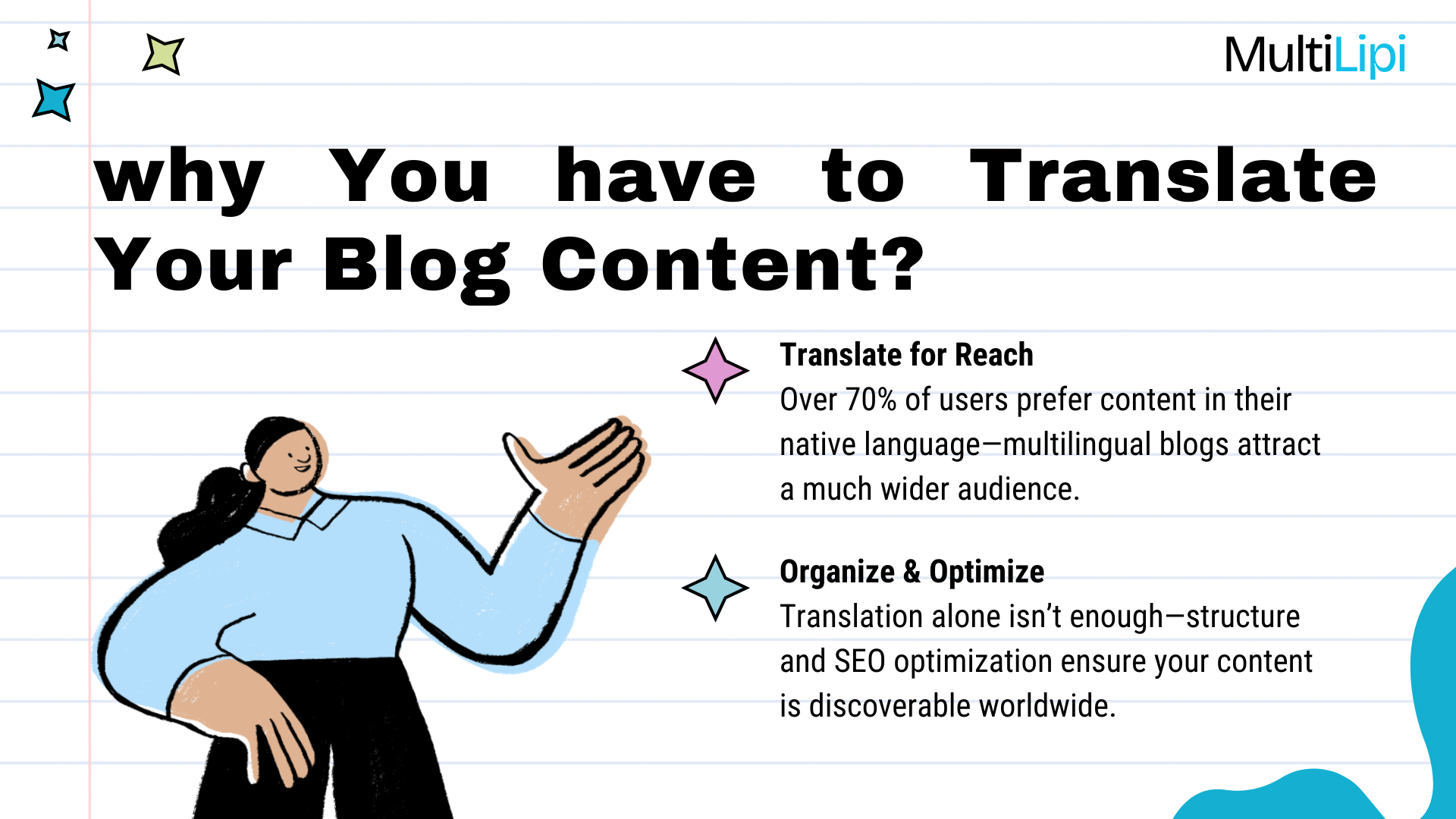
To boost your blog’s readership and reach a global audience, you should consider making it available in multiple languages. Research shows that over 70% of internet users prefer to browse websites in their native language (CSA-Forschung ). This means offering content in different languages can dramatically expand your blog’s appeal. However, creating a successful multilingual blog involves more than just translating posts. You’ll also need to decide how to organize the translated content on your site and optimize it so that international readers can actually find it.
In diesem umfassenden Leitfaden behandeln wir effektive Möglichkeiten, Ihre Blog-Inhalte zu übersetzen und wie Sie Ihre mehrsprachigen Seiten strukturieren (einschließlich der Auswirkungen auf die SEO). Anschließend geben wir Ihnen Tipps zur Optimierung Ihrer übersetzten Inhalte für Suchmaschinen und zur Bereitstellung einer nahtlosen Benutzererfahrung für Leser auf der ganzen Welt.
Wie können Sie Ihre Blog-Inhalte übersetzen?
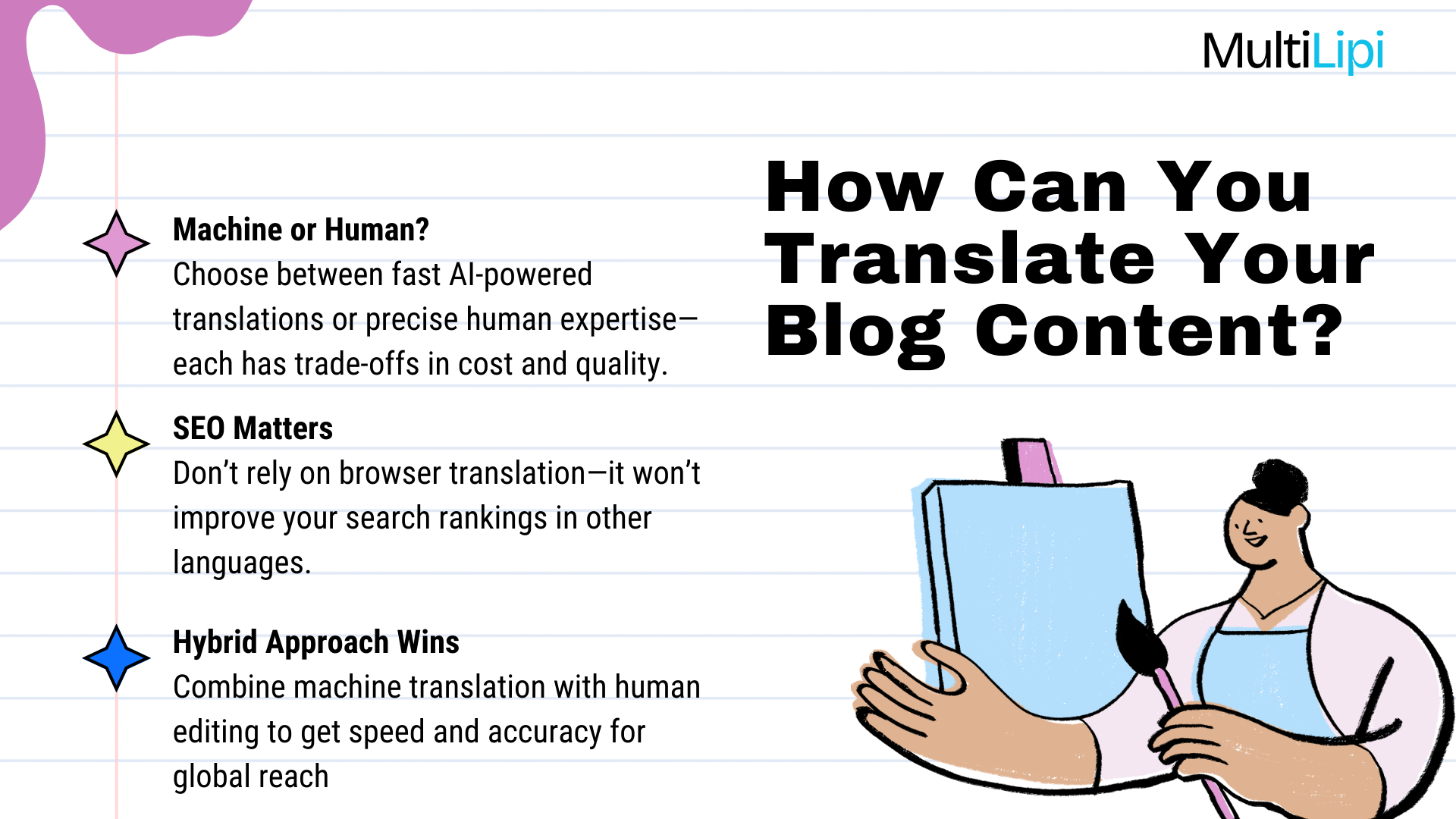
When converting your blog into multiple languages, you have a few translation approaches to choose from. The main options are relying on in-browser translation, using human translators, or using machine translation. Each method has its pros and cons:
1. Verlassen Sie sich auf In-Browser-Übersetzung
The most straightforward (but limited) method is to let visitors use their web browser’s built-in translation feature. Modern browsers like Chrome offer to translate webpages via services such as Google Translate. For example, a reader can right-click on your post and select "Übersetzen in [Sprache]" und Google Übersetzer rendert Ihre Inhalte in dieser Sprache.
Dies erfordert zwar keinen Aufwand Ihrerseits, um separate Sprachversionen zu erstellen, aber es gibt mehrere Erhebliche Nachteile bis abhängig von der Übersetzung im Browser:
- Schlechte Benutzererfahrung: It puts the burden on visitors to translate content themselves. This extra step isn’t very user-friendly – many users may simply leave rather than manually translate a page. And if they do translate it, the page might reload with an awkward layout or untranslated bits, causing confusion (Nielsen Norman Group).
- Unkontrollierte und oft ungenaue Übersetzungen: You have zero control over the quality or accuracy of the automatic translation. Machine translation tools can make mistakes or produce unnatural phrasing, especially for idioms or complex sentences. In fact, one study found Google Translate preserved the meaning accurately only about 82% of the time across 26 languages, with accuracy dropping as low as 55% for some languages (MIT Technology Review).
- No SEO benefits for your site: Perhaps the biggest drawback is that in-browser translation provides no multilingual SEO advantage. Since you aren’t actually publishing separate pages in other languages, search engines see and index only the original version. Your blog won’t capture any search traffic in other languages because those translated versions don’t exist as crawlable content on your site (Google Developers).
Aufgrund dieser Probleme ist die Übersetzung im Browser in der Regel Keine tragfähige langfristige Strategie for a multilingual blog. It can be a quick fix, but it sacrifices user experience and search visibility. Instead, you’ll likely want to create and publish proper translated versions of your posts, using either human or machine translation (or a mix of both).
2. Menschliche Übersetzung
If maintaining nuance and accuracy is your top priority, human translation is the gold standard. This means having a fluent speaker manually translate each blog post, adapting wording as needed for the target audience. The translator could be you (if you’re bilingual), a team member, or a professional translation service.
Von Menschen übersetzte Inhalte lesen sich in der Regel natürlicher und genauer als rohe maschinelle Inhalte, insbesondere wenn es um den kulturellen Kontext oder die kreative Sprache geht. Aber Sich ausschließlich auf menschliche Übersetzungen zu verlassen, ist oft nicht skalierbar for a frequently updated blog or one with lots of content, due to several reasons:
- Zeitaufwändiger Prozess: Translating an article manually takes significant time and effort. Even a fast translator needs time to carefully translate and proofread each post. If you publish new posts regularly, waiting for translations (whether done in-house or by an external agency) will introduce delays of days or weeks before your international readers can see the content.
- Hohe Kosten: Professionelle Übersetzungen sind nicht billig. Die Preise liegen in der Regel zwischen etwa 0,08 USD und 0,25 USD pro Wort ( gts-translation.com), depending on language and complexity, and can be higher for specialized content. If your posts are long or you have dozens of them, the costs add up quickly. Plus, agencies might charge extra for editing and proofreading on top of translation.
- Verwaltungsprobleme: Handling many translation projects can become a logistical headache. You would need a workflow to send each new post to a translator, coordinate revisions, and then publish the translated version on your site. The more languages and translators involved, the more complex it gets to manage consistency and deadlines. This can detract from time you could spend creating content or engaging with your audience.
- Integrationsaufwand: Even after you receive a human-translated text, you’ll need to integrate it into your website (creating new pages or posts for each language, adding navigation links, etc.). This technical implementation requires additional development work or plugins to display the translations properly on your blog. (Inhaltlich ).
In summary, human translation yields high-quality output but doesn’t address wie to efficiently deliver and maintain that translated content on your site. It can work if you only plan occasional translations (say a few cornerstone posts) or have a budget for a dedicated localization team. For most growing blogs, though, an automated or semi-automated solution will be more practical.
3. Maschinelle Übersetzung
Machine translation involves using software – powered by artificial intelligence – to translate text automatically. Modern machine translation (MT) engines like DeepL, Google Translate, Microsoft Translator, or Yandex Translate have become quite advanced. They use neural networks and huge datasets to predict accurate translations, and can handle large volumes of text in seconds.
Die großen Vorteile der maschinellen Übersetzung für einen Blogger sind Schnelligkeit und Wirtschaftlichkeit . An entire 2,000-word blog post can be translated into dozens of languages almost instantly with MT, at minimal or no incremental cost per word. This makes it feasible to translate content at scale, even if you publish frequently or have a vast archive of posts.
However, while machine translation is continuously improving, it’s nicht perfekt . The raw output may contain errors or unnatural phrasing, especially for less common language pairs or content with creative wording. That’s why many sites adopt a hybrid approach: use machine translation to get a quick first draft, then have humans review and edit the translation for accuracy and cultural fit (a process known as post-editing).
If machine translation sounds like the way to go for your blog, consider investing in a dedicated website translation solution that gives you the Das Beste aus beiden Welten – fast automated translation with the ability to easily refine the results.
Hier ist der Ort, an dem MultiLipi Kann helfen:
MultiLipi is an AI-powered website translation platform that streamlines the process. It automatically scans your site, translates content using top-tier engines, and lets you review translations in a visual editor.
MultiLipi is an AI-powered website translation platform (and multilingual SEO tool) that streamlines the entire process of creating a multilingual blog. Once MultiLipi is set up on your site, it will automatically scan all your content and instantly translate your blog posts into your chosen languages using state-of-the-art neural machine translation. Notably, MultiLipi can leverage different top-tier MT engines and even choose the one that provides the highest accuracy for each language pair (multilipi.com ), ensuring you start with the best possible machine-generated translation.(MultiLipi Preisgestaltung )
Nach der Generierung der Übersetzungen kümmert sich MultiLipi um die displaying them on your site under separate language-specific URLs (more on the structure options in the next section). For example, it can publish your French posts under a subdomain or subdirectory like “fr.yoursite.com" oder " yoursite.com/fr/” automatically. All your translations are stored in one place – a centralized MultiLipi dashboard – where you have full editing control. Through a user-friendly visual editor, you (or your team members or hired linguists) can review the machine translations and polish any sentences to better fit your brand voice or local idioms. This means you’re not locked into whatever the machine produced; you can refine wording, adjust key phrases, and ensure the content truly resonates with local readers. MultiLipi even allows collaborative editing, so multiple contributors can work on translations simultaneously in the dashboard.
Another big benefit is that MultiLipi Synchronisiert sich kontinuierlich with your site. Whenever you publish a new post or update existing content, the platform detects it and automatically translates the new content in the background. This real-time syncing saves you the manual work of tracking which posts need translation – your multilingual blog is always up to date without extra effort.
Being a dedicated website translation solution, MultiLipi also covers aspects beyond just text translation. It handles many technical details of multilingual SEO (like managing URL structures, metadata translation, and hreflang tags, which we’ll discuss later) out of the box MultiLipi.com . General-purpose tools like Google Translate won’t do any of that. In short, MultiLipi gives you a scalable, efficient way to translate your blog content while maintaining control over quality and ensuring the translated versions are properly integrated into your website.
Now that we’ve covered how to generate translations, let’s look at how to organize your multilingual content on your site for the best results.
Wie sollten Sie Ihre mehrsprachigen Blog-Inhalte organisieren?
Das Übersetzen Ihrer Blogbeiträge ist nur die halbe Miete. Sie müssen sich auch entscheiden where and how those translated posts will live on your website. Die Art und Weise, wie Sie Ihre mehrsprachigen Inhalte organisieren, kann sich auf die Benutzererfahrung und sogar auf Ihre Suchmaschinen-Rankings auswirken.
Das Einfachste Vorgehensweise would be to publish all language versions in the same section of your site (e.g., the same blog directory). For example, you might end up with a blog feed where one post is in English, the next is in Spanish, followed by one in French, all mixed together. This “everything in one bucket” approach is easy in terms of setup, but it’s nicht ideal . Readers who speak a particular language will find it frustrating to navigate a blog that alternates languages unpredictably – it’s a disjointed experience if they have to skip every other post because it’s not in a language they understand.
Moreover, lumping all languages together could confuse search engines about your site’s target audience. If an English and a Spanish post sit in the same folder, Google might not be confident whether your site is meant for English speakers, Spanish speakers, or both, and might not rank either version as prominently as it could if the site clearly targeted one language.
A better practice is to segregate your content by language using either Subdomains oder Unterverzeichnisse (subfolders). Both methods give a clearer structure to users and search engines, and each has its own benefits. Let’s break down the two:
Verwenden von Subdomains für verschiedene Sprachen
Ein Subdomäne is essentially a separate section of your site with its own unique URL, usually prefixed before the main domain name. For instance, if your main site is yoursite.comkönnten Sie folgende Möglichkeiten haben:
- en.yoursite.comfür den englischen Blog
- es.yoursite.comfür den spanischen Blog
- fr.yoursite.comfür den französischen Blog und so weiter.
In this setup, each language version of your blog exists on a distinct subdomain. Subdomains are part of your overall website, but search engines treat each subdomain almost like a separate website for indexing and ranking purposes. This has a key implication: content on one subdomain does not automatically benefit from the SEO authority of your main domain or your other subdomains. Mit anderen Worten, wenn Ihre yoursite.comviel Reputation und Backlinks aufgebaut hat, es.yoursite.com (Spanish version) doesn’t inherit all of that “SEO juice” – it has to earn its own authority over time.
Vorteile des Subdomain-Ansatzes: Each language site can be optimized independently for its audience without overlapping or confusing signals. You can target different regions more explicitly if needed. Also, subdomains offer technical flexibility; for example, you could host each subdomain on a server in the target country or use different CMS platforms for different languages (though this is a complex route that most bloggers don’t need to take).
Nachteile: The isolation of subdomains means more work to build up each language’s SEO performance from scratch. You’ll effectively be running separate SEO campaigns for each language – doing keyword research for each locale, creating content, and earning backlinks for multiple sites. Building authority and rankings for one subdomain won’t directly help the others. Google generally does not aggregate ranking signals across subdomains (MultiLipi-Unterstützung ), so your multilingual content won’t get a free boost from your main site’s reputation. For a single-person blog or small team, maintaining that can be challenging. Additionally, subdomains require a bit of technical setup (configuring DNS, possibly setting up SSL for each, etc.), though solutions like MultiLipi can automate much of this setup for you.
Verwenden von Unterverzeichnissen für verschiedene Sprachen
Ein Unterverzeichnis (oder Unterordner) speichert alle Sprachen unter derselben Domäne. Sie hätten URLs wie:
- yoursite.com/en/für englischsprachige Inhalte
- yoursite.com/es/für spanische Inhalte
- yoursite.com/fr/für französische Inhalte usw.
In dieser Struktur yoursite.com is the single website, and the different languages are organized in folders within that site. Search engines will view all these pages as part of one website. That means any authority or credibility your site gains (say through backlinks, popularity, etc.) is generally shared across all languages to some extent. Your Spanish pages can benefit from the strength of your English pages, because they’re all under the same domain. This often makes it easier to get new translated content indexed and ranking, since the domain likely already has some clout.
Vorteile des Unterverzeichnis-Ansatzes: Simpler SEO management – you’re growing one site, not many. A high-authority backlink to any page boosts the domain as a whole, which helps all language sections. From the user perspective, it’s also clear that all language versions belong to the same site/brand (just different sections), and navigation between languages can be seamless. Technically, subdirectories are easy to set up on most CMS platforms, and you don’t need separate hosting.
Nachteile: You have slightly less flexibility in treating each language completely separately. All languages share the same server and CMS in this setup (which is fine for most use cases). Also, if you wanted to target different country domains or significantly different site designs per language, subdirectories might be limiting (those cases might call for subdomains or even separate domains). But for the typical blog, these drawbacks are minor.
Im allgemeinen Sowohl Unterdomänen als auch Unterverzeichnisse sind gültige Auswahlmöglichkeiten for organizing a multilingual blog. Neither is inherently “wrong” – it depends on your goals:
- If you want to keep each language’s SEO profile distinct (say, a different content strategy for each region) and don’t mind the extra work, subdomains give you that separation. For example, a company might run a blog in English and a totally separate blog in Chinese on a subdomain, each with unique content not directly translated from one another.
- If you prefer a unified approach where all languages contribute to one overall site authority (and you’re largely translating the same content), subdirectories are often the better route. Many SEO experts lean towards subfolders for multilingual sites because your efforts building up domain authority benefit all language sections.
Für welche Struktur Sie sich auch entscheiden, Konsistenz ist das A und O . Stick to one approach for all languages to avoid confusion. Also, make sure to interlink the versions (for example, provide a language switcher or menu so users can navigate to their language). This not only aids usability but also allows search engines to discover the alternate versions of a page.
Und noch etwas: hreflang-Tags (HTML annotations that tell search engines about alternate language versions) should be implemented for corresponding pages in different languages. When you use a solution like MultiLipi, you won’t have to worry about this technical detail – MultiLipi will automatically generate hreflang tags for every translated page and even create localized sitemaps. This helps Google and other search engines serve the right language page to the right users, improving your multilingual SEO.
MultiLipi will also simplify the directory setup itself. As part of translating your blog, it can automatically create the subdomains or subfolders for each language based on your preference. For example, if you opt for subdirectories, MultiLipi will publish translations under yourdomain.com/[language_code]/ paths without you manually restructuring your site. If you prefer subdomains, it handles the subdomain creation and routing as well. This means you get the organizational and SEO benefits of a clean multilingual site structure without needing to manually configure lots of settings. Your English and Spanish posts will be neatly separated, and readers can easily stay within their language on your blog.
(At this point in your journey, you’ve translated your content and set up a sensible structure for it. Next, we’ll discuss how to ensure people can find and engage with your multilingual content – i.e., making it successful.)
Lokalisieren Sie Ihre mehrsprachigen Blog-Inhalte
Translating your posts is a great start, but writing a truly successful multilingual blog requires going a step further: Lokalisierung . Localization means adapting your content so that it feels natural and relevant to the target audience’s local culture, not just literally translating word-for-word.
Why is this important? Even a perfect translation can fall flat if it doesn’t account for cultural differences. Remember, the goal is for your international readers to feel like the content was written for them, not for a foreign audience. In fact, 73 % der Verbraucher bevorzugen Inhalte (wie Produktbewertungen oder Blog-Posts) in ihrer Muttersprache , und sie verlieren schnell das Vertrauen in Nachrichten, die sich "daneben" oder maschinenartig anfühlen. Durch die Lokalisierung erhöhen Sie das Engagement und das Vertrauen der Leser, was letztendlich dazu beiträgt, dass Ihr Blog in diesen Märkten wächst.
Hier sind einige wichtige Lokalisierungsaufgaben, die Sie für Ihre Blog-Inhalte berücksichtigen sollten:
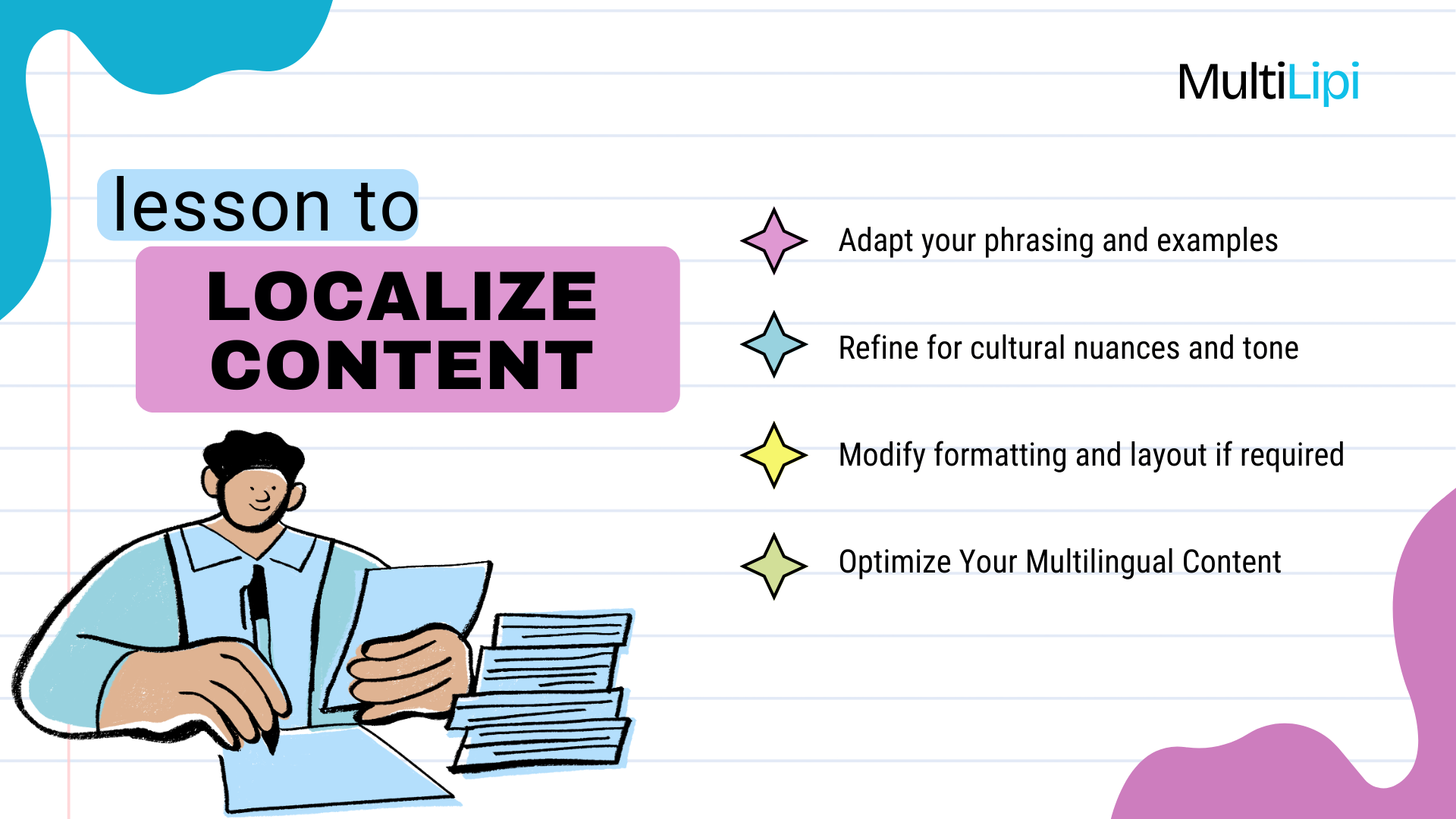
- Passen Sie Ihre Formulierungen und Beispiele an: Einige Ausdrücke oder Verweise in deinem ursprünglichen Beitrag ergeben für jemanden aus einem anderen Land möglicherweise keinen Sinn. Redewendungen, Humor oder Anspielungen auf die Popkultur tun dies oft nicht translate well. If your English post says “breaking the ice with a joke,” a direct translation of that phrase might confuse readers elsewhere. Adjust such instances to equivalent phrases or a more culturally appropriate example in the target language. As one localization expert put it, making content feel “local” involves acknowledging cultural nuances – slang or humor that works in one language may need to be completely rephrased in another (Bewegungspunkt ). Stellen Sie sicher, dass Ihre übersetzten Beiträge Begriffe und Beispiele verwenden, mit denen sich Ihre lokalen Leser sofort identifizieren können.
- Verfeinern Sie nach kulturellen Nuancen und Tönen: Beyond words, consider the tone and formality. Different cultures have different communication styles. For example, a very casual, first-name-basis writing style might be fine for a U.S. audience but could seem too informal or even disrespectful in Japan. Adjust the tone if needed when translating. You can also sprinkle in local slang or region-specific terms (where appropriate) to give the content a familiar feel. The more readers feel that the content “speaks their language,” the more time they’ll spend on your blog and the more value they’ll find in it. MultiLipi’s platform recognizes this need – it combines machine translation with human review to preserve tone and context, ensuring the translated content isn’t just technically correct but also culturally on-point.
- Ändern Sie bei Bedarf die Formatierung und das Layout: Different languages and locales have different formatting conventions. If you translate into a language that reads right-to-left (RTL) like Arabic or Hebrew, you’ll need an RTL layout for those pages. This could mean adjusting alignment of text and images. Likewise, adjust date formats, units of measure, or even color choices if certain colors have cultural connotations. Ensure things like currency symbols or address formats are localized in any examples you give. These details show respect for the reader’s culture and improve comprehension. Tools like MultiLipi will detect many of these elements (for instance, it can handle switching to an RTL display automatically for RTL languages). But it’s good to review your pages in each language to make sure everything looks natural.
By localizing your content — not just translating it — you make each reader feel like the content was written for sie . This greatly improves user engagement. Readers are more likely to share the content, trust your site, or follow your calls-to-action (whether that’s signing up for a newsletter, leaving a comment, etc.) when the language and references resonate with them personally.
Optimize Your Multilingual Content for Higher Search Engine Visibility
Übersetzung und Lokalisierung stellen sicher, dass Ihre Inhalte Dose vom internationalen Publikum verstanden und geschätzt werden. Die nächste Herausforderung besteht darin, diesen Zielgruppen zu helfen finden your content in the first place. This is where international or multilingual SEO comes into play. Just as you optimize your original blog posts for search engines in your language, you should also optimize translated content for search visibility in each target language.
Hier sind einige Strategien, um die Leistung Ihres mehrsprachigen Blogs auf den Ergebnisseiten (SERPs) von Suchmaschinen zu steigern:
- Führen Sie eine internationale Keyword-Recherche durch: Die Schlüsselwörter, die Menschen verwenden, können je nach Sprache und Region drastisch variieren. Gehen Sie nicht davon aus, dass ein übersetztes Äquivalent Ihres englischen Keywords tatsächlich das ist, wonach die Leute auf Französisch oder Japanisch suchen. Verwende SEO-Tools (Google Keyword Planner, Ahrefs, SEMrush usw.), um beliebte Suchbegriffe zu finden in der Zielsprache that relate to your topic. Sometimes, local searchers might use an entirely different phrase for the same concept. Identify high-volume, relevant keywords in each language and incorporate those into your translated content, titles, and headings. In other words, treat each language version of your post like its own SEO project – find out what terms will attract your Spanish readers, your German readers, etc., and optimize accordingly. This process is often called Mehrsprachige Keyword-Lokalisierung . It can make a huge difference: using language-specific keywords will improve your relevance and ranking in local search results, whereas direct translations of English keywords might not. Use tools like Google Keyword-Planer , Ubersuggest und Ahrefs , um Schlüsselwörter in jeder Sprache zu finden.
- Implementieren Sie hreflang-Tags (Sprach-Tags): Hreflang is an HTML attribute that signals to search engines what language a page is in and (optionally) what region it’s intended for. For example, you would use hreflang to tell Google “this is the English (en) version of the page, and here is the Spanish (es) version of the same page.” These tags prevent Google from getting confused by duplicate content across languages and help it serve the correct language page to each user. Proper hreflang implementation can improve your SEO by ensuring, for instance, that a French user sees your French page in results, not the English page. The tags can be a bit tricky to code manually (you need to reference every version on every other version), but if you’re using a platform like MultiLipi or a similar multilingual plugin, this is handled for you automatically. It’s essential if you’re targeting multiple languages or countries. (Igitt ).
- Achten Sie auf die regionalen Suchmaschinenrichtlinien: Während Google in vielen Ländern die dominierende Suchmaschine ist, gibt es bemerkenswerte Ausnahmen. Zum Beispiel Yandex ist die führende Suchmaschine in Russland und Baidu is the most used search engine in China. Each of these has its own algorithms and webmaster guidelines. If you are targeting users in a region where a different search engine prevails, take time to learn what factors that engine prioritizes. For instance, Yandex tends to value high-quality unique content and might be more sensitive to on-page factors, while Baidu has specific requirements like having the site hosted in China for better indexing, using Simplified Chinese, etc. Understanding these differences will help you optimize your content appropriately (cmsmart.net ). Even for Google, different locales might have subtle differences (for example, Google.fr might show preference for sites with a French ccTLD or hosting). In short: know your audience’s primary search engine and adapt your SEO strategy to it. This could involve things like registering with local webmaster tools (e.g., Yandex Webmaster, Baidu Webmaster) and following their SEO best practices. (Land der Suchmaschine ).
In addition to the above, standard SEO rules still apply: ensure your translated pages have unique meta titles and descriptions in the target language (and include localized keywords in them). Make sure the site is crawlable – a multilingual sitemap can help search bots discover all your language pages. MultiLipi automatically generates translated meta tags and a multilingual sitemap for your site (MetaDeta Bedeutung ), which is a big help. Also, building some backlinks to your translated content (perhaps from local directories or blogs in that language) can boost its authority in that market. The effort you put into multilingual SEO will pay off in the form of sustained organic traffic from different corners of the world.
Übersetzen Sie alle anderen Inhalte in Ihrem Blog (nicht nur Beiträge)
When focusing on blog articles, it’s easy to forget that a great user experience in another language means alles the user sees should ideally be in that language. If a visitor clicks through to your beautifully translated post but the site navigation, sidebar, or footer are still in English (or another default language), it creates a jarring experience. Important information could be lost on them, and it undermines the professionalism of your multilingual site.
Stellen Sie sicher, dass Sie alle Nicht-Post-Elemente Ihres Blogs übersetzen, wie zum Beispiel:
- Site navigation menus and headers: The menu labels, category names, and any sidebar widgets or calls-to-action should appear in the reader’s language. For example, if your menu has “About”, “Blog”, “Contact” in English, your Spanish site should show “Acerca de”, “Blog”, “Contacto”, etc. A user shouldn’t have to decipher English menu items to move around a Spanish page.
- Inhalt der Fußzeile und der Seitenleiste: This includes things like footer links, copyright notices, newsletter sign-up forms, or any common UI text in sidebars (e.g. “Recent posts”, “Search”, “Related articles”). These need translation too. It can be easy to overlook these bits, but they stand out if left untranslated.
- E-Commerce oder Landingpages: If your blog is part of a larger website that includes product pages, landing pages, or an e-commerce section, those pages should be available in the same languages as your blog content. Consistency is key – users won’t understand why your blog post is in their language but the product page it links to is not. That disconnect can lead them to drop off.
- Meta-Inhalte: Translate SEO meta titles and descriptions for each page, as well as alt text for images if those convey important info. Also translate any microcopy like form error messages, confirmation messages, etc., that are part of the user experience.
Denken Sie daran, dass users judge your site as a whole. If parts of it are not in their language, it can cause confusion or mistrust. A seamless experience means a reader can navigate from your homepage, through blog posts, to contact forms or product purchases, all in one language without hitting an unexpected language barrier. According to user experience experts, if visitors can’t navigate or understand parts of your site due to a language barrier, they are likely to become frustrated and leave (bounce)motionpoint.com. Vermeiden Sie dies, indem Sie alle Grundlagen in der Übersetzung abdecken.
MultiLipi is particularly handy here because it automatically finds and translates Alle Texte content on your site, not just the blog articles. This includes menu text, button labels, widgets, etc., across your site’s pages. It even translates content added via plugins or page builders in WordPress. This saves you from hunting down every snippet manually. Of course, you’ll want to review those translations too, but the heavy lifting is done for you.
Ein weiterer Bereich, den Sie berücksichtigen sollten, ist Ihr Externe und Marketing-Inhalte . If you’re serious about engaging international readers, extend your localization efforts to places like social media posts, email newsletters, and ads that promote your blog content. For example, if you publish a post in French and plan to share it on Twitter or LinkedIn, write the social media caption in French as well (not just in English). The same goes for any pay-per-click ads targeting other countries – craft those in the local language. Consistency in language across all touchpoints reinforces that you genuinely cater to that audience, rather than offering a half-translated experience.
(Profi-Tipp: Wenn Sie MultiLipi verwenden, können Sie nach der Übersetzung Ihres Blogs ganz einfach Ausschnitte des übersetzten Textes (z. B. ein überzeugendes Zitat oder eine Überschrift) kopieren, um sie in Ihren sozialen Werbeaktionen oder E-Mails für diese Region zu verwenden, um sicherzustellen, dass die Botschaften aufeinander abgestimmt bleiben.)
Durch Übersetzen Alles, was wichtig ist to the user’s journey, you greatly increase the chances that international visitors will stay on your site longer, engage with your calls-to-action, and come back for more. It shows respect for your readers and builds credibility.
Anmerkung: The above tips just scratch the surface. If your blog runs on WordPress, you may also want to look into additional best practices for managing a multilingual WordPress site (like using the right plugins, handling permalinks, backups, etc.). But with the core elements – content translation, site structure, localization, and SEO – in place, you’ll be well on your way to multilingual success.
Verbessern Sie Ihren Workflow zur Erstellung mehrsprachiger Blogs
Maintaining a multilingual blog may sound like a lot of work, but with the right approach and tools, it can be done efficiently. To recap and conclude:
Wenn Sie eine primäre Blogsprache haben und auf mehrere andere Sprachen erweitern möchten, machine translation augmented by human editing is generally the best approach to balance quality, speed, and cost. It allows you to scale up easily without breaking the bank, while still delivering accurate, reader-friendly content. Manual translation of every post would be ideal in a perfect world, but it’s usually impractical for a growing blog due to time and cost. Automated translation gets you 90% of the way there in seconds, and a bit of post-editing can polish the result to near-human quality.
MultiLipi embodies this optimized workflow. It handles the heavy lifting of translating your blog into over 100 languages instantly, then gives you the tools to fine-tune as needed. It also takes care of organizing those translations on the front-end (subdomains/subfolders, navigation, etc.) and on the back-end (adding hreflang tags, creating localized URLs, generating sitemaps). Crucially, MultiLipi is built with Mehrsprachige SEO Dinge, die normalerweise technisches Know-how erfordern würden, passieren automatisch, von SEO-freundlichen URL-Strukturen bis hin zu übersetzten Meta-Tags und Analysen für jede Sprache.
With so many tedious aspects automated, you can focus on what truly makes your blog successful: creating great content and localizing it thoughtfully. Instead of spending hours managing translators or tweaking site settings, you can invest that time in crafting high-quality posts and then adjusting the translations for cultural nuance (the fun part!). The result is a smoothly running multilingual content engine: you publish content, and your site quickly serves it to audiences in their own language, optimized for both understanding and discoverability.
Running a multilingual blog is a fantastic way to grow your audience and make your content accessible worldwide. By applying the strategies we’ve discussed – from choosing the right translation methods to structuring your site properly and fine-tuning for SEO/UX – you set yourself up for success. And if you leverage a platform like MultiLipi, you gain a partner that simplifies and supercharges your multilingual workflow.

Sind Sie bereit, die globale Reichweite Ihres Blogs zu erweitern? You can start translating your blog content with MultiLipi in minutes. Sign up for a free trial and see how effortless it is to turn your single-language blog into a multilingual one. With the right preparation and tools, you’ll be able to publish in multiple languages as easily as you do in one – and welcome a world of new readers to your content at multilipi.com Heute.
Kommentare