
In large-scale web deployments, URL structures often change. You might decide to rename your entire /blog/ directory to /news/ across 500 translated pages. Doing this manually is operational suicide. MultiLipi's Bulk Slug Edit engine allows you to perform "Find & Replace" operations across your entire localized sitemap in seconds, ensuring your SEO strategy remains agile.
This guide details the protocol for executing these batch routing updates.
1. Navigationsprotokoll
Accessing the routing table.
To initiate a bulk operation, you must first access the registry of all translated paths.
Schritt 1: Projektkontext aufrufen
Melden Sie sich in Ihrem MultiLipi-Dashboard an.
Select the specific Project you wish to manage.
Step 2: Access Translation Registry
In the project navigation, click on Übersetzungen.
Wählen Sie im Untermenü URLs.
Kontext: This view lists every active sub-URL in your project, along with its current translated slug status.
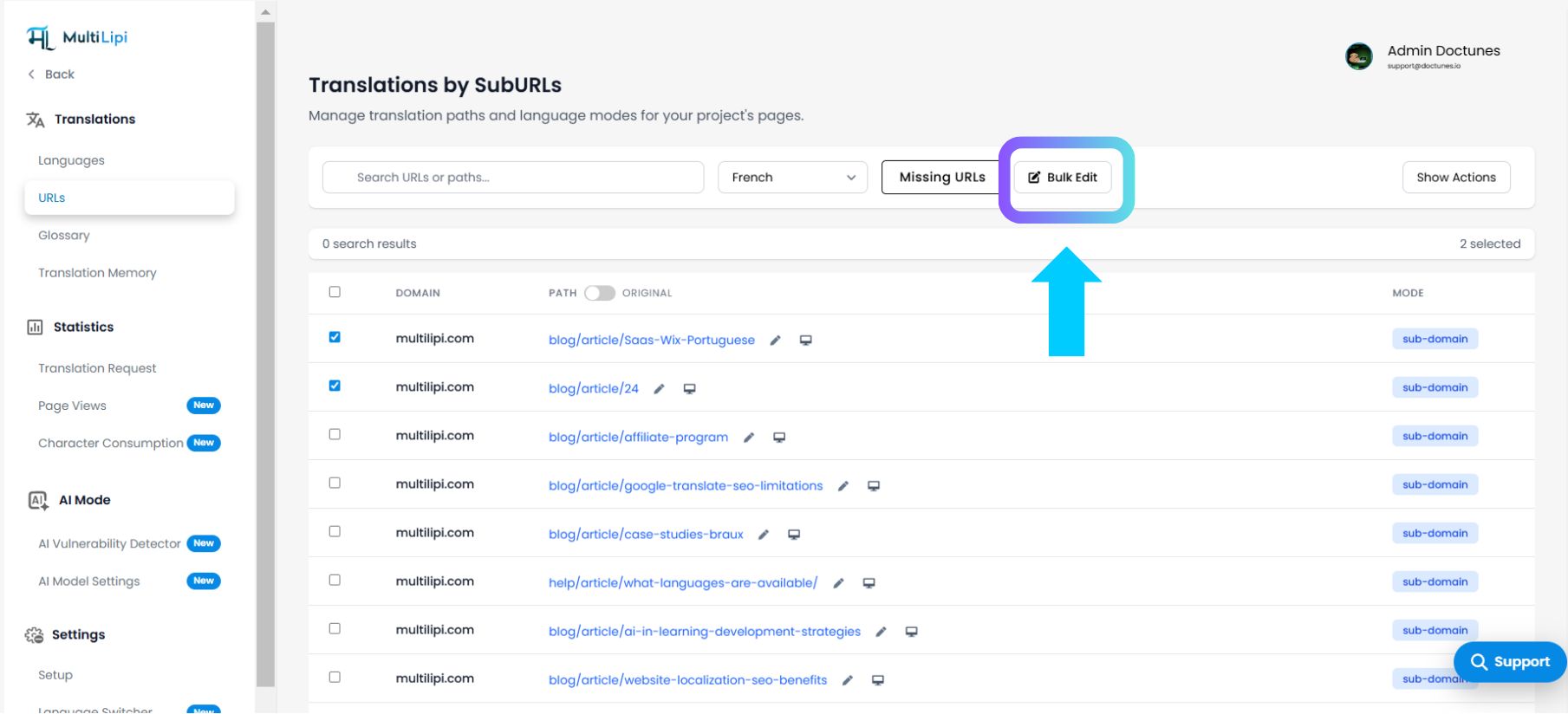
2. The Batch Protocol
Executing the Find & Replace logic.
Step 1: Selection Strategy
Manual Selection: Check the boxes beside specific URLs to target a subset (e.g., just the product pages).
Global Selection: You can choose to apply changes to the entire list in the next step.
Step 2: Initialize Operation
Klicken Sie auf die Bulk Edit button located in the top-right corner of the table.
Systemaktion: This triggers the "Find & Replace" modal window.
Step 3: Define Pattern
Find: Enter the text string you want to remove (e.g., article).
Replace: Enter the new text string (e.g., articles).
Step 4: Define Scope
Choose the application scope:
Only selected items: Applies changes only to the rows you checked in Step 1.
All items: Applies the pattern match to every URL in the list (e.g., all 677 pages).
Schritt 5: Speichern
Klicken Sie auf die Ersetzen Schaltfläche.
Ergebnis: The engine processes the batch instantly. Your internal routing map is updated, and the new slugs go live immediately.
3. Strategic Use Cases
When to use batch operations.
Taxonomy Shifts: If your marketing team changes the category "Sweaters" to "Knitwear," you can update the slug for all 50 product pages in Spanish (/sueteres/ → /tejidos/) in one click.
Standardization: Fixing inconsistent naming conventions (e.g., ensuring all blog posts start with /blog- instead of just /).
Error Correction: Rapidly fixing a typo that propagated across multiple URLs during an AI translation batch.
4. Post-Deployment Protocol
Updating the search index.
Changing a URL (Slug) is a significant SEO event. After performing a bulk edit:
Regenerate Sitemap: Ensure your XML sitemap reflects the new paths.
Submit to Google: Log in to Google Search Console and resubmit your sitemap to force a re-crawl.
Redirects: If these pages were already indexed, ensure your underlying CMS handles 301 redirects from the old pattern to the new pattern to preserve traffic.